answer.
Ask question
Login Signup
Ask question
All categories
  • English
  • Mathematics
  • Social Studies
  • Business
  • History
  • Health
  • Geography
  • Biology
  • Physics
  • Chemistry
  • Computers and Technology
  • Arts
  • World Languages
  • Spanish
  • French
  • German
  • Advanced Placement (AP)
  • SAT
  • Medicine
  • Law
  • Engineering
hoa
1 month ago
6

Claire is a manager at a toy packaging company. The company packs 80 boxes of toys every hour for the first 3 hours of the day.

They stop packaging for the next 2 hours in order to carry out a training session. Then, for the next 4 hours, they pack 20 boxes of toys every hour. Which graph models the piecewise function for the given situation?

Mathematics
2 answers:
Svet_ta [12.7K]1 month ago
8 0

Response:

Refer to the figure attached.

Step-by-step explanation:

Each portion is treated as a function.

Let x represent the hours worked in a day

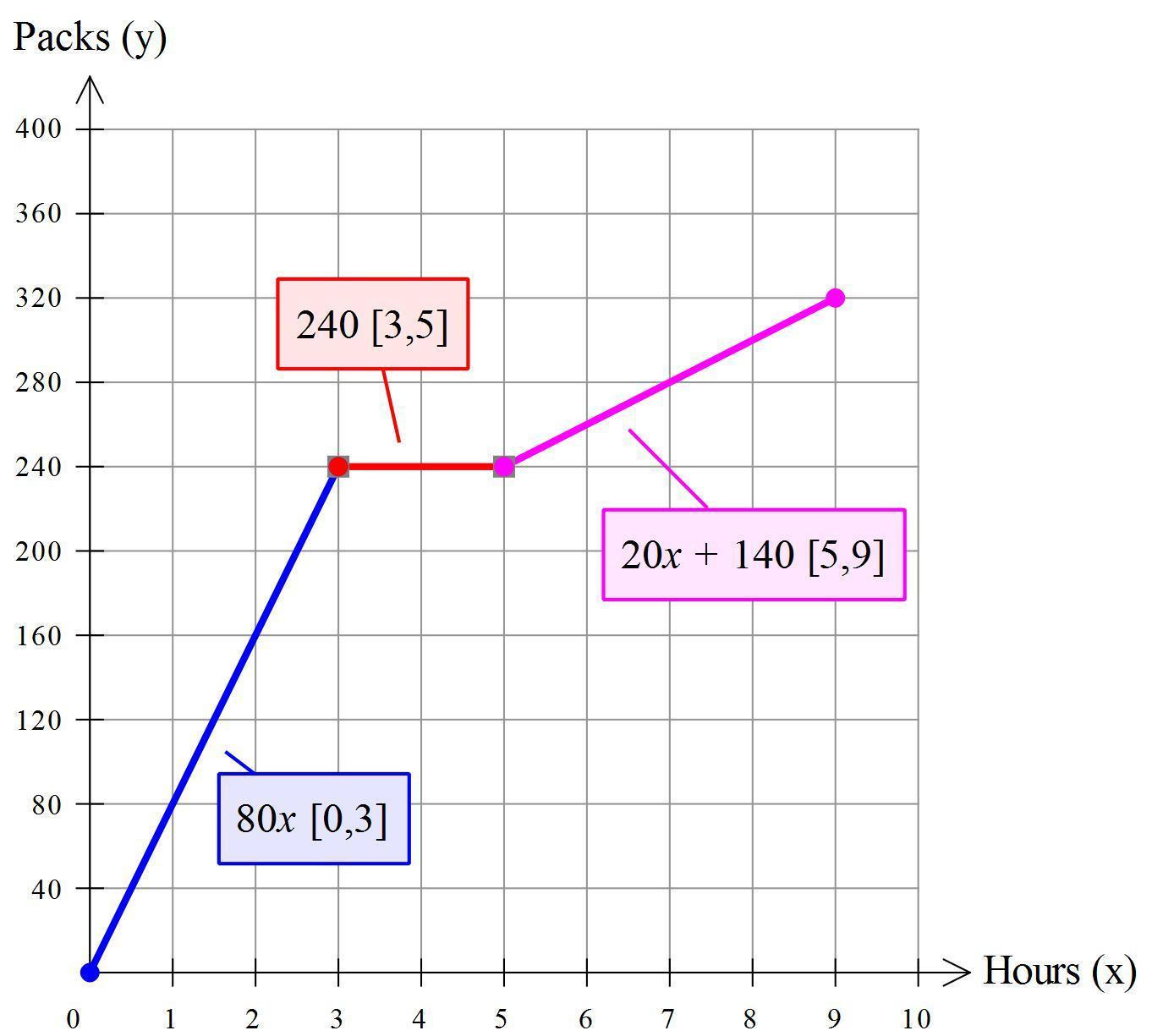
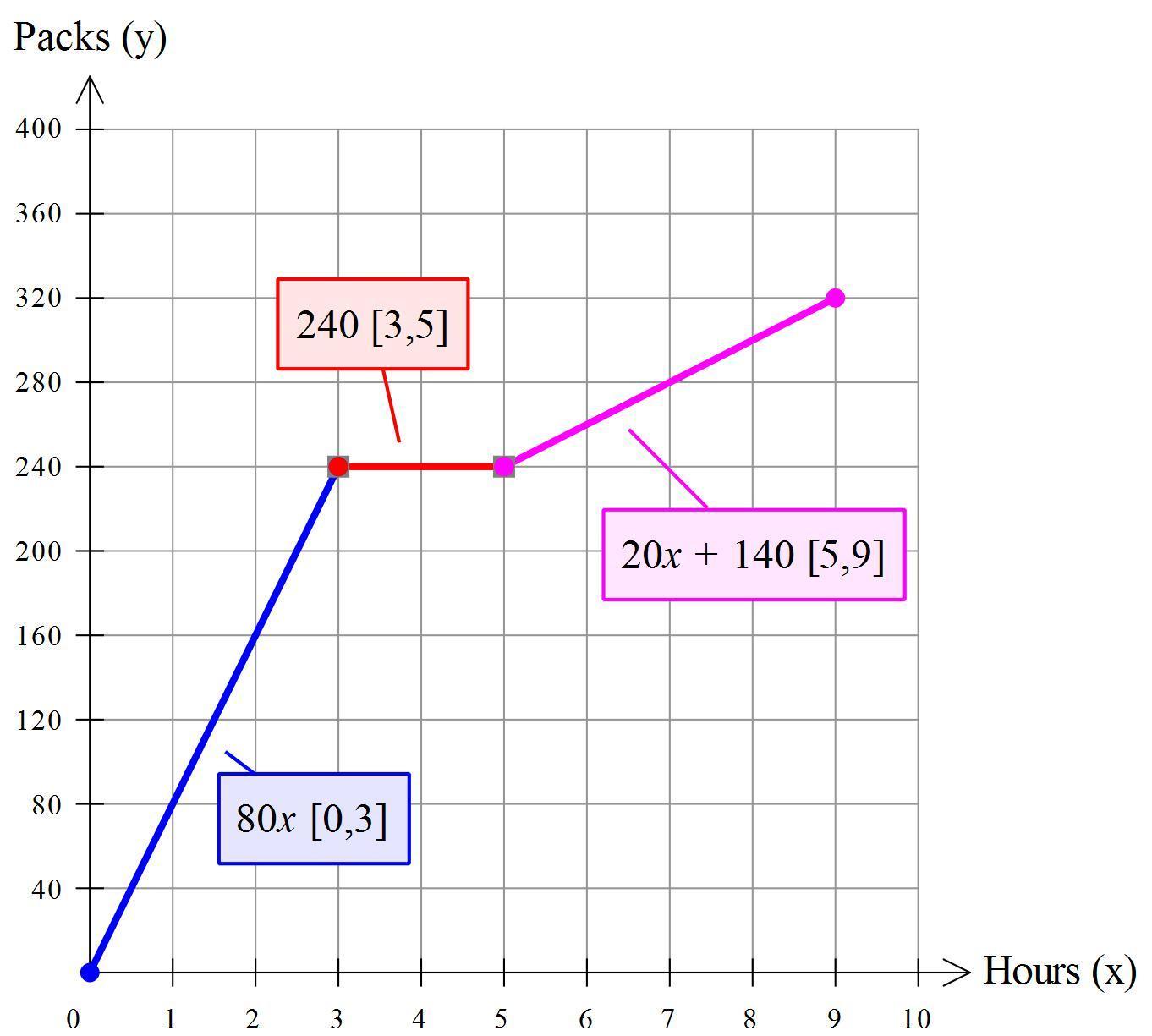
The company packs 80 boxes of toys each hour during the first three hours. Thus, y₁ = 80x, for x ∈ [0,3]

After three hours, the total boxes packed = 80 * 3 = 240

They pause packaging for two hours for a training session. Therefore, y₂ = 240, for x ∈ [3,5]

Next, for the subsequent four hours, they pack 20 boxes of toys hourly

y₃ = 20x + c, for x ∈ [5,9]

To determine c, equate y₂ and y₃ at x = 5

∴ 240 = 20 * 5 + c

∴ c = 240 - 20 * 5 = 240 - 100 = 140

∴ y₃ = 20x + 140, for x ∈ [5,9]

Consequently,

y₁ = 80x, for x ∈ [0,3]

y₂ = 240, for x ∈ [3,5]

y₃ = 20x + 140, for x ∈ [5,9]

The graph plotting the piecewise function that depicts the described situation is shown in the attached illustration.

babunello [11.8K]1 month ago
6 0

Response: D

Step-by-step explanation:

You might be interested in
Find the distance from (4, −7, 6) to each of the following.
Zina [12379]

Answer:

(a) 6 units

(b) 4 units

(c) 7 units

(d) 9.22 units

(e) 7.21 units

(f) 8.06 units

Step-by-step explanation:

The distance between two points, (x₁, y₁, z₁) and (x₂, y₂, z₂), can be calculated using;

d = √[(x₂ - x₁)² + (y₂ - y₁)² + (z₂ - z₁)²]

According to the problem;

(a) The distance from (4, -7, 6) to the xy-plane

The xy-plane corresponds to where z equals 0, so

xy-plane = (4, -7, 0).

Thus, the distance d is calculated from (4, -7, 6) to (4, -7, 0)

d = √[(4 - 4)² + (-7 - (-7))² + (0 - 6)²]

d = √[(0)² + (0)² + (-6)²]

d = √(-6)²

d = √36

d = 6

Thus, the distance to the xy-plane is 6 units

(b) The distance from (4, -7, 6) to the yz-plane

The yz-plane is located where x is 0, hence

yz-plane = (0, -7, 6).

So, the distance d is from (4, -7, 6) to (0, -7, 6)

d = √[(4 - 0)² + (-7 - (-7))² + (6 - 6)²]

d = √[(4)² + (0)² + (0)²]

d = √(4)²

d = √16

d = 4

Thus, the distance to the yz-plane is 4 units

(c) The distance from (4, -7, 6) to the xz-plane

The xz-plane exists where y is 0, meaning

xz-plane = (4, 0, 6).

The distance d from (4, -7, 6) to (4, 0, 6)

d = √[(4 - 4)² + (-7 - 0)² + (6 - 6)²]

d = √[(0)² + (-7)² + (0)²]

d = √[(-7)²]

d = √49

d = 7

Thus, the distance to the xz-plane is 7 units

(d) The distance from (4, -7, 6) to the x-axis

The x-axis is defined by y and z being 0, which implies

x-axis = (4, 0, 0).

Thus, the distance d is from (4, -7, 6) to (4, 0, 0)

d = √[(4 - 4)² + (-7 - 0)² + (6 - 0)²]

d = √[(0)² + (-7)² + (6)²]

d = √[(-7)² + (6)²]

d = √[(49 + 36)]

d = √(85)

d = 9.22

Hence, the distance to the x-axis is 9.22 units

(e) The distance from (4, -7, 6) to the y-axis

The y-axis is defined where x and z are both 0, thus

y-axis = (0, -7, 0).

Thus, the distance d is from (4, -7, 6) to (0, -7, 0)

d = √[(4 - 0)² + (-7 - (-7))² + (6 - 0)²]

d = √[(4)² + (0)² + (6)²]

d = √[(4)² + (6)²]

d = √[(16 + 36)]

d = √(52)

d = 7.22

Thus, the distance to the y-axis is 7.21 units

(f) The distance from (4, -7, 6) to the z-axis

The z-axis is defined by x and y being 0, which gives

z-axis = (0, 0, 6).

Thus, the distance d is calculated from (4, -7, 6) to (0, 0, 6)

d = √[(4 - 0)² + (-7 - 0)² + (6 - 6)²]

d = √[(4)² + (-7)² + (0)²]

d = √[(4)² + (-7)²]

d = √[(16 + 49)]

d = √(65)

d = 8.06

Thus, the distance to the z-axis is 8.06 units

5 0
1 month ago
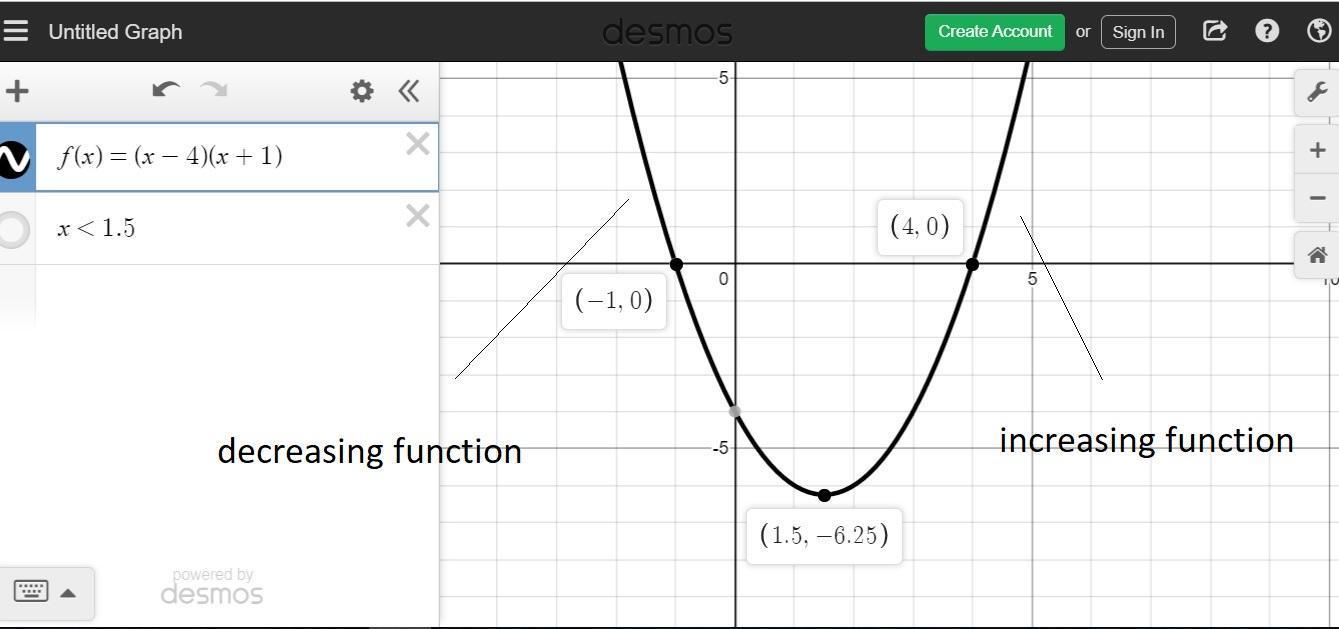
The graph of the function f(x) = (x – 4)(x + 1) is shown below. On a coordinate plane, a parabola opens up. It goes through (neg
tester [12383]

Answer:

The function decreases across all real numbers x where x < 1.5.

Step-by-step explanation:

We have

f(x)=(x-4)(x+1)

f(x)=x^2+x-4x-4

f(x)=x^2-3x-4

This represents an upward-opening vertical parabola

The vertex denotes a minimum point

The vertex is located at (1.5,-6.25)

We know that

The function is decreasing within the interval ----> (-∞, 1.5) x < 1.5

This means----> the function is continuously decreasing for all real x values under 1.5

Conversely, the function is increasing within the interval ----> (1.5, ∞) x> 1.5

Thus, for all real x values greater than 1.5, the function is increasing

Check the attached figure for further clarification

Therefore

The true statement is

The function decreases across all real numbers x where x < 1.5.

5 0
1 month ago
Read 2 more answers
La siguiente figura representa una torre de transmisión de energía eléctrica: ¿Mediante cual razón trigonométrica se puede deter
PIT_PIT [12445]
B. The correct ratio is sen α = BC/b. Step-by-step explanation: Trigonometric identities are utilized for resolving problems involving right angles. In any right-angled triangle, the side opposite to the angle is known as the opposite side, while the adjacent side runs parallel to the angle, ultimately leading to the longest side, called the hypotenuse.
6 0
24 days ago
What is the domain of the given function? {(3, –2), (6, 1), (–1, 4), (5, 9), (–4, 0)}
babunello [11817]
The domain consists of all x-values for which the function is defined, which are -4, -1, 3, 5, and 6.
3 0
2 months ago
Read 2 more answers
An urn contains 3 red and 7 black balls. Players and withdraw balls from the urn consecutively until a red ball is selected. Fin
Leona [12618]

Correct question:

An urn holds 3 red and 7 black balls. Players A and B take turns withdrawing balls until a red one is chosen. Calculate the probability that A picks the red ball. (A goes first, followed by B, with no replacement of drawn balls).

Answer:

The likelihood that A picks the red ball is 58.33 %

Step-by-step explanation:

A will select the red ball if it is drawn 1st, 3rd, 5th, or 7th.

1st draw: 9C2

3rd draw: 7C2

5th draw: 5C2

7th draw: 3C2

Calculating for all possible scenarios gives us:

9C2 = (9!) / (7!2!) = 36

7C2 = (7!) / (5!2!) = 21

5C2 = (5!) / (3!2!) = 10

3C2 = (3!) / (2!) = 3

Adding these possibilities results in 36 + 21 + 10 + 3 = 70.

The total outcomes for selecting a red ball = 10C3

10C3 = (10!) / (7!3!)

= 120.

The probability that A selects the red ball is determined by dividing the sum of possible events by the overall outcomes.

P( A selects the red ball) = 70 / 120

= 0.5833

= 58.33 %

7 0
1 month ago
Other questions:
  • The population of Birmingham is 1,274,589. What is the value of the 7?
    12·2 answers
  • The number of members f(x) in Joe's health club increased by 25% every year over a period of x years. The function below shows t
    5·2 answers
  • John runs 500 feet per minute. identify the correct conversion factor setup required to compute john's speed in inches per secon
    12·2 answers
  • According to this diagram, what is tan 62 degrees ?
    6·2 answers
  • The production department has installed a new spray machine to paint automobile doors. As is common with most spray guns, unsigh
    15·1 answer
  • Stephen borrows $10,000 from his uncle at a simple interest rate of 2%. He repays the loan in full after 3 years. How much money
    13·2 answers
  • 893 hundreds x 85 tens =
    12·2 answers
  • A machine called Feynman, produces output, that is 5 times its input followed by an increase of 2. Another machine called Maxwel
    7·2 answers
  • The Naturally Made Bath and Body store pays $550 a month for rent and utilities. The average cost for its products to be manufac
    9·2 answers
  • 10. The continuously compounded annual return on a stock is normally distributed with a mean of 20% and standard deviation of 30
    6·1 answer
Add answer
Login
Not registered? Fast signup
Signup
Login Signup
Ask question!