answer.
Ask question
Login Signup
Ask question
All categories
  • English
  • Mathematics
  • Social Studies
  • Business
  • History
  • Health
  • Geography
  • Biology
  • Physics
  • Chemistry
  • Computers and Technology
  • Arts
  • World Languages
  • Spanish
  • French
  • German
  • Advanced Placement (AP)
  • SAT
  • Medicine
  • Law
  • Engineering
melomori
1 month ago
8

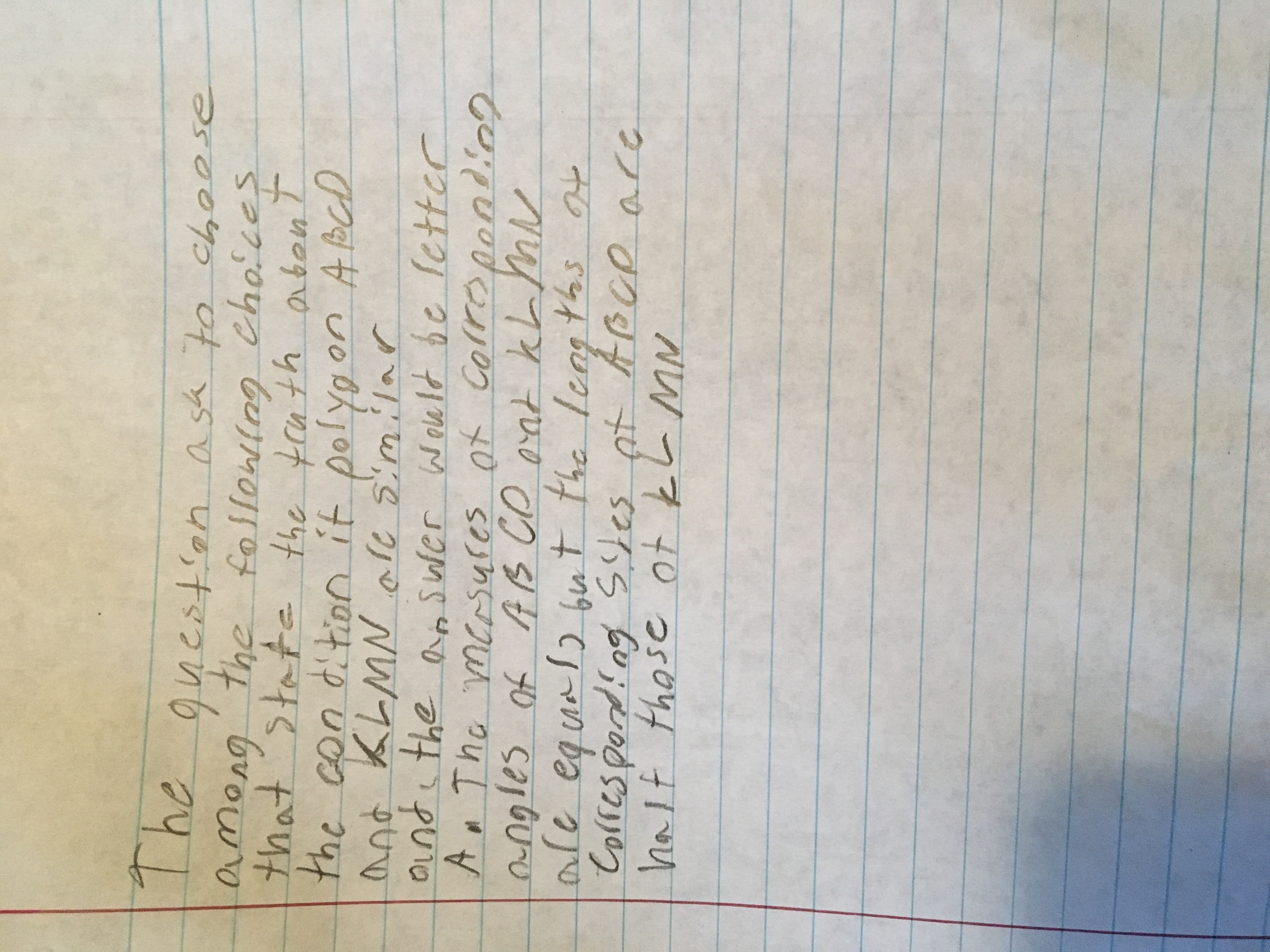
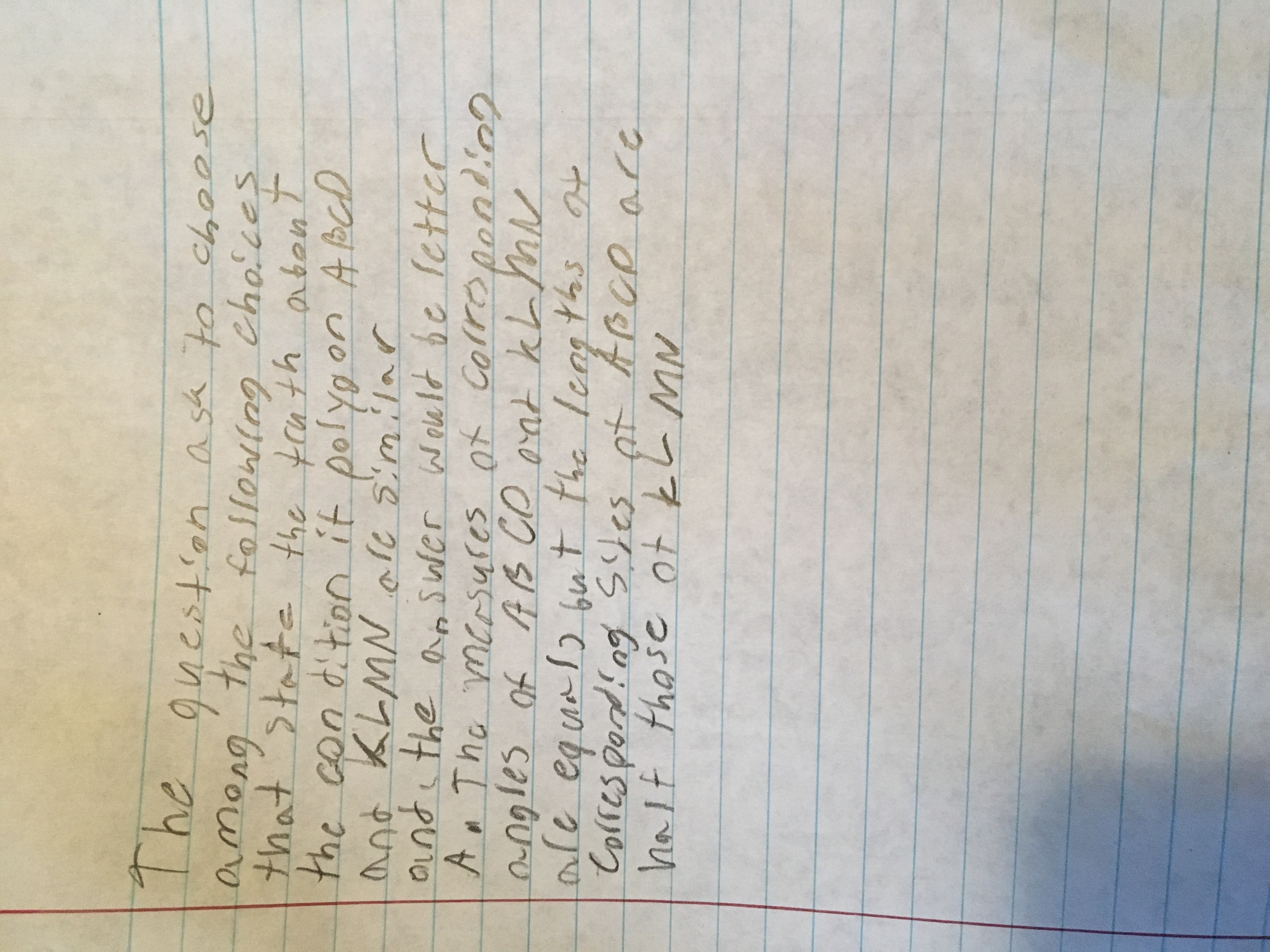
Which of these conditions might be true if polygons ABCD and KLMN are similar? The measures of corresponding angles of ABCD and

KLMN are equal, but the lengths of corresponding sides of ABCD are half those of KLMN. The measures of corresponding angles of ABCD and KLMN are in the ratio 1 : 2, but the lengths of corresponding sides of ABCD and KLMN are not proportional. The lengths of corresponding sides of ABCD and KLMN are equal, but the measures of corresponding angles of ABCD and KLMN are not equal. The lengths of corresponding sides of ABCD and KLMN are proportional, but the measures of corresponding angles of ABCD and KLMN are not equal. The measures of corresponding angles of ABCD and KLMN are not proportional, but the lengths of corresponding sides of ABCD and KLMN are proportional.

Mathematics
2 answers:
Leona [12.6K]1 month ago
4 0
The task is to select from the provided options that accurately represent the conditions under which polygons ABCD and KLMN would be considered similar; hence the selected answer is A. The angles of ABCD and KLMN that correspond are equal, while the side lengths of ABCD are half those of KLMN.

PIT_PIT [12.4K]1 month ago
3 0

Answer:  The correct choice is

(A) The angles of ABCD and KLMN corresponding to each other are equal, but the sides of ABCD are half the length of those in KLMN.

Step-by-step explanation: It is required to identify which statement reflects the potential truth if the polygons ABCD and KLMN are similar.

Two polygons are considered SIMILAR when their corresponding angles are congruent and the sides are in proportion.

Hence, options (B), (C), (D), and (E) are incorrect since they contradict the principles of similarity.

In option (A), we see

The angles of ABCD and KLMN that correspond are equal. Thus, they must be congruent.

Moreover, the lengths of corresponding sides of ABCD are half those of KLMN.

Thus, we can deduce

AB=\dfrac{1}{2}KL,~~BC=\dfrac{1}{2}LM,~~CD=\dfrac{1}{2}MN,~~AD=\dfrac{1}{2}KN\\\\\\\Rightarrow \dfrac{AB}{KL}=\dfrac{BC}{LM}=\dfrac{CD}{MN}=\dfrac{AD}{KN}=\dfrac{1}{2}.

Consequently, the corresponding sides are proportional.

Therefore, option (A) holds true if the two polygons are similar.

You might be interested in
Part A: During what interval(s) of the domain is the water balloon's height increasing?
tester [12383]

Answer:

Below is the answer

Step-by-step explanation:

The linear model illustrates the height, f(x), of a water balloon thrown from a building over time, x, in seconds: It shows ordered pairs at 0, 60 and 2, 75 and 4, 75 and 6, 40 and 8, 20 and 10, 0 and 12, 0 and 14, 0. The x-axis indicates Time in seconds, while the y-axis represents Height in feet. Part A: At what interval(s) is the water balloon's height increasing? (2 points) Part B: At what interval(s) does the water balloon's height remain constant? (2 points) Part C: At what interval(s) is the decrease in the water balloon's height most rapid? Use complete sentences to explain. (3 points) Part D: Utilizing real-world conditions, predict the water balloon's height at 16 seconds.

Answer:

Part A: The water balloon's height increases between 0 and 2 seconds, from 60 feet to 75 feet.

Part B: The balloon’s height remains at 75 feet from 2 to 4 seconds. At 10 seconds, it is at 0 feet.

Part C: The most rapid decrease in height occurs from 4 to 6 seconds, where it falls from 75 feet to 40 feet (about -17.5 ft/s).

From 6 to 8 seconds, it decreases from 40 feet to 20 feet (around -10 ft/s).

Between 8 and 10 seconds, it drops from 20 feet to 0 feet (also about -10 ft/s).

Therefore, the steepest decline is between 4 and 6 seconds.

Part D: Based on real-world constraints, at 16 seconds, the balloon will still be on the ground, so its height is 0 feet.
6 0
3 months ago
Select the correct answer. What is the surface area of the victory podium shown here? Include all surfaces of the podium, includ
lawyer [12517]

Answer:

The correct answer is Option C.

Step-by-step explanation:

We are provided with the dimensions of the podium, including its length, width, and height, and need to determine its surface area.

To find the surface area of a cuboid, the formula used is 2(LW + WH + HL)

Referring to the provided figure, the dimensions of the upper cuboid are

L=2.5 ft., W=1.5 ft, H=1.5 ft

\text{Surface area=}2(2.5(1.5)+1.5(1.5)+1.5(2.5))=19.5ft^2

\text{Area of bottom face of upper cuboid=}L\timesW=2.5\times1.5=3.75ft^2

Since the upper face appears twice, it must be deducted to accurately calculate the area

The dimensions for the lower podium are

L=7.5 ft., W=1.5 ft, H=1.5 ft

\text{Surface area=}2(7.5(1.5)+1.5(1.5)+1.5(7.5))=49.5ft^2

Therefore, the overall surface area of the podium, including the bottom, is

19.5 + 49.5 - 3.75 = 65.25 square feet.

Thus, option C is indeed correct.

4 0
2 months ago
Flip two coins 100 times, and record the results of each coin toss in a table like the one below:
PIT_PIT [12445]
1) The theoretical likelihood of obtaining two heads in a coin toss is 25%. 2) The experimental probability of landing two heads when flipping a coin is 44%. 3) The theoretical chance of achieving two tails in a coin toss stands at 25%. 4) The experimental likelihood of getting two tails when tossing a coin is measured at 34%. 5) The theoretical probability for obtaining one head and one tail during a toss is 50%. 6) The experimental probability of achieving one head and one tail stands at 22%. 7) The slight variations between experimental and theoretical probabilities can be attributed to the relatively small number of trials; as the count of trials increases, experimental probabilities tend to converge with theoretical ones. Probability is defined as the desired outcome divided by total outcomes.
6 0
1 month ago
Other questions:
  • If  BD BC, BD = 5x – 26, BC = 2x + 1, and AC = 43, find AB.
    5·1 answer
  • Solve 11 - 1/2y= 3 + 6x for y.​
    11·1 answer
  • Parker invested $7,800 in an account
    10·1 answer
  • Which of the following functions best describes this graph
    13·1 answer
  • A)
    8·1 answer
  • There are 28 people on a martial arts course. 13 are female and 15 are male. What fraction of the people are male? ​
    14·1 answer
  • At a summer camp, 72% of the campers participate in rope climbing and 26% participate in canoeing. 83% of the campers participat
    9·2 answers
  • One gallon is approximately 3.875 liters. Mario buys 1.5 gallons of gasoline for his lawn trimmer. How many liters of gasoline,
    13·1 answer
  • People were surveyed worldwide, being asked the question "How important is acquiring wealth to you?" of 1500 respondents in coun
    7·1 answer
  • Six years ago, Kelsey opened a savings account that earns 1.2% simple interest every year. She started the account with $600 and
    10·2 answers
Add answer
Login
Not registered? Fast signup
Signup
Login Signup
Ask question!
