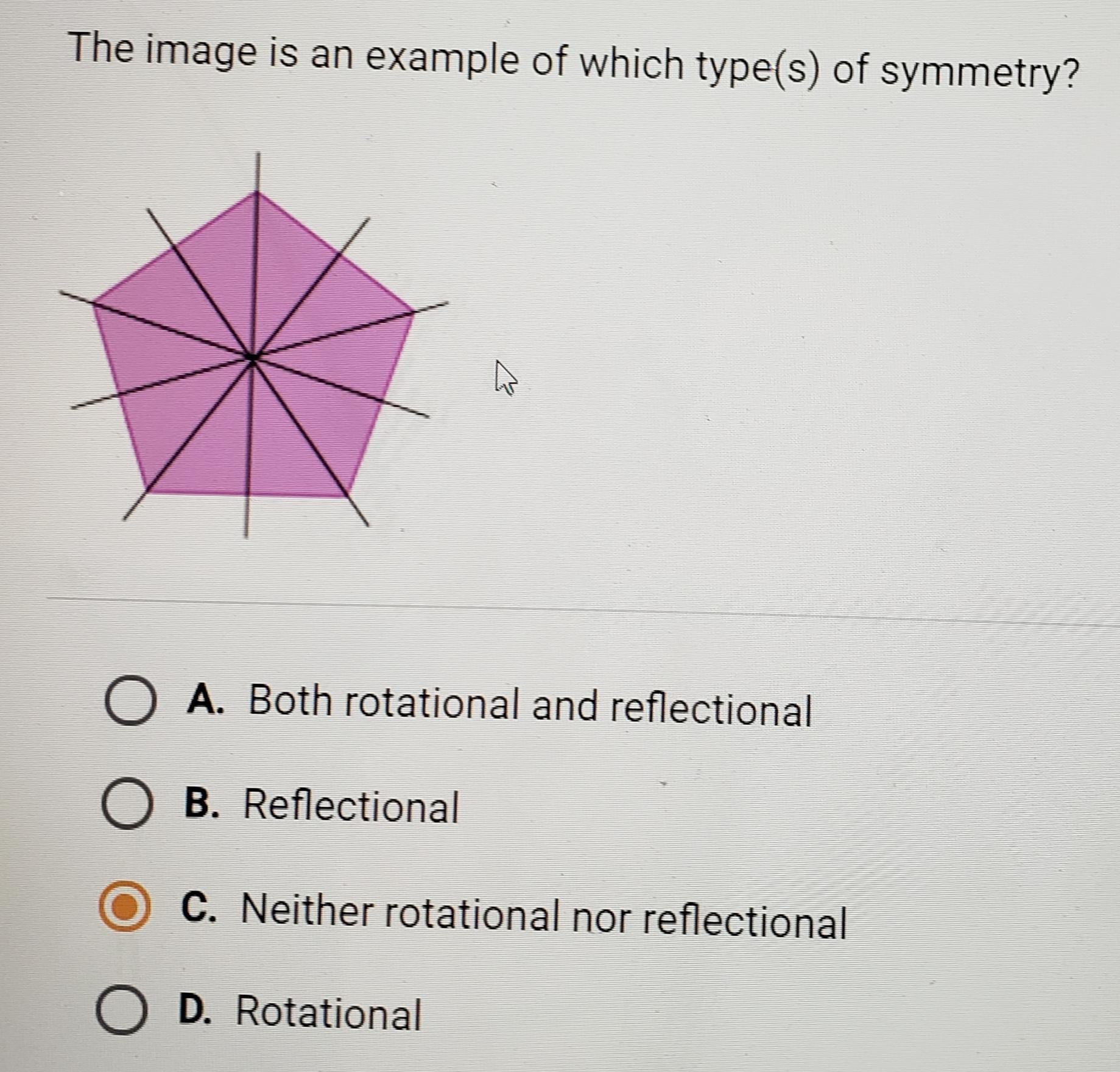
This image illustrates both reflectional and rotational symmetry.
The depiction shown is of a regular polygon, specifically a pentagon, characterized by its five equal sides and five congruent angles.
Further Explanation
Analyzing the image, we can see that each symmetry divides the pentagon into two identical halves, indicating the presence of reflectional symmetry.
To clarify, reflectional symmetry denotes a form of rigid motion in two dimensions and is also termed line symmetry, simplest symmetry, or mirror symmetry.
It is easily recognized because one side mirrors the other.
The polygon also exhibits rotational symmetry; to determine this for any polygon, divide 360 degrees by the number of sides. The central angle for any regular polygon is calculated by dividing 360 degrees by the number of sides, and for a pentagon with 5 sides, this calculation gives 360 divided by 5, resulting in 72 degrees.
Rotational symmetry exists when a shape can be rotated around a central point without altering its appearance. This means a shape possesses rotational symmetry if it can rotate about a fixed point and occupies the same space as before.
LEARN MORE:
- rotational and reflectional symmetry:
KEYWORDS:
- pentagon
- polygon
- rotational symmetry
- reflectional symmetry
- image