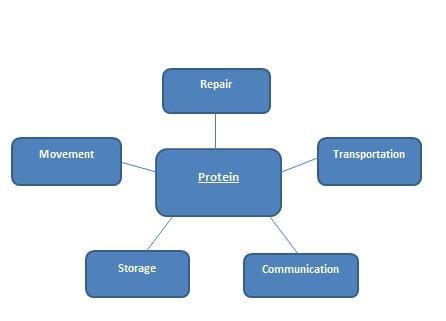
Keeping the body insulated is not a role performed by proteins; that function is typically carried out by fats. Hence, choice (C) is the correct answer.
Further Explanation:
Biomolecules fulfill a variety of essential roles within organisms. The principal biomolecule categories are proteins, fats (lipids), nucleic acids, and carbohydrates. These compounds primarily contain carbon (C), oxygen (O), hydrogen (H), and nitrogen (N). Proteins are large, complex biomolecules composed of amino acid monomers. Different proteins have distinct amino acid sequences, and these amino acids are joined by peptide bonds
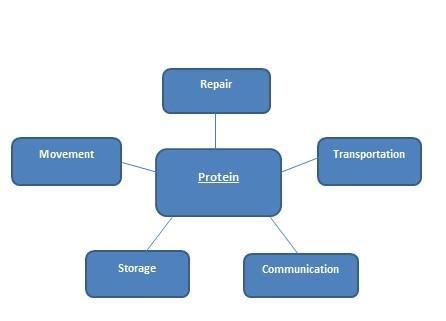
. The sequence of amino acids (the primary structure) determines a protein’s three-dimensional conformation and its function. Proteins perform most cellular tasks, including repair and structural support, energy provision, molecule transport and storage, catalysis as enzymes, signaling as hormones, and immune defense as antibodies. They supply structural support to cells and contribute to movement; actin is an example of a structural protein.
Certain proteins (for example ferritin) bind small molecules and ions (such as iron) and aid their storage in the body. Antibodies are protein molecules that help defend the body against foreign agents. Enzymes are proteins that participate in numerous biochemical reactions. Proteins also assist with food breakdown and thereby supply energy. Hormones are examples of signaling proteins that coordinate biological processes.
Fats (lipids) play a key role in insulating the body from shock and in maintaining healthy skin and body temperature. Lipids also serve in energy storage and in signaling.
Learn more:
1. Learn more about the treatment of eukaryotic cell with a drug
2. Learn more about the proteins synthesis in a cell
3. Learn more about exchange of gases by blood cells
Answer Details:
Grade: High School
Subject: Biology
Chapter: Biomolecules
Keywords:
Biomolecule, carbohydrate, proteins, lipids, fats, monomer, amino acid, energy storage, hormones, enzymes, insulation.