answer.
Ask question
Login Signup
Ask question
All categories
  • English
  • Mathematics
  • Social Studies
  • Business
  • History
  • Health
  • Geography
  • Biology
  • Physics
  • Chemistry
  • Computers and Technology
  • Arts
  • World Languages
  • Spanish
  • French
  • German
  • Advanced Placement (AP)
  • SAT
  • Medicine
  • Law
  • Engineering
-Dominant-
24 days ago
14

Suppose that an increase in production costs decreases the supply of wheat, such that less wheat is supplied at each price level

. The new equilibrium quantity (after the decrease in supply) is _____.

History
2 answers:
BigorU [1.6K]24 days ago
7 0

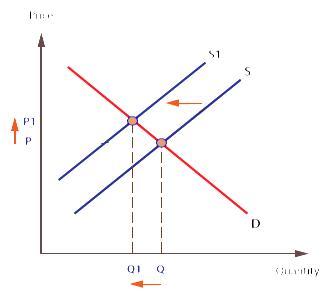
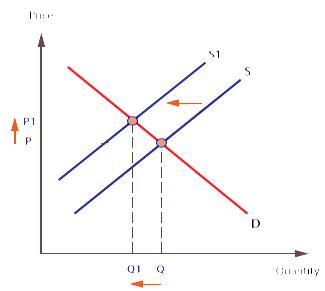
The accurate response is: "The new equilibrium quantity (after the decrease in supply) is SMALLER".

A supply function details the quantity of a particular good or service that producers are ready to supply at various price points. The law of supply asserts that there is a direct correlation between price and supply quantity (ceteris paribus, assuming all else remains constant).

In this situation, a different factor comes into play: the rise in production costs. This change causes the supply curve to shift leftward (as illustrated in the attached graph). The effects of this shift on the equilibrium point (where the demand and supply curves intersect) are an increase in the equilibrium price and a reduction in the equilibrium quantity.

Xelga [1.6K]24 days ago
6 0

The problem informs us that wheat farmers will provide varying amounts at different prices.

According to economic theory, the price of a product affects its supply and demand. For instance, when prices increase, more farmers will supply wheat, while consumers may buy less. A decline in demand results in a drop in wheat prices.

This principle can also apply when rising production costs cause a reduction in wheat prices. The demand will adjust according to the price level. As prices fluctuate, so will consumer demand, until an equilibrium is achieved.

For example, if a producer initially offers 100kg of wheat at $10, and production costs rise, they have two choices: raise the price or lower the supply. In this case, they choose to reduce supply. Let's say the supply drops to 30kg at $10, leading to a backlog of demand for wheat.

With every increase in price, the supplier will present more wheat. Hypothetically:

At a price of $12, the offer can rise to 60kg

If the price is $15, they can increase supply to 120kg

And at $50, the supply can grow to 1000kg

How will demand react in these situations? It will adjust to match the supply. Some buyers may purchase at $12, while fewer will buy at $15. However, at $50, it’s possible that no one will buy! This could potentially drive prices down, as outlined by the Law of Supply and Demand.

Thus, supply and demand are flexible. Different prices will lead to varying levels of demand.

You might be interested in
Match each economist to his economic belief.
marta [1577]

Responses:

Adam Smith

  • Competition serves as a regulatory mechanism.

Friedrich von Hayek

  • Limited government intervention provides individuals with greater economic autonomy.

Milton FriedmanThe government should refrain from regulating the money supply.

  • John Maynard Keynes

Intervention from the government is essential for economic stability.

Explanation:

In his pivotal work, The Wealth of Nations published in 1776, Adam Smith challenged governmental control over trade and argued in favor of competition among businesses acting as a self-regulating force.

Friedrich von Hayek's influential 1944 book The Road to Serfdom represented a crucial classical liberal argument in economics, which can be more accurately described today as libertarianism.

Milton Friedman expressed skepticism about the effectiveness of the Federal Reserve's management of the money supply, with his essays compiled in Capitalism and Freedom , published in 1962.

John Maynard Keynes proposed that enhancing government spending and reducing taxes would bolster demand, facilitating economic recovery from depression. His approach was adopted in President Franklin D. Roosevelt's New Deal program, which aimed to lift the United States from the Great Depression.

3 0
1 month ago
How did the kingdom of benin differ from the kingdom of ghana during the postclassical era
katrin2010 [1707]
Leaders in Songhai adopted Islam, whereas those in Benin continued to practice their indigenous faith. The Kingdom of Benin, which is associated with Vodan or Voodoo, stands in contrast to the Kingdom of Songhai during the postclassical period.
6 0
1 month ago
Read 2 more answers
Imagine living in Europe as the Renaissance was beginning. What are some of the problems you might have? Can you think of ways t
BigorU [1667]

The appropriate response to this open question is as follows.

I could face challenges at the onset of the Renaissance, such as the persistent assaults from the Catholic Church opposing my views on freedom of expression, questioning the existence of a supreme deity, and my unending pursuit for new truths beyond the teachings of the church.

What solutions could address these issues?

Indeed, by raising awareness and educating individuals that the dark ages have ended, the Medieval era has passed, and that humans are capable of using reason for learning, freedom, and progress. The more individuals become literate and gain access to education, the better. No longer should control be exerted through religious dogma.

During the Renaissance, the Catholic Church increasingly faced criticism as a corrupt body with excessive authority.

This period marked the introduction of the idea of

3 0
18 days ago
How did the strategies of the Union and Confederacy differ during the Civil War? In your response, be sure to include the tactic
LenKa [1871]

At the war’s inception, the Confederacy adopted a defensive approach, whereas the Union opted for an offensive strategy. The Confederacy's defensive posture failed to match the strength of the Union forces, leading to successful incursions into Confederate regions by the Union. Over time, the Confederate army diminished in strength, prompting President Jefferson Davis to shift to a strategy combining offense and defense, which allowed for the safeguarding of territories while enabling strategic attacks or counterattacks. The Confederacy aimed not to conquer Union land, but simply to defend its right to secede. Unfortunately, the Confederacy's strategies proved ineffective against the might of the United States.

The Civil War fundamentally transformed warfare. Numerous technological innovations emerged, including the telegraph, railways, trench fighting, hot air balloons, and ironclads. In my view, the telegraph was the most significant of these developments. This invention enabled near-instantaneous long-distance communication. A dysfunctional telegraph could dramatically alter the outcome of a battle. The Union had a more dependable telegraph system than the Confederates, which likely played a crucial role in their success. Although railroads were first introduced in 1825, they gained importance only during the Civil War, enabling both sides to efficiently transport troops, supplies, and food. The first balloon flight occurred in 1783, yet the Civil War marked the initial use of balloons for reconnaissance and shelling support. Trench warfare became a reality during this conflict, extending combat durations. Ironclads represented a remarkable leap in naval combat due to their resilience.

3 0
1 month ago
Consider the different justices' opinions about affirmative action. Whose opinion do you agree with most?
mr_godi [1697]

Response:

Affirmative action seeks to address the effects of social discrimination against minorities (such as African Americans, Hispanics, and LGBT individuals) by granting them advantages compared to the majority population. A notable example of this is the implementation of racial quotas at certain institutions like universities and federal offices.

In my view, while this approach functions as a quick fix for discrimination where it is implemented, I do not think it is a sustainable long-term solution. I believe that the roots of discrimination lie in inadequate education and lack of social awareness, which can only be resolved through improved understanding of equality—one of our nation's core principles.

To sum up, even though these measures may initially contribute to decreasing discrimination, there must be broader structural changes to effectively tackle this issue.

6 0
1 month ago
Other questions:
  • Corroboration: what were two similarities between bryan’s Speech and lease’s
    15·1 answer
  • Susan received a 450-acre property from her grandfather when he died. He died testate. What is the legal name of what Susan rece
    15·1 answer
  • For each label, determine whether it describes the independence movement in Ghana, in Kenya, or both. Someone help lol.
    15·2 answers
  • Carol buys a house for 234 900 she pays a 10% deposit what was the amount of the 10% deposit paid by carol
    11·1 answer
  • Paano ipinakita nina Pygmalion at Galatea ang pasasalamat kay Aphrodite?
    13·1 answer
  • Which conclusion would make the most sense after looking at the graph? The infliction of heavy casualties upon the communists di
    13·2 answers
  • What economic activity took place in the three forks area
    15·2 answers
  • What is Abraham Lincoln's favorite color?
    11·2 answers
  • Read the excerpt from James Madison’s notes on the Constitutional Convention from July 14, 1787. Mr. SHERMAN urged the equality
    14·2 answers
  • Read the Gallup poll results of registered voters when asked this question. Thinking about how the gun issue might affect your v
    8·2 answers
Add answer
Login
Not registered? Fast signup
Signup
Login Signup
Ask question!