answer.
Ask question
Login Signup
Ask question
All categories
  • English
  • Mathematics
  • Social Studies
  • Business
  • History
  • Health
  • Geography
  • Biology
  • Physics
  • Chemistry
  • Computers and Technology
  • Arts
  • World Languages
  • Spanish
  • French
  • German
  • Advanced Placement (AP)
  • SAT
  • Medicine
  • Law
  • Engineering
shepuryov
1 month ago
5

Elena wants to make a scale drawing of her bedroom. Her bedroom is a rectangle with length 5 m and width 3 m. She decides on a s

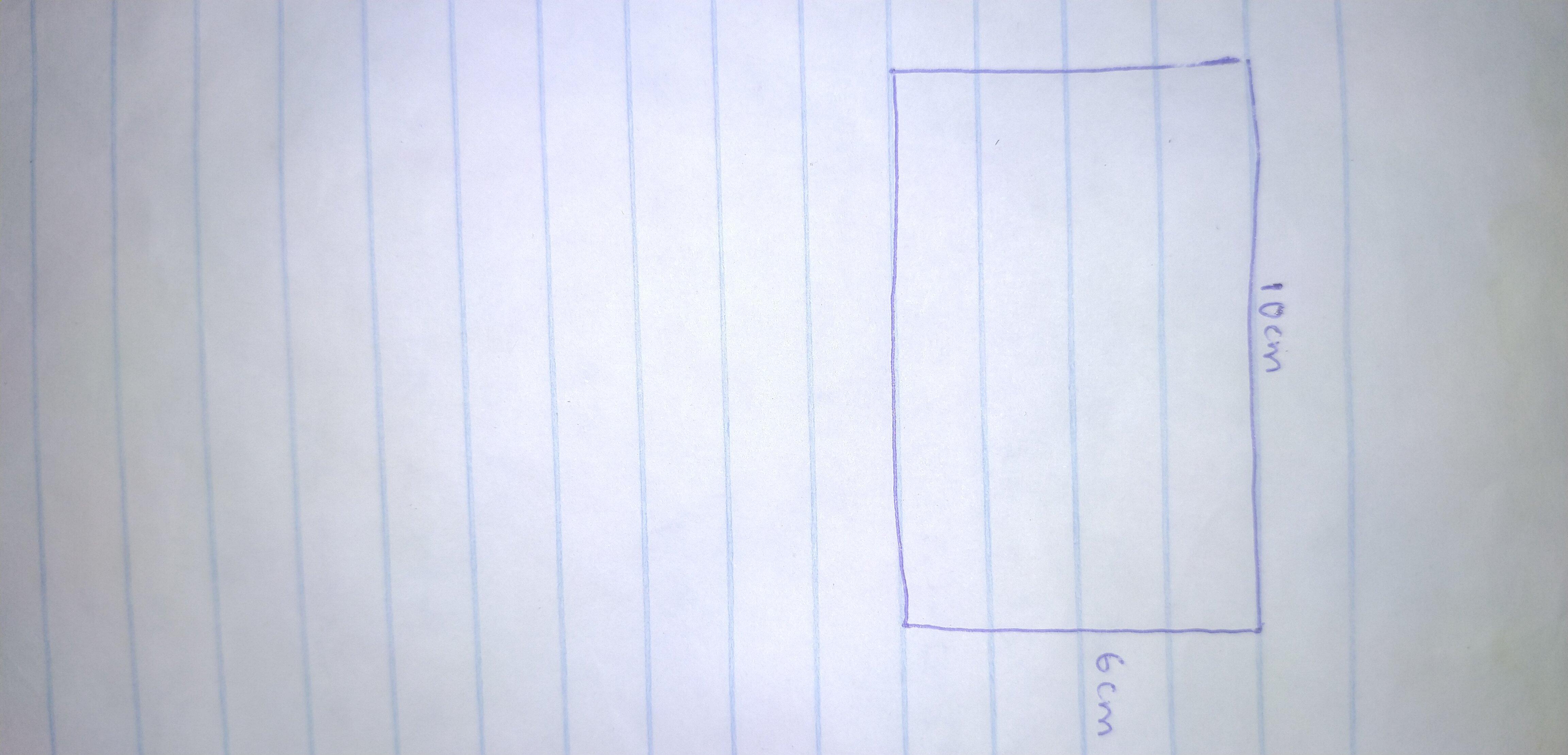
cale of 1 to 50. Draw and label the dimensions of a scale drawing of Elena's bedroom, using a scale of 1 to 50. Elena's bedroom door is 0.8 m wide. How wide should the door be on the scale drawing? Explain how you know. Elena's bed measures 4 cm by 3 cm on the scale drawing. What are the actual measurements of her bed? How would I draw this out

Mathematics
1 answer:
tester [12.3K]1 month ago
8 0

Answer:

Please refer to the explanation

Step-by-step explanation:

The following information is provided:

Actual dimensions of the rectangular bedroom = 5m in length

Actual dimensions of the rectangular bedroom = 3m in width

Scale used = 1 to 50

Scaled dimensions of the bedroom = 5m/50 = 0.1m = 10cm

Scaled dimensions of the bedroom width = 3m/50 = 0.06m = 6cm

If the door measures 0.8m in width

Scaled width of the door: 0.8m/50 = 0.016m = 1.6cm on the drawing.

The bed is represented as: 4cm by 3cm on the scale drawing;

The actual dimensions of the bed:

4cm * 50 = 200cm; 200/100 = 2m

3cm * 50 = 150cm; 150/100 = 1.5m

You might be interested in
Assume that 12 people, including the husband and wife pair, apply for 4 sales positions. People are hired at random.
Inessa [12570]

The formula C(n, r)= \frac{n!}{r!(n-r)!}, where r! is defined as 1*2*3*...r

provides the total number of combinations for forming groups of r items from a collection of n items.

For instance, with 10 items, there are C(10,6) possible ways to create groups of 6 from these 10 objects.

-----------------------------------------------------------------------------------------------


Choosing 4 individuals from a total of 12 can be accomplished in:

\displaystyle{C(12, 4)= \frac{12!}{4!8!}= \frac{12\cdot11\cdot10\cdot9\cdot8!}{4!8!}= \frac{12\cdot11\cdot10\cdot9}{4!}=11\cdot5\cdot9= 495 many different ways.


All unique groupings of 4 individuals, including the husband and wife pair, can be computed as C(10, 2) ways, since we only consider the potential selections of 2 from 10 individuals to form a group of 4.


\displaystyle{ C(10, 2)= \frac{10!}{2!8!}= \frac{10\cdot9}{2}=45


Consequently, the probability that both the husband and wife are selected is 45/495=0.09


Part 2)

The chance that one gets selected while the other does not =

P(husband selected, wife not selected) + P(wife selected, husband not selected)

These two scenarios are precisely equal, so it suffices to compute one.


Let's analyze the scenario: husband chosen, wife not selected.

Assuming the husband is selected, we need to determine the possible formations of 3 from the 11 total excluding the wife=10 individuals.

This results in:

\displaystyle{ C(10, 3)= \frac{10!}{3!7!}= \frac{10 \cdot9 \cdot8}{3\cdot2}=10\cdot3\cdot4=120


Hence,


P(husband selected, wife not selected)=120/495=0.24


Thus, the overall probability that one is picked while the other is not =

P(husband selected, wife not selected) + P(wife selected, husband not selected) =

0.24+0.24=0.48


Result:


A) 0.09


B) 0.48

4 0
1 month ago
A region R in the xy-plane is given. Find equations for a transformation T that maps a rectangular region S in the uv-plane onto
babunello [11817]
X(u, v) = (2(v - c) / (d - c) + 1)cos(pi * (u - a) / (2b - 2a))
y(u, v) = (2(v - c) / (d - c) + 1)sin(pi * (u - a) / (2b - 2a))

As v goes from c to d, the term 2(v - c) / (d - c) + 1 will vary from 1 to 3, which perfectly defines the radius range. Simultaneously, as u varies from a to b, pi * (u - a) / (2b - 2a) varies from 0 to pi/2, ideal for the angle. This maps the rectangle to R.
6 0
8 days ago
1. What is the probability of rolling a number greater than a 4 on a standard dice? Remember to reduce your fraction.
babunello [11817]
1. 1/3. 2. 7.
6 0
9 days ago
Read 2 more answers
The quotient of 9 3/4 and 5/8​
AnnZ [12381]

Answer:

15.6

Step-by-step explanation:

  1. 9\frac{3}{4} = \frac{39}{4}
  2. Insert 39/4: 39/4 ÷ 5/8
  3. 39/4 ÷ 5/8 = 39/4 × 8/5
  4. 39/4 × 8/5 = 312/20
  5. \frac{312}{20} = 15.6

I hope this information is helpful!

4 0
1 month ago
Read 2 more answers
Given: mAngleEDF = 120°; mAngleADB = (3x)°; mAngleBDC = (2x)° Prove: x = 24 3 lines are shown. A line with points E, D, C inters
zzz [12365]

Answer:

" Vertical angles are equal " ⇒ 2nd answer

Step-by-step explanation:

* Refer to the attached illustration

- Three lines intersect at point D.

- We have to identify the missing justification in step 3.

∵ Line FA intersects line EC at point D.

- When two lines cross, the angles created are referred to as

 vertical angles.

- By the vertical angles theorem, vertical angles are equal.

Thus, ∠ADC and ∠FDE are vertical angles.

Since vertical angles are equal

∴ ∠EDF ≅ ∠ADC

Thus, m∠EDF ≅ m∠ADC

Given that m∠EDF = 120°.

∵ m∠ADC is the sum of m∠ADB and m∠BDC.

Therefore, m∠ADB + m∠BDC = 120°.

∵ m∠ADB = (3x)° ⇒ given.

∵ m∠BDC = (2x)° ⇒ given.

Thus, 3x + 2x = 120 ⇒ combine like terms.

Thus, 5x = 120 ⇒ divide both sides by 5.

Thus, x = 24.

Column (1)                                                     Column (2)

m∠EDF = 120°                                               given

m∠ADB = 3 x                                                 given

m∠BDC = 2 x                                                 given

∠EDF and ∠ADC are vertical angles           definition of vertical angles

∠EDF is equal to ∠ADC                           vertical angles are equal

                                                                        equal  

m∠ADC = m∠ADB + m∠BDC                        angle addition principle.

m∠EDF = m∠ADC                                          definition of equality.

m∠EDF = m∠ADB + m∠BDC                         substitution.

120° = 3 x + 2 x                                               substitution.

120 = 5 x                                                         addition.

x = 24                                                           division.

∴ The missing justification is " vertical angles are equal "

- From the reasoning above, ∠ADC and ∠FDE are vertical angles and therefore they are equal according to the vertical angle theorem.

6 0
1 month ago
Read 2 more answers
Other questions:
  • The linear equation 3x – 11y = 10 has
    11·1 answer
  • renaldo catches the bus at 4:00 onto ride 3.2 miles from his house to the dentist office. He arrives at 4:30 p.m for one hour ap
    13·1 answer
  • Jessica is 5 years older than her sister Jenna. Jenna tells her sister that in 5 years, she will be as old as Jessica was 5 year
    11·1 answer
  • Use the method of cylindrical shells to find the volume V generated by rotating the region bounded by the given curves about the
    7·1 answer
  • Mr. Richard's science class is conducting a variety of experiments with projectiles and falling objects. Two groups of students
    5·2 answers
  • Concentric circles are circles with the same center but different radii. Which equations represent concentric circles along with
    13·2 answers
  • Miguel created the ratio table below to show how he uses the money he earns at work. How much money will he save if he earns 120
    7·2 answers
  • Simplify 16x^2 9y^2/(4x-3y)^2​
    14·1 answer
  • 10. Marie can afford a $250 per month car payment. She's found a 5 year loan at 7% interest.
    10·1 answer
  • The Naturally Made Bath and Body store pays $550 a month for rent and utilities. The average cost for its products to be manufac
    9·2 answers
Add answer
Login
Not registered? Fast signup
Signup
Login Signup
Ask question!