answer.
Ask question
Login Signup
Ask question
All categories
  • English
  • Mathematics
  • Social Studies
  • Business
  • History
  • Health
  • Geography
  • Biology
  • Physics
  • Chemistry
  • Computers and Technology
  • Arts
  • World Languages
  • Spanish
  • French
  • German
  • Advanced Placement (AP)
  • SAT
  • Medicine
  • Law
  • Engineering
qwelly
18 days ago
7

1. Walking through the forest, you find a large population of toadstools. From your extensive knowledge of the kingdom fungi, yo

u know that the allele for being spotted (S) is dominant over the allele for being plain (s). In this population of 1007, you find 14 toadstools that are not spotted. What are the allele frequencies? In a different forest, you find a somewhat smaller population of 549. Through genetic testing, you determine that there are 308 homozygous spotted, 206 heterozygous, and 34 homozygous plain toadstools. Is this what you expected? If not, what are the allele frequencies of this population?
Biology
You might be interested in
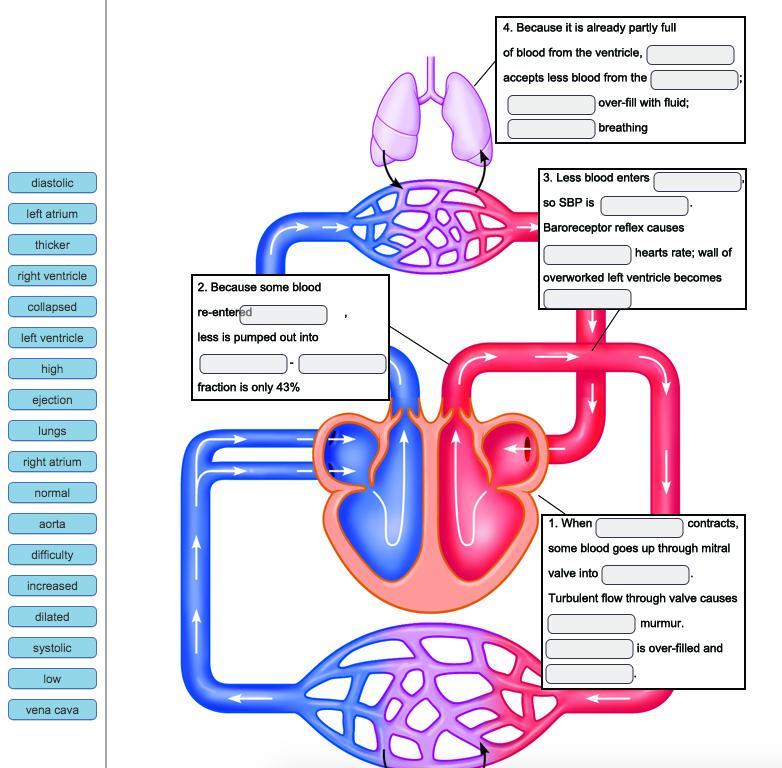
Drag and drop the appropriate labels into position to explain how this defect might cause mr. g's other problems.
Rainbow [2354]

How does the altered circulation in Mr. G correlate with his symptoms? Drag and drop the appropriate labels into the correct sequence to clarify how this defect could lead to Mr. G's other issues. Complete the boxes in order, starting with 1, then 2, etc.

(Image attached)

Answer:

  1. When the left ventricle contracts, a portion of the blood flows through the mitral valve into the left atrium. Turbulent flow within the valve results in a systolic murmur, causing the atrium to become overfilled and dilated.
  2. Some blood returning through the mitral valve means less blood is ejected into the aorta, leading to an ejection fraction of just 43%.
  3. The reduced flow into the aorta results in lower SBP. The baroreceptor reflex triggers an increase in heart rate; the left ventricle's wall, under stress, thickens.
  4. Due to being partly filled with blood from the ventricle, the left atrium can receive less blood from the lungs, causing the lungs to become fluid-overloaded, leading to difficulties in breathing.

Explanation:

A murmur arises from abnormal heart blood flow. It produces unusual sounds heard between heartbeats. A systolic murmur happens when heart muscles contract, within the intervals defined by S1 and S2.

From the information presented, it appears Mr. G is suffering from mitral regurgitation. This condition occurs when the mitral valve fails to close tightly, causing blood to flow back from the left ventricle into the left atrium.

8 0
3 months ago
Scientists determined that a species of a reptile dinosaur cohort had 20% survivorship during the first two years of life, but t
s2008m [2378]
C. downward slope.
5 0
3 months ago
Rosa eats a peanut butter sandwich for lunch. Peanut butter contains a lot of protein, and bread is mostly starch. Rosa plans to
lana [2441]

Answer:

What does she require from the food consumed and the air inhaled to successfully complete her run?

A. To support her jogging, Rosa needs food that is rich in carbohydrates (like bread). It is not advisable for her to consume protein-rich items just before exercise unless she is following a weight loss regimen.

B. To carry out aerobic respiration, Rosa requires oxygen, which is crucial for maximizing energy release (36 molecules produced per reaction). In contrast, anaerobic reactions produce lesser energy (2 ATP molecules per reaction) and are not ideal.

How do Rosa's body systems collaborate to transport the necessary molecules into her cells?

For her body cells to engage in aerobic respiration and release energy efficiently, they depend on carbohydrates (glucose) and oxygen. These molecules travel through diffusion into the bloodstream. While she jogs, the complex carbs in bread (like starch) break down into simpler glucose molecules, which then diffuse into the blood. Concurrently, increased oxygen is delivered to the cells through faster blood circulation, assisted by the rapid pumping action of the lungs and heart. This collective function ensures both glucose and oxygen are provided to cells, where they are utilized by mitochondria to create ATP energy molecules.

How do hair cells utilize these molecules for energy release allowing her to run?

Once glucose and oxygen enter the bloodstream, they are absorbed into cells, directed to mitochondria which convert them into energy in the form of ATP. Mitochondria are aptly referred to as the cell's powerhouse. Within each cell, energy release occurs in a sequence comprising glycolysis, the Krebs cycle, and oxidative phosphorylation. In this process, glucose reacts with oxygen, ultimately creating 36 ATP molecules per reaction run, sufficient to meet high energy demands. During exercise, both oxygen and glucose are supplied more rapidly due to the accelerated activity of the lungs and heart.

PS: Anaerobic respiration is not able to meet higher energy demands as it yields only 2 ATP per reaction.


5 0
3 months ago
Amniotes produce eggs that contain fluids that bathe the embryo during gestation..
garik1379 [2080]

Response: a) true

Clarification: The liquid within the egg plays a critical role in ensuring the embryo's survival and providing a fluid medium necessary for its development.

8 0
3 months ago
Read 2 more answers
Other questions:
  • We can be sure that a mole of table sugar and a mole of vitamin C are equal in their
    9·1 answer
  • A family decides that they want to produce chihuahuas with long hair. identify a procedure that could be used to make sure that
    11·1 answer
  • Jill is heterozygous for gene A and is going to have a child with Jack, who is homozygous recessive for gene A. Which of the fol
    9·1 answer
  • It has been hypothesized that people who are heterozygous for the allele that causes the deadly genetic condition cystic fibrosi
    5·1 answer
  • 3. From problem 2, suppose another boy, Boy C pulls the heavy cabinet with 5 N
    11·1 answer
  • Name and describe one process carbon undergoes to change pools
    6·1 answer
  • the gypsy moth is a pest species whose larvae feed on the leaves of hardwood trees. the population size of gypsy moths naturally
    7·1 answer
  • white perch is a fish that is native to atlantic coastal regions and is invasive to the great lake it feeds on native species an
    15·2 answers
  • 7. Why are adult sponges said to be sessile animals? |
    13·1 answer
  • 1 When a single cell of E. coli reproduces, it first duplicates its DNA. Next, the cell elongates as each copy of DNA is pulled
    11·2 answers
Add answer
Login
Not registered? Fast signup
Signup
Login Signup
Ask question!