Answer:
This is the implementation of the copy assignment operator for CarCounter:
CarCounter& CarCounter::operator=(const CarCounter& objToCopy) {
carCount = objToCopy.carCount;
return *this; }
The syntax for a copy assignment operator is:
ClassName& ClassName:: operator= ( ClassName& object_name)
In this code snippet, the class name is CarCounter, and the object being copied is objToCopy.
The assignment operator = is invoked to transfer objToCopy.carCount to the carCount of the new instance.
This operator is utilized when an initialized object receives a new value from another active object.
Then return *this returns a reference to the invoking object.
Explanation:
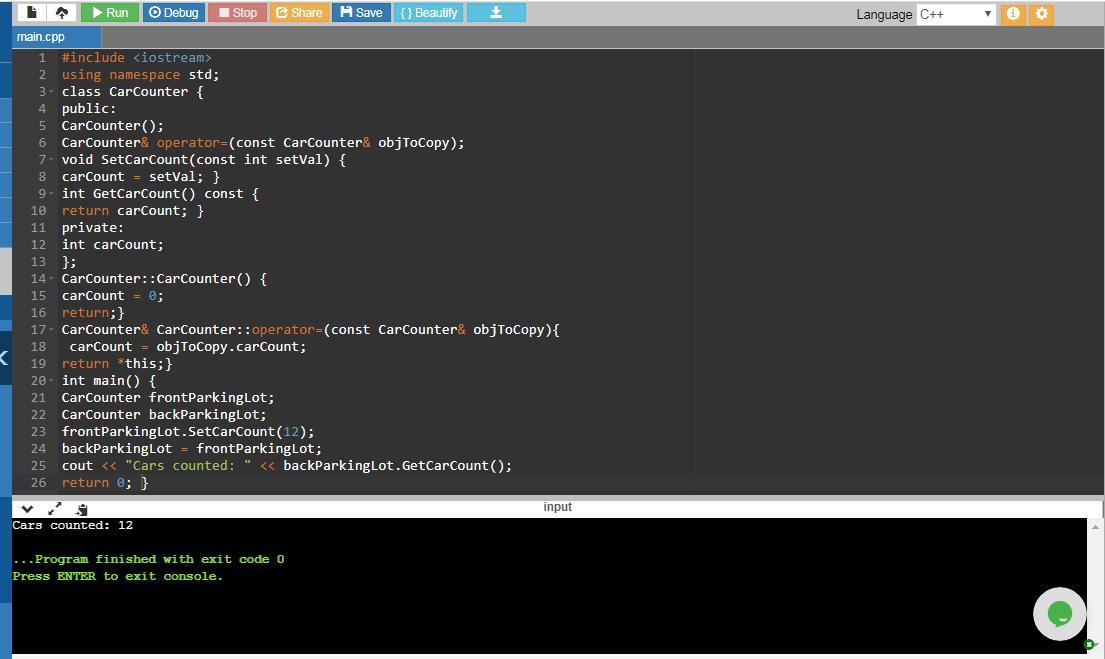
The complete program looks like this:
#include <iostream> // for input/output functions
using namespace std; // enables access to objects like cin cout
class CarCounter { // defining the class
public: // public member functions of CarCounter
CarCounter(); // constructor for CarCounter
CarCounter& operator=(const CarCounter& objToCopy); // copy assignment operator for CarCounter
void SetCarCount(const int setVal) { // method to set the car count value
carCount = setVal; }
// assigns setVal to carCount
int GetCarCount() const { // method to access carCount
return carCount; }
private: // private members of the class
int carCount; }; // private data member of CarCounter
CarCounter::CarCounter() { // constructor
carCount = 0; // initializes carCount to zero in the constructor
return;
}
// FIXME implement copy assignment operator
CarCounter& CarCounter::operator=(const CarCounter& objToCopy){
/* this copy assignment operator sets objToCopy.carCount to the new object's carCount, then returns *this */
carCount = objToCopy.carCount;
return *this;}
int main() { // start of the main() function
CarCounter frontParkingLot; // creates CarCounter instance
CarCounter backParkingLot; // creates another CarCounter instance
frontParkingLot.SetCarCount(12); // sets the value of carCount in frontParkingLot to 12
backParkingLot = frontParkingLot; // assigns frontParkingLot's value to backParkingLot
cout << "Cars counted: " << backParkingLot.GetCarCount(); // retrieves and prints the value of carCount using GetCarCount
return 0; }
The program outputs:
Cars counted = 12