answer.
Ask question
Login Signup
Ask question
All categories
  • English
  • Mathematics
  • Social Studies
  • Business
  • History
  • Health
  • Geography
  • Biology
  • Physics
  • Chemistry
  • Computers and Technology
  • Arts
  • World Languages
  • Spanish
  • French
  • German
  • Advanced Placement (AP)
  • SAT
  • Medicine
  • Law
  • Engineering
kondor19780726
2 months ago
9

Which graph shows the equation c = 10+ 3t, where c is the total cost of going to the carnival and t is the number of $3 tickets

purchased?

Mathematics
2 answers:
Leona [12.6K]2 months ago
7 0

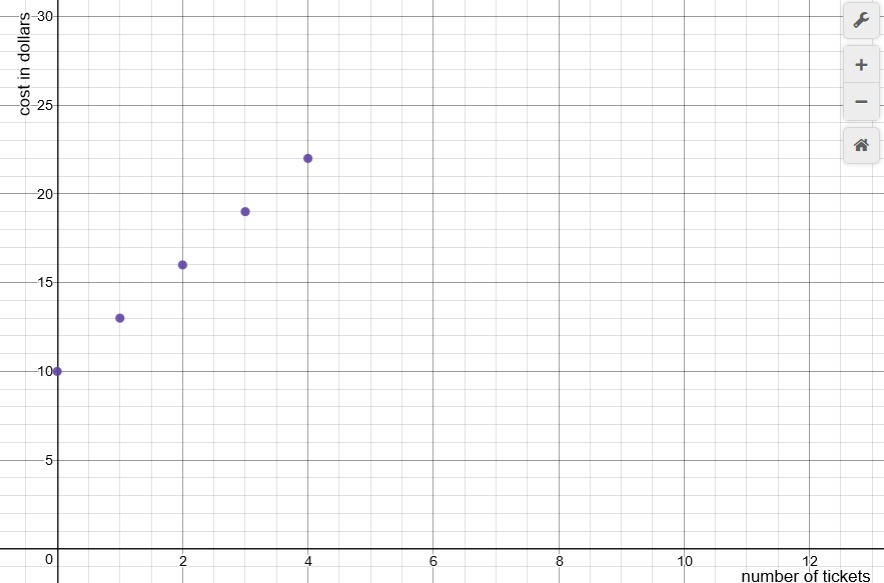
Answer: refer to the included chart.


Explanation:


The equation c = 10 + 3t represents a linear relationship, so its graph plots as a straight line.


The graph's slope is unchanging and equals the coefficient before the independent variable (t here).


The variable c is the dependent variable, representing the overall cost for attending the carnival.


The constant term, which is 10 here, reflects a fixed charge or the starting value of the function at t = 0.


To plot the graph, take the following steps:


  • Create two intersecting axes at right angles, horizontal and vertical.
  • Label the horizontal axis with the independent variable’s name and units: the number of tickets.
  • Label the vertical axis with the dependent variable and its units: cost in dollars.
  • Define the function's domain and range.

Domain: possible values for t, which are whole numbers [0, 1, 2, 3, ...]

Range: numbers starting from 10 and increasing by 3s because t ≥ 0: [10, 13, 16, 19, 22, ...]

  • Remember the function is discrete, meaning values occur at distinct points instead of being continuous.
  • Choose a suitable scale and place tick marks on each axis, like 1 unit intervals.
  • Plot the initial point where t = 0: c = 10 + 3(0) = 10.
  • Plot additional points using this table:

t c($)

0 10

1 13

2 16

3 19


Finally, include the graph's title: cost of going to the carnival.


Using these details, you can interpret the attached sketch, which illustrates some of the described characteristics.


tester [12.3K]2 months ago
6 0

Given the function:

c = 10+ 3t

where

c---------> denotes the total expense for attending the carnival

t---------> represents the count of \$3 tickets bought

we establish that

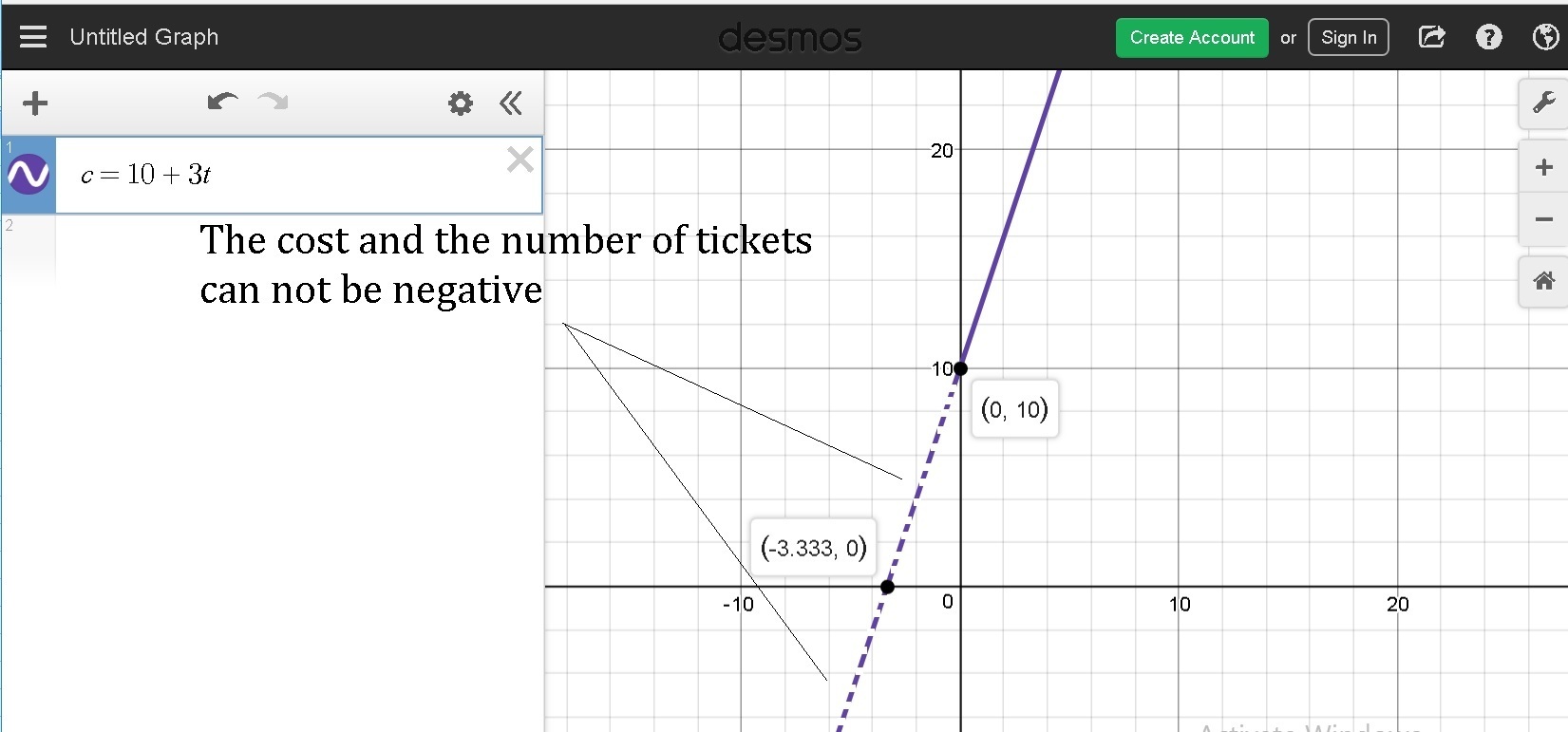
the domain of the function is the interval---------------> [0,∞)

Because ticket quantities cannot be less than zero

The range of this function is the interval-------------> [10,∞)

Since total costs cannot be below ten

pictured with graphing software,

refer to the attached image

The solution is shown in the accompanying figure

You might be interested in
Which of these relations on{0,1,2,3}are partial orderings? Determine the properties of a partial ordering that the others lack.
Svet_ta [12734]

Step-by-step explanation:

A = {0,1,2,3}

a): R = {(0,0),(2,2),(3,3)}

R displays antisymmetry, as whenever (a,b)∈R, it follows that a=b.

R lacks reflexivity since (1,1) ∉ R even though 1 ∈ A.

R is transitive; therefore, if (a,b)∈R and (b, c) ∈ R, then a=b=c and (a,c)=(a,a)∈R.

R fails to be a partial ordering due to its lack of reflexivity.

b): R = {(0,0),(1,1),(2,0),(2,2),(2,3),(3,3)}

R is antisymmetric because if (a,b)∈R and (b, a) ∈ R, then a must equal b (e.g., (2,0) ∈ R and (0,2) ∉ R; likewise, (2,3) ∈ R and (3,2) ∉ R).

R is reflexive since each (a,a) resides in R for all elements a ∈ A.

R is transitive; if (a,b)∈R and (b,c)∈R, it implies (a,c) exists in R or identical to (a,b) in R.

R qualifies as a partial ordering due to its reflexivity, antisymmetry, and transitivity.

c): R =  {(0,0),(1,1),(1,2),(2,2),(3,1),(3,3)}

R is reflexive as (a,a)∈R is true for every a ∈ A.

R is antisymmetric; if (a,b)∈R holds and if also (b,a)∈R, then a invariably equals b (e.g., (1,2)∈R while (2,1) ∉ R; similarly for (3,1) and (1,3)).  

R fails transitivity because (3,1) ∈ R and (1,2) ∈ R, but (3,2) ∉ R.

R is not a partial ordering due to transitivity not being satisfied.

d): R =  {(0,0),(1,1),(1,2),(1,3),(2,0),(2,2),(2,3), (3,0),(3,3)}

R exhibits reflexivity since (a,a)∈R for each element a ∈ A.

R displays antisymmetry, as if (a,b)∈R and (b,a)∈R then a must equal b (e.g., (1,2)∈R and (2,1)∉R; similarly validated for others).

R is not transitive because (1,2)∈R and (2,0)∈R, but (1,0)∉R.

R is not a partial ordering due to transitivity issues.

e):  R = { ( 0, 0 ), ( 0, 1 ), ( 0, 2 ), ( 0, 3 ), ( 1, 0 ), ( 1, 1 ), ( 1, 2 ), ( 1, 3 ), ( 2, 0 ), ( 2, 2 ), ( 3, 3 ) }

R proves to be reflexive, given that (a,a)∈R for all a∈A.

R is not antisymmetric since both (1,0)∈R and (0,1)∈R hold while 0 is distinct from 1.

R lacks transitivity, as (2,0)∈R and (0,3)∈R, while (2,3)∉R.

R cannot be classified as a partial ordering as it fails in both antisymmetry and transitivity.
3 0
1 month ago
A business had sales last year of $139,526,000. Write the value of the 9 digit in this number. _________________________________
babunello [11817]
Oooooooonnnnnneeeeeeeemmmmmmmmiiiiilllllllliiiiieeee
7 0
20 days ago
Find the common difference of the arithmetic sequence. 6,9.4,12.8,16.2
zzz [12365]

An arithmetic sequence is defined by the property that the difference between each pair of adjacent terms is consistently the same. When this requirement is met, that constant is recognized as the common difference.

This particular sequence is arithmetic, as the difference between each term and the preceding one is

  • 9.4 - 6 = 3.4
  • 12.8 - 9.4 = 3.4
  • 16.2 - 12.8 = 3.4

Thus, the common difference is 3.4, considering that the adjacent terms differ by 3.4

8 0
19 days ago
give an example on an addition problem in which you would and would not group the addends differently to add
AnnZ [12381]
Addends refer to the numbers being summed in an equation. 

Their arrangement only matters if parentheses are utilized to modify the usual Order of Operations. 

For example:
2 - (8 + 3)  in this case, 8 and 3 must be grouped first before tackling the subtraction.

Any addition scenario without parentheses can similarly function where the grouping is irrelevant.
3 0
1 month ago
A frame around a rectangular family portrait has a perimeter of 60 inches. The length is 15 inches less than 2 times the width.
zzz [12365]
2(2w-5) + 2w = 50

4w - 10 + 2w = 50

6w - 10 = 50

6w = 60

w = 10

The length is calculated as 2(10) - 5 = 20 - 5 = 15

I hope this is useful!!
5 0
1 month ago
Read 2 more answers
Other questions:
  • Evaluate. 58−(14)2=58-142= ________
    13·1 answer
  • Which graph shows the axis of symmetry for the function f(x) = (x – 2)2 + 1?
    5·2 answers
  • O.9c + 1.89r = 17.01 c=18.9 - 2.1r equation answer
    7·1 answer
  • Given: WXYZ is a rhombus. If 1 = 25°, then 2 = <br> a. 25<br> b. 50 <br> c. 6
    8·2 answers
  • A beverage manufacturer performs a taste-test and discovers that people like their fizzy beverages best when the radius of the b
    6·2 answers
  • If you plot the absorbance measurements of solutions vs. their concentrations, what is the slope equal to:_______
    7·1 answer
  • A horticulturist conducted an experiment on 110 thirty-six inch plant boxes to see if the amount of plant food given to the plan
    11·1 answer
  • A building 64 ft high casts a 288-ft shadow. Sarah casts an 18-ft shadow. The triangle formed by the building and its shadow is
    7·1 answer
  • Find the domain of the Bessel function of order 0 defined by [infinity]J0(x) = Σ (−1)^nx^2n/ 2^2n(n!)^2 n = 0
    12·1 answer
  • 3400 dollars is placed in an account with an annual interest rate of 8.25%. How much will be in the account after 25 years, to t
    13·1 answer
Add answer
Login
Not registered? Fast signup
Signup
Login Signup
Ask question!