answer.
Ask question
Login Signup
Ask question
All categories
  • English
  • Mathematics
  • Social Studies
  • Business
  • History
  • Health
  • Geography
  • Biology
  • Physics
  • Chemistry
  • Computers and Technology
  • Arts
  • World Languages
  • Spanish
  • French
  • German
  • Advanced Placement (AP)
  • SAT
  • Medicine
  • Law
  • Engineering
vitfil
27 days ago
11

Suzuki Supply reports the following amounts at the end of 2021 (before adjustment). Credit Sales for 2021 $ 260,000 Accounts Rec

eivable, December 31, 2021 55,000 Allowance for Uncollectible Accounts, December 31, 2021 1,100 (Credit) 3. Calculate the effect on net income (before taxes) and total assets in 2021 for each method. Suzuki estimates 12% of receivables and 3% of credit sales respectively will not be collected.
Business
1 answer:
soldi70 [3.1K]27 days ago
7 0

Answer:

1. Suzuki calculates 12% of receivables: Net income (before taxes) for 2021 falls by $5,500  and total assets for 2021 reduce by $5,500

2. Suzuki calculates 3% of credit sales: Net income (before taxes) for 2021 falls by $7,800 and total assets for 2021 reduce by $7,800

Explanation:

1. Suzuki calculates 12% of receivables.

Estimated bad debts: 12% x $55,000 = $6,600

Prior to adjustments, the Allowance for Uncollectible Accounts has a balance of $1,100 (credit).

Bad debts expense = $6,600  - $1,100 = $5,500.

The journal entry will be:

Debit Bad debts expense $5,500

Credit Allowance for Uncollectible Accounts $5,500

Net income (before taxes) in 2021 falls by $5,500  and total assets in 2021 reduce by $5,500

2. Suzuki calculates 3% of credit sales.

Estimated bad debts: 3% x $260,000 = $7,800.

The company follows the percentage of sales methodology.

Bad debts expense = $7,800.

The journal entry will be:

Debit Bad debts expense $7,800

Credit Allowance for Uncollectible Accounts $7,800.

Net income (before taxes) in 2021 falls by $7,800 and total assets in 2021 reduce by $7,800

You might be interested in
INCOME STATEMENT Little Books Inc. recently reported $3 million of net income. Its EBIT was $6 million, and its tax rate was 40%
Katen [2881]

Answer:

The interest amounts to $1,000,000.

Explanation:

The standard format of an income statement includes:

Revenue/Sales (+)

Cost of Goods Sold (COGS) (-)

=Gross Profit

Marketing, Advertising, and Promotion Expenses (-)

General and Administrative (G&A) Expenses (-)

=EBITDA

Depreciation & Amortization Expense (-)

=Operating Income or EBIT

Interest (-)

Other Expenses (-)

=EBT (Pre-Tax Income)

Income Taxes (-)

=Net Income

For this case:

EBIT equals $6,000,000.

The interest is to be determined.

Tax is calculated as 0.40.

EBITDA stands at $3,000,000.

The interest formula is: interest = [EBITDA / (1 - tax)] - EBIT

Substituting values, interest = 3000000 / 0.60 - 6000000 = -$1,000,000.

With EBIT at 6 million, the interest is $1 million, and the tax amounts to 2 million (calculated as (EBIT - interest) * 0.40).

Thus, the net income is $3 million.

7 0
25 days ago
Following is partial information for the income statement of Audio Solutions Company under three different inventory costing met
Nady [2940]

Answer:

The calculations are presented below:

Explanation:

1.                       FIFO    LIFO Average cost  

Cost of goods sold      

Beginning inventory       $11,200      $11,200  $11,200

(400 units ×  $28)                          

Purchases                       $16,625    $16,625   $16,625

(475 units × 35)                  

Total goods available $27,825    $27,825   $27,825  

Ending inventory             $18,025    $15,575    $16,695

(525 units)  

Cost of goods sold          $9,800    $12,250    $11,130  

Calculated using ending inventory = 475 × $35 + 50 × $28    

FIFO = $18,025  

For LIFO ending inventory: 400 × $28 + 125 × $35

Results in $15,575  

Average cost is found by: $27,825 ÷ $875    

Which equals 31.8      

Ending inventory is calculated as 525 × 31.8

This leads to $16,695

2.                           FIFO            LIFO         Average

Sales

(307 × $50)                $15,350         $15,350    $15,350

Cost of goods sold     $9,800    $12,250    $11,130

Gross Profit                 $5,550           $3,100      $4,220

Expenses                     $1,680           $1,680      $1,680

Net income                  $3,870           $1,420       $2,540

3. FIFO ranks as 3

LIFO ranks as 2

Average ranks as 1

5 0
24 days ago
Granite State Airlines serves the route between New York and Portsmouth, NH, with a single-flight-daily 100-seat aircraft. The o
stepan [2980]

Answer:

The data indicates: One flight has a total of 100 seats.

Full fare passengers, ticket cost=$150, average=56 passengers, SD=23.

Discount fare passengers, ticket cost=$100, average=88 passengers, SD=44.

(a) The question suggests optimizing total revenue per flight (one way) by potentially only taking full fare passengers, which would yield $15,000. However, historical probabilities show an average of 56 with a standard deviation of 23, thus in an ideal scenario, total full fare passengers could reach 79. That would allocate 21 tickets for discount passengers, leading to total revenues of $13,950.

(b) Now with the new constrained policy, specific seat allocations for both categories are set—44 for discount (resulting in total revenues of 44*100) and 56 for full fare (resulting in total revenues of 56*150)—both within the previously mentioned probabilities. The total revenue in this case will be 44*100+56*150 = $12,800.

(c) The difference in excess revenues between both scenarios for optimal total revenues and limited seats policy is calculated as answer (a) - answer (b) = $13,950 - $12,800 = $1,150.

(d) Realistically, this question cannot be properly answered without a clear confidence interval. Another simplifying assumption is to take the mean number of passengers as expected bookings (which can later be adjusted with provided confidence intervals). The total revenues in this scenario will come from 44*100 from discount and 56*150 from full fare passengers. This remains similar to answer (c) due to the assumption of no constraints, so optimal bookings might total 54 full fare tickets and 44 discount tickets. Worst case scenarios could involve subtracting SD from each passenger type’s mean, or for better scenarios, add SD of full fare passengers to the mean and allocate remaining seats for discount fare in order to maximize revenue.

6 0
1 month ago
Read 2 more answers
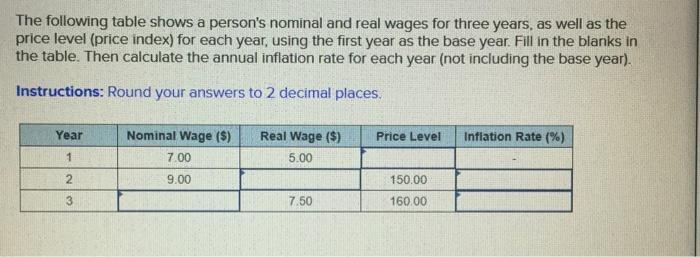
The following table shows a person's nominal and real wages for three years, as well as the price level (price index) for each y
marusya05 [3075]

Response:

Year  Nominal wage  Real wage  Price level  Inflation rate

1                  $7                  $5                140             None

2                 $9                  $6                150               7.14 %

3                 $12                 $7.5             160              6.67 %

Explanation:

Note: A visual representation of the table is also provided.

The price level for Year 1 is calculated as (Nominal wage in year 1/Real wage in year 1) multiplied by 100.

Thus, Price level in Year 1 = ($7.00 / $5.00) * 100

Resulting in Price level in Year 1 = 1.4 times 100

Which gives Price level in Year 1 = 140

To find Real wage in Year 2: (Nominal wage in year 2 / Price level in year 2) multiplied by 100.

Which gives Real wage in Year 2 = ($9.00 / 150.00) * 100

Thus, Real wage in Year 2 = $6

To calculate Nominal wage in Year 3: (Real wage in Year 3 * Price level in Year 3) divided by 100.

<pthis results="" in="" nominal="" wage="" year="">

As a result, Nominal wage in Year 3 = $1,200 / 100

Leading to Nominal wage in Year 3 = $12

To determine Inflation rate in Year 2: (Price level in Year 2 - Price level in Year 1) divided by Price level in Year 1.

<phence inflation="" rate="" in="" year="">

Therefore, Inflation rate in Year 2 = 10 / 140

Giving Inflation rate in Year 2 = 0.0714, or 7.14 %

For Inflation rate in Year 3: (Price level in Year 3 - Price level in Year 2) divided by Price level in Year 2.

<pthis leads="" to="" inflation="" rate="" in="" year=""><pfinally inflation="" rate="" in="" year="" resulting="" or="">

</pfinally></pthis></phence></pthis>
6 0
25 days ago
Concerning the allocation of the publication budget among various journals, Select one: a. the cost-per-thousand calculation sho
Nady [2940]

Response:

adgggrg

Justification:

4 0
24 days ago
Other questions:
  • In a manufacturing company as many as 100 labourers are working in the production department.
    13·1 answer
  • A new restaurant has introduced a wildly popular macaroni and cheese dish made with goat cheese. however, at approximately the s
    10·2 answers
  • An investor paid $43,000 for a lot and $520,000 to have a strip mall constructed on it. he has depreciated the property for the
    5·1 answer
  • Given the following financial data for Boston Technology, compute the firmâs degree of combined leverage.
    10·1 answer
  • You purchased 1000 shares of stock in Cumberland Software for $3 per share on January 1, 2006. Over the next four years, you rec
    13·1 answer
  • Cost pressure from international competitors pushes companies toward greater scale and efficiency. But some products must also m
    7·1 answer
  • Shelby's annual take home pay is $51,000. What is the maximum amount that she can spend per month paying off credit cards and lo
    13·2 answers
  • The market interest rate related to a bond is also called the a.stated interest rate b.contract interest rate c.effective intere
    15·1 answer
  • Hewitt Company expects cash sales for July of​ $11,000, and a​ 19% monthly increase during August and September. Credit sales of
    10·1 answer
  • A recent income statement of McClennon Corporation reported the following data:
    14·1 answer
Add answer
Login
Not registered? Fast signup
Signup
Login Signup
Ask question!