answer.
Ask question
Login Signup
Ask question
All categories
  • English
  • Mathematics
  • Social Studies
  • Business
  • History
  • Health
  • Geography
  • Biology
  • Physics
  • Chemistry
  • Computers and Technology
  • Arts
  • World Languages
  • Spanish
  • French
  • German
  • Advanced Placement (AP)
  • SAT
  • Medicine
  • Law
  • Engineering
mario62
2 months ago
9

Let X represent the amount of gasoline (gallons) purchased by a randomly selected customer at a gas station. Suppose that the me

an value and standard deviation of X are 11.5 and 4.0, respectively.a. In a sample of 50 randomly selected customers, what is the approximate probability that the sample mean amount purchased is at least 12 gallons?b. In a sample of 50 randomly selected customers, what is the approximate probability that the total amount of gasoline purchased is at most 600 gallons.c. What is the approximate value of the 95th percentile for the total amount purchased by 50 randomly selected customers.
Mathematics
1 answer:
babunello [11.8K]2 months ago
5 0

Answer:

a) There is an 18.94% chance that the sample mean of the amount purchased will be at least 12 gallons.

b) There is an 81.06% chance that the total gasoline purchased will not exceed 600 gallons.

c) The estimated value for the 95th percentile of the total consumption by 50 randomly chosen customers is 621.5 gallons.

Step-by-step explanation:

The solution to this query involves applying the normal probability distribution and the central limit theorem.

Normal probability distribution

Issues involving normally distributed samples can be addressed using the z-score formula.

In a dataset characterized by mean \mu and standard deviation \sigma, the z-score for a value X is expressed as:

Z = \frac{X - \mu}{\sigma}

The z-score indicates how many standard deviations a particular value is from the mean. After calculating the z-score, we reference the z-score table to find its corresponding p-value, which represents the probability that a measure is less than X, essentially giving us X's percentile. By subtracting the p-value from 1, we find the chance that the measure exceeds X.

Central Limit Theorem

The Central Limit Theorem posits that for a normally distributed variable X, with mean \mu and standard deviation \sigma, the distribution of sample means with size n approximates a normal distribution characterized by mean \mu and standard deviation s = \frac{\sigma}{\sqrt{n}}.

Even when dealing with a skewed variable, the Central Limit Theorem remains applicable as long as n is no less than 30.

For sums, this theorem can likewise be employed, accompanied by mean \mu and standard deviation s = \sqrt{n}*\sigma.

In this scenario, we are given that:

\mu = 11.5, \sigma = 4

a. For a group of 50 randomly selected customers, what is the estimated probability that the sample mean amount purchased is at least 12 gallons?

Here we have n = 50, s = \frac{4}{\sqrt{50}} = 0.5657

This probability is derived from 1 minus the p-value of Z corresponding to X = 12.

Z = \frac{X - \mu}{\sigma}

According to the Central Limit Theorem

Z = \frac{X - \mu}{s}

Z = \frac{12 - 11.5}{0.5657}

Z = 0.88

Z = 0.88 yields a p-value of 0.8106.

1 - 0.8106 = 0.1894

Therefore, there is an 18.94% chance that the sample mean amount purchased is at least 12 gallons.

b. For a group of 50 randomly selected customers, what is the estimated probability that the total amount of gasoline purchased does not exceed 600 gallons?

Regarding sums, we have mu = 50*11.5 = 575, s = \sqrt{50}*4 = 28.28

This probability equals the p-value of Z when X = 600. Hence,

Z = \frac{X - \mu}{s}

Z = \frac{600 - 575}{28.28}

Z = 0.88

Z = 0.88 displays a p-value of 0.8106.

Thus, there is an 81.06% chance that the total gasoline purchased will be 600 gallons or less.

c. What is the approximate figure for the 95th percentile regarding the total purchases by 50 randomly chosen customers?

This value corresponds to X when Z indicates a p-value of 0.95, which occurs at Z = 1.645.

Z = \frac{X - \mu}{s}

1.645 = \frac{X- 575}{28.28}

X - 575 = 28.28*1.645

X = 621.5

The 95th percentile estimate for the total amount purchased by 50 randomly selected customers stands at 621.5 gallons.


You might be interested in
A study was conducted on the effects of long-term marriage (more than 10 years). Researchers gathered data from a random sample
Leona [12618]

Response:

The right choice is;

We cannot determine a cause and effect association because several variables were considered

Detailed explanation:

Establishing a cause and effect relationship requires the following criteria;

1) There must be a time sequence where the cause occurs before the effect

The question does not clearly indicate if the divorce (the potential cause) occurred prior to the event

2) If the cause happens, the effect must follow

Thus, everyone who is unmarried should ideally be accounted for to establish a cause and effect relationship

3) The relationship should not be explainable by alternative factors

The query mentions that those who were married tended to be more physically active, maintain a healthy weight, and were non-smokers, all of which contribute to longevity.

8 0
1 month ago
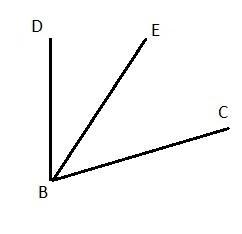
If m<DBC=(12x-3)°, m<DBE=(5x+12)°, and m<EBC=(3x+13)°, find m<EBC.
Leona [12618]

Answer:

m∠EBC=34°

Step-by-step explanation:

We establish that

m∠DBC=m∠DBE+m∠EBC

Refer to the accompanying diagram for clarity on the issue

Replace the known values in the equation and determine x

(12x-3)\°=(5x+12)\°+(3x+13)\°\\12x-3=8x+25\\12x-8x=25+3\\4x=28\\x=7

Calculate the size of angle EBC

m∠EBC=(3x+13)°

Insert the value for x

m∠EBC=(3(7)+13)°

m∠EBC=(21+13)°

m∠EBC=34°

8 0
3 months ago
Which expression has a negative value?
babunello [11817]

Answer:

A: 7 + 3 (-4) (2)

Step-by-step explanation:

Generally speaking, multiplying or dividing a negative by a positive results in a negative outcome. However, if you multiply or divide two negatives or two positives, the result is positive.

Now, let's convert all these statements into straightforward math expressions and solve them:

A) "7 + 3 (-4) (2)" = 7 + 3 * (-4) * 2 = 7 + (-24) = -17

B) "-2(12/(-3))" =

-2 * [12/(-3)] = -2 * (-4) = 8

C) "(15 - 7) - (9/3)" = (15 - 7) - (9/3) = 8 - 3 = 5

D) "-5(7 + (-14)) - 30" =

-5 * [7 + (-14)] - 30 = -5 * (-7) - 30 = 35 - 30 = 5

The sole expression yielding a negative result is the first one, A.

Hope this was helpful!

3 0
2 months ago
Read 2 more answers
Which of the following are remote interior angles of <6? check all that apply
tester [12383]
C. <3, E. <1
8 0
3 months ago
Other questions:
  • A fish bowl contains blue, green and red plastic fish. When a fish is picked out at random, the probability of it being blue is
    14·1 answer
  • Jeremy is making a trail mix containing raisins and peanuts. Raisins cost $1.50 per pound. Peanuts cost $2.50 per pound. Jeremy
    15·2 answers
  • Quadrilateral EFGH is a scaled copy of quadrilateral ABCD. Select all of the true statements. *
    9·1 answer
  • A constant volume of pizza dough is formed into a cylinder with a relatively small height and large radius. The dough is spun an
    9·1 answer
  • Alex believes the honor roll students at his school have an unfair advantage in being assigned to the science class they request
    8·2 answers
  • Which graph represents an even function?
    10·2 answers
  • Casey likes to run she runs a additional 1/4 mile each day on the last day she ran 1 1/4 miles if she ran half a mile her first
    5·1 answer
  • 8.5b−3.4∙(13a−3.2b)+a
    8·1 answer
  • Tran flips a coin 4 times. Which is true? Select two answers.
    11·2 answers
  • Type the correct answer in each box. Use numerals instead of words. If necessary, use / for the fraction bar.
    12·2 answers
Add answer
Login
Not registered? Fast signup
Signup
Login Signup
Ask question!