answer.
Ask question
Login Signup
Ask question
All categories
  • English
  • Mathematics
  • Social Studies
  • Business
  • History
  • Health
  • Geography
  • Biology
  • Physics
  • Chemistry
  • Computers and Technology
  • Arts
  • World Languages
  • Spanish
  • French
  • German
  • Advanced Placement (AP)
  • SAT
  • Medicine
  • Law
  • Engineering
Juli2301
1 month ago
3

21% of the students had a score of 80/100 or higher on both midterms. 25% had a score of 80/100 or higher on midterm 1. what per

centage of the students who had score of 80/100 or higher on midterm 1 had a score of 80/100 or higher on midterm 2
Mathematics
1 answer:
tester [12.3K]1 month ago
7 0
Let's define event A as achieving a high score on midterm 1.
Define event B as achieving a high score on midterm 2.

We require P(B|A).
P(B|A) = P(B&A)/P(A)
P(B|A) = 0.21/0.25
P(B|A) = 84%

84% of those with a high score on midterm 1 also scored high on midterm 2.
You might be interested in
4 Points] Under the HMM generative model, what is p(z1 = z2 = z3), the probability that the same die is used for the first three
babunello [11817]
To begin with, consider a straightforward hidden Markov model (HMM). We observe a series of outcomes from rolling a four-sided die at an "occasionally dishonest casino". At time t, the result x_t belongs to the set {1, 2, 3, 4}. The casino can either be in state z_t belonging to {1, 2}. When z_t is equal to 1, it uses a fair die, whereas when z_t is equal to 2, the die is biased towards rolling a 1. Specifically: p (x_t = 1 | z_t = 1) = p (x_t = 2 | z_t = 1) = p (x_t = 3 | z_t = 1) = p (x_t = 4 | z_t = 1) = 0.25, p (x_t = 1 | z_t = 2) = 0.7, and p (x_t = 2 | z_t = 2) = p (x_t = 3 | z_t = 2) = p (x_t = 4 | z_t = 2) = 0.1. Assume there is an equal likelihood of starting in either state at time t = 1, which leads to p (z1 = 1) = p (z1 = 2) = 0.5. The casino generally maintains the same die for several iterations, but it occasionally switches states with these probabilities: p (z_t + 1 = 1 | z_t = 1) = 0.8 and p (z_t + 1 = 2 | z_t = 1) = 0.2; likewise, p (z_t + 1 = 2 | z_t = 2) = 0.1 and p (z_t + 1 = 1 | z_t = 2) = 0.9. To find the probability p (z1 = z2 = z3) that the same die is used across the first three rolls under the HMM generative model, consider the following. If we assume the first die is state 1, the probability can be calculated as p(z1=1)=0.5, and consequently, p(z2=1|z1=1)=0.8 signifies that the same die might still be in use. Alternatively, if we start with the die in state 2, p(z1=2)=0.5 and p(z2=2|z1=2)=0.9 also provides a probability. Adjacent transition probabilities can be expressed as follows: p(z_t+1=2|z_t=1)=1-p(z_t+1=1|z_t=1)=0.2 and p(z_t+1=1|z_t=2)=1-p(z_t+1=2|z_t=2)=0.1. The equation for p(z3=1|z1=1) can thus be derived as a combination of previous probabilities: [p(z3=1|z2=2)*p(z2=2|z1=1)] + [p(z3=1|z2=1)*p(z2=1|z1=1)]=0.1*0.2+0.8*0.8=0.66. Similarly for p(z3=2|z1=2): [p(z3=2|z2=2)*p(z2=2|z1=2)]+[p(z3=2|z2=1)*p(z2=1|z1=2)]=0.9*0.9+0.2*0.1=0.83. Consequently, the overall probability for using the same die for the initial three rolls can be computed via: {p(z1=1)*p(z3=1|z1=1)}*{p(z1=2)*p(z3=2|z1=2)} = 0.5*0.66+0.5*0.83 = 0.745; thus, the probability amounts to 0.745.
4 0
1 month ago
NEED ASAP PLEASE
Zina [12379]
The answer is 116.15

Step-by-step explanation:

The calculation is as follows: 1.95 - 30.00 - 7.20 - 38.50 = 38.50

This results in 77.65 = 38.50

Thus, x = $116.15

7 1
1 month ago
Read 3 more answers
A certain pen has been designed so that true average writing lifetime under controlled conditions (involving the use of awriting
tester [12383]

Answer:

a) Null hypothesis:\mu \geq 10

Alternative hypothesis:\mu < 10

b) p_v =P(t_{17}

Given that the p-value is lower than the significance threshold in this situation, we have sufficient grounds to reject the null hypothesis.

c) p_v =P(t_{17}

In this case, since the p-value exceeds the significance threshold, we have adequate evidence to FAIL to reject the null hypothesis.

d) p_v =P(t_{17}

Here again, with the p-value being less than the significance level, we can reject the null hypothesis.

Step-by-step explanation:

1) Provided data and references

\bar X represents the average of the samples

s denotes the standard deviation of the samples

n=18 indicates the number of samples

\mu_o =10 is the value we are examining

\alpha defines the significance level for the test.

t represents the specific statistic of interest

p_v indicates the p-value relevant to the test (the variable of concern)

Define the null and alternative hypotheses.

To assess if the true mean is at least 10 hours, we must set up a hypothesis:

Part a

Null hypothesis:\mu \geq 10

Alternative hypothesis:\mu < 10

If we consider the sample size being less than 30 and the population deviation unknown, it’s more appropriate to use a t-test to compare the actual mean with the reference value, calculated as:

t=\frac{\bar X-\mu_o}{\frac{s}{\sqrt{n}}} (1)

Part b

In this scenario t=-2.3, \alpha=0.05

Initially, we need to calculate the degrees of freedom df=n-1=18-1=17

Since this is a left-tailed test, the p-value is determined by:

p_v =P(t_{17}

In this instance, with the p-value being less than the significance level, we have sufficient evidence to reject the null hypothesis.

Part c

For this situation t=-1.8, \alpha=0.01

We need to find the degrees of freedom df=n-1=18-1=17

For the left-tailed test, the p-value is given by:

p_v =P(t_{17}

In this case, since the p-value is above the significance level, we have enough grounds to FAIL to reject the null hypothesis.

Part d

For this case t=-3.6, \alpha=0.05

Firstly, we find the degrees of freedom df=n-1=18-1=17

Since we are conducting a left-tailed test, the p-value is calculated as:

p_v =P(t_{17}

Here, with the p-value being lower than the significance threshold, we can reject the null hypothesis.


5 0
2 months ago
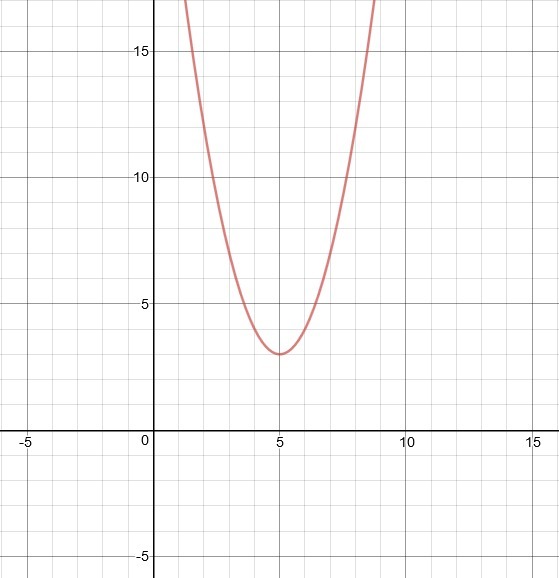
Which graph represents the function f(x) = (x – 5)2 + 3?
Inessa [12570]
The function
f(x)=(x-5)^2+3
represents a parabola positioned at the vertex (5, 3).

Attached here is the graph depicting this function.

4 0
2 months ago
Read 2 more answers
On a coordinate plane, a curved line labeled f of x with a minimum value of (1.9, negative 5.7) and a maximum value of (0, 2), c
AnnZ [12381]

Answer: F(x) > 0 in the ranges (-0.7, 0.76) and (0.76, ∞).

I hope this is useful:)

5 0
1 month ago
Read 2 more answers
Other questions:
  • The height of a rocket a given number of seconds after it is released is modeled by h (t) = negative 16 t squared + 32 t + 10. W
    13·2 answers
  • Line AB and BC for a right angle at point B. If A(-3,4) and B(4,4) what is the equation of line BC?
    12·2 answers
  • Assemble the proof by dragging tiles to the statements and reasons columns.<br><br> PLEASE HELP
    9·2 answers
  • A child is hopping along a sidewalk. The ratio below shows the comparison between the number of hops and the distance traveled.
    9·1 answer
  • Which fraction lies between 0.70 and 0.75 on number line?
    14·1 answer
  • Kendal bought x boxes of cookies to bring to a party. Each box contains 12 cookies. She decides to keep two boxes for herself. S
    12·1 answer
  • The admission fee at a movie theater is $5 for children and $9 for adults. If 3200 people go to the movies and $24000 is collect
    9·1 answer
  • In the figure, ∆ABD ≅ ∆CBD by Angle-Side-Angle (ASA). Which segments are congruent by CPCTC?
    15·2 answers
  • Rita promises her daughter on her 12th birthday that she will give her $12,000 for college on her 18th birthday. How much does R
    12·2 answers
  • A bucket has a leak that started 6 hours ago. At time 0, when the bucket just emptied, a tap was turned on for 3 hours. The amou
    12·2 answers
Add answer
Login
Not registered? Fast signup
Signup
Login Signup
Ask question!