answer.
Ask question
Login Signup
Ask question
All categories
  • English
  • Mathematics
  • Social Studies
  • Business
  • History
  • Health
  • Geography
  • Biology
  • Physics
  • Chemistry
  • Computers and Technology
  • Arts
  • World Languages
  • Spanish
  • French
  • German
  • Advanced Placement (AP)
  • SAT
  • Medicine
  • Law
  • Engineering
den301095
1 month ago
8

Flowgorithm, Design a program that prompts the user to enter a number within the range of 1 through 10. The program should displ

ay the Roman numeral version of that number. If the number is outside the range of 1 through 10, the program should display an error message?

Computers and Technology
1 answer:
Rzqust [1K]1 month ago
6 0
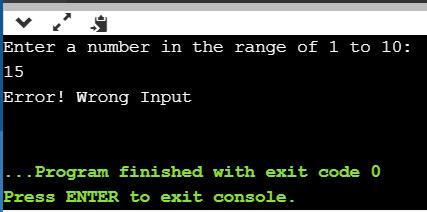
The provided explanation, including the step-by-step code, is as follows: We can approach this issue employing the if elif else model. def main(): # prompts the user to input an integer between 1 to 10 num = int(input('Enter a number in the range of 1 to 10:\n')) # utilizing if elif to display the roman numeral from 1 to 10 if num == 1: print('Roman Numeral for 1 is I') elif num == 2: print('Roman Numeral for 2 is II') elif num == 3: print('Roman Numeral for 3 is III') elif num == 4: print('Roman Numeral for 4 is IV') elif num == 5: print('Roman Numeral for 5 is V') elif num == 6: print('Roman Numeral for 6 is VI') elif num == 7: print('Roman Numeral for 7 is VII') elif num == 8: print('Roman Numeral for 8 is VIII') elif num == 9: print('Roman Numeral for 9 is IX') elif num == 10: print('Roman Numeral for 10 is X') # else to show error message for numbers outside the specified range else: print('Error! Wrong Input') # invoking the main function main() Output: Enter a number in the range of 1 to 10: 6 Roman Numeral for 6 is VI Enter a number in the range of 1 to 10: 15 Error! Wrong Input.
You might be interested in
You are a police officer trying to crack a case. You want to check whether an important file is in the evidence room. Files have
Harlamova29_29 [1022]

Answer:

Since RANDY operates randomly, any file within the specified index range will have the recurrence relation as follows:

T(n) = T(n-i) + O(1)

Here, the probability is 1/n, where i can vary between 1 and n. The variable n in T(n) denotes the size of the index range, which will subsequently reduce to (n-i) in the following iteration.

Given that i is probabilistically distributed from 1 to n, the average case time complexity can then be expressed as:

T(n) = \sum_{i=1}^{n}\frac{1}{n}T(n-i) + O(1) = T(n/2)+O(1)

Next, solving T(n) = T(n/2) + O(1)

yields T(n) = O(log n).

Thus, the complexity of this algorithm is O(log n).

It should be noted that this represents the average time complexity due to the algorithm's randomized nature. In the worst-case scenario, the index range may only decrease by 1, resulting in a time complexity of O(n) since the worst-case scenario would be T(n) = T(n-1) + O(1).

3 0
2 months ago
Read 2 more answers
Write a program that creates a login name for a user, given the user's first name, last name, and a four-digit integer as input.
Amiraneli [1052]

Answer:

In C++:

#include <iostream>

#include <string>

#include <sstream>

using namespace std;

int main(){

   string lname, fname, stringnum;    int num; string login, pwd;

   cout<<"Last Name: ";    cin>>lname;

   cout<<"First Name: ";    cin>>fname;

   cout<<"Four-digit integer: ";    cin>>num;

   stringnum = to_string(num).substr(0, 4);

   stringstream geek(stringnum);    geek>>num;

   num = num%100;

   pwd = to_string(num);

   if(lname.length()<5){ login = lname + fname.substr(0, 1);    }

   else{ login = lname.substr(0, 5) + fname.substr(0, 1);    }

   cout<<"Login Name: "<<login<<endl;

   cout<<"Password: "<<pwd<<endl;

   return 0;

}

Explanation:

This initializes all the required variables

   string lname, fname, stringnum;    int num;     string login, pwd;

This asks the user for their last name

   cout<<"Last Name: ";    cin>>lname;

This asks for the first name of the user

   cout<<"First Name: ";    cin>>fname;

This prompts for a four-digit number

   cout<<"Four-digit integer: ";    cin>>num;

This converts the number into a string and extracts the first four digits

   stringnum = to_string(num).substr(0, 4);

This changes the string back into an integer

   stringstream geek(stringnum);    geek>>num;

This extracts the last two digits of the four-digit number

   num = num%100;

This generates the user's password

  pwd = to_string(num);

This constructs the user's login name.

This block runs if the last name has fewer than five letters

   if(lname.length()<5){ login = lname + fname.substr(0, 1);    }

This block runs otherwise

   else{ login = lname.substr(0, 5) + fname.substr(0, 1);    }

This displays the login name

   cout<<"Login Name: "<<login<<endl;

This displays the password

   cout<<"Password: "<<pwd<<endl;
3 0
2 months ago
8. In time series, which of the following cannot be predicted? A) large increases in demand B) technological trends C) seasonal
Natasha_Volkova [1026]

Answer: Random fluctuations.

Explanation: A time series consists of data points ordered chronologically, arranged in equal intervals. Typically, this data sequence is systematic and has defined intervals. However, there’s no allowance for randomness, making unpredictable variations, or random fluctuations, absent in such series. Thus, option (D) is the correct choice.

6 0
2 months ago
A company is performing an analysis on the computers at its main office. The computers are spaced along a single row. The analys
oksian1 [950]

Answer:

array = input("Enter the list of computer memory: ").split(',')

int_arr = [int(x) for x in array]

segment = int(input("Enter the length of segment to analyze: "))

list_len = len(int_arr)

segList = []

mini = []

for x,i in enumerate(int_arr):

   seg = int_arr[i-1:segment+i-1]

   if len(seg) == segment:

       segList.append(seg)

for x in segList:

   mini.append(min(x))

result = mini.index(min(mini))

print("Segment with the minimum memory is: ",segList[result])

Explanation:

This Python program outputs the segment after evaluating, which has the lowest disk storage space. It collects the computer memory array based on user input and divides it according to the specified segment length, then compares the minimum across all segments.

5 0
3 months ago
Other questions:
  • Which of the following is true of how computers represent numbers?
    9·2 answers
  • Assume that getPlayer2Move works as specified, regardless of what you wrote in part (a) . You must use getPlayer1Move and getPla
    14·1 answer
  • array of String objects, words, has been properly declared and initialized. Each element of words contains a String consisting o
    11·1 answer
  • Write a program that prompts the user for an integer, then asks the user to enter that many values. Store these values in an arr
    14·1 answer
  • Your computer uses 4 bits to represent decimal numbers (0, 1, 2, 3 and so on) in binary. What is the SMALLEST number for which a
    8·1 answer
  • Write lines of verse that rhyme to remember the following information:
    16·2 answers
  • Write a MATLAB function named average_of_scores_with_drops The function will have two inputs and two return values. The first in
    11·1 answer
  • Write a statement that defines an ifstream object named inputFile and opens a file named "Friends.txt".
    13·1 answer
  • Stan’s assignment is to print a three-dimensional image on a piece of paper. Which printing technique should he use?
    14·2 answers
  • ​<br><br> Access from and output to the register is slow true false​
    5·1 answer
Add answer
Login
Not registered? Fast signup
Signup
Login Signup
Ask question!
