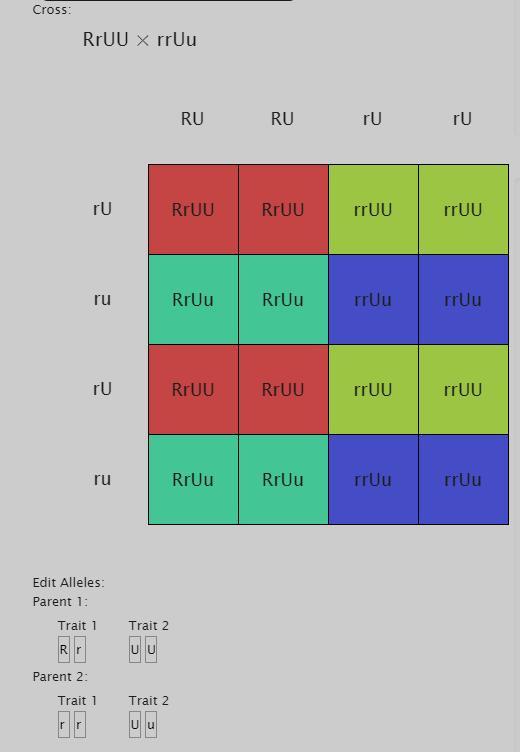
Response:
F1 generation: RrUu, rrUU, rrUu, RrUU
25%: 25%: 25%: 25%
Ratios
- genotype: 1: 1: 1: 1...(derived from punnet square)
- phenotype: 1: 1
Clarification:
Punnett squares serve as a visual tool to determine the traits of hybrid offspring produced through genetic crosses. The genotypes and phenotypes of the parents are typically well understood, conforming to typical Mendelian ratios and inheritance patterns.
The study of Mendelian genetics emphasizes the origin or transmission of traits. Traits are contained within gametes produced individually and may exhibit dominance, such that one trait can obscure the expression of another.
These principles are referred to as the Law of Segregation, Independent assortment, and Dominance, respectively.
In this instance... Assumptions:
Unattached lobes are dominant
- The ability to roll the tongue is dominant
- Parent generation or P generation:
Gametes:
R → rolling trait (R), non-rolling trait (r)
U → unattached trait (U), attached trait (u)
P generation: RUrU× rUru
rolling, unattached × non-rolling, unattached
F1 generation: RrUu, rrUU, rrUu, RrUU
25%: 25%: 25%: 25%
Ratios
- genotype: 1: 1: 1: 1...(from punnet square)
- phenotype: 1: 1
Half of the offspring will have unattached lobes and the ability to roll their tongues, while the other half will have unattached lobes but will be unable to roll their tongues...
Each punnet cross is attached below