Answer:
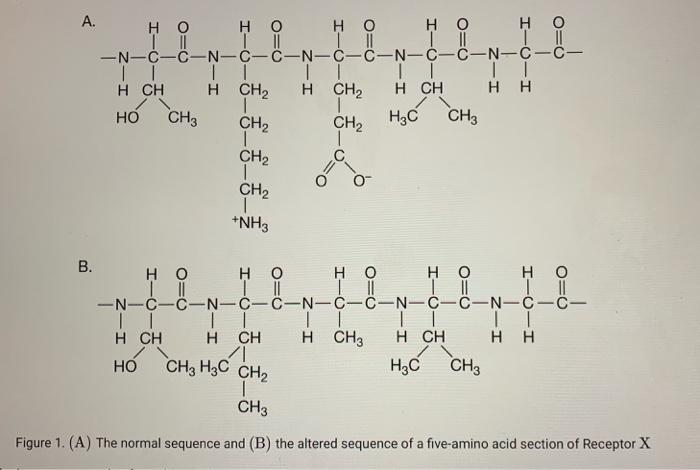
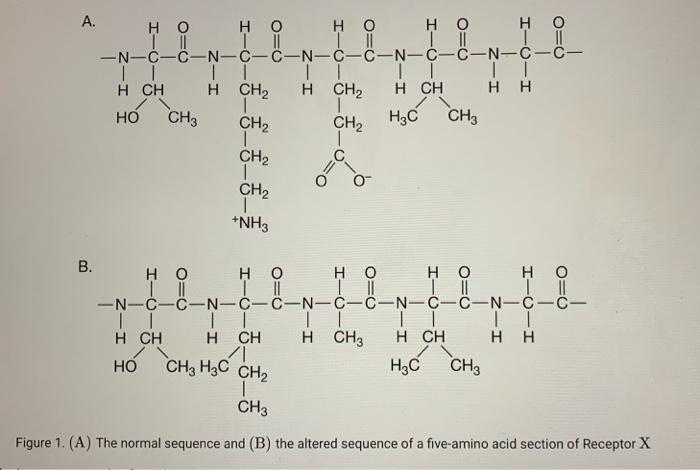
Receptor X has altered shape due to the substitution of amino acids that exhibit charged, ionic, or hydrophilic R-groups with two amino acids that possess uncharged, nonpolar, or hydrophobic R-groups.
Explanation:
The characteristics of amino acids are determined by their R-groups or side chains. R-groups that are polar or hydrophilic make the amino acids hydrophilic, enabling interactions with polar environments such as the extracellular matrix or cytosol.
On the other hand, R-groups that are non-polar or hydrophobic make amino acids hydrophobic, resulting in an orientation that positions them towards the internal part of a protein, specifically influencing protein tertiary structure.
According to the provided image, the original sequence of amino acids is Threonine - Lysine - Glutamate - Valine - Glycine, while the modified sequence is Threonine - Isoleucine - Alanine - Valine - Glycine.
Lysine and Glutamate are polar amino acids likely situated on the protein's exterior, whereas Isoleucine and Alanine are non-polar and would be located inside. Consequently, this sequence alteration induces a conformational shift in receptor X.