answer.
Ask question
Login Signup
Ask question
All categories
  • English
  • Mathematics
  • Social Studies
  • Business
  • History
  • Health
  • Geography
  • Biology
  • Physics
  • Chemistry
  • Computers and Technology
  • Arts
  • World Languages
  • Spanish
  • French
  • German
  • Advanced Placement (AP)
  • SAT
  • Medicine
  • Law
  • Engineering
frez
1 month ago
6

Question 20 a raindrop has a mass of 50.mg and the pacific ocean has a mass of ×7.081020kg . use this information to answer the

questions below. be sure your answers have the correct number of significant digits.

Chemistry
2 answers:
Tems11 [2.7K]1 month ago
8 0

The two questions to be addressed are:

1) What is the mass of one mole of raindrops?

2) How many moles of raindrops exist within the Pacific Ocean?

Solutions:

1) Calculating the mass of one mole of raindrops:
Mass = number of raindrops × mass per raindrop.
Since one mole contains 6.02 × 10^23 particles,
Mass of one mole of raindrops = 6.02 × 10^23 raindrops × 50 mg × (1 kg / 1,000,000 mg) = 3.01 × 10^19 kg.
Because 50. mg has two significant digits, final answer must be rounded to two significant digits as 3.0 × 10^19 kg.

2) Number of moles in the Pacific Ocean:
Using proportionality 1 mol / 3.0 × 10^19 kg = x mol / 7.08 × 10^20 kg,
solve for x:
x = (7.08 × 10^20 kg) × (1 mol) / (3.0 × 10^19 kg) = 23.6 mol,
which rounds to 24 moles with two significant digits.

KiRa [2.9K]1 month ago
7 0

1. Mass of one mole of raindrops = 3.0 × 10¹⁹ kg

2. Pacific Ocean contains 24 moles of raindrops

Explanation

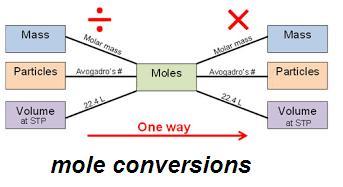
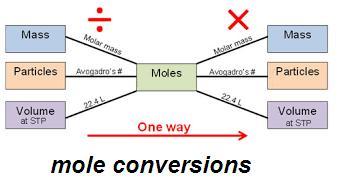
A mole represents a quantity of particles (atoms, molecules, ions), equal to the number of atoms in 12 grams of Carbon-12, which is 6.02 × 10²³ particles.

The number of moles can be found by dividing mass (in grams) by the relative atomic or molecular mass.

\large{\boxed{\bold{mole\:=\:\frac{grams}{the\:relative\:mass\:of\:elements\:or\:the relative\:mass\:of\:molecules} }}}

Tasks:

  • 1. Calculate the mass of one mole of raindrops
  • 2. Determine how many moles of raindrops are in the Pacific Ocean

1. Each raindrop weighs 50 mg (which is 5.0 × 10⁻² g). One mole contains 6.02 × 10²³ raindrops, so total mass is:

6.02 × 10²³ × 5.0 × 10⁻² = 3.01 × 10²² g

Rounded to two significant figures: 3.0 × 10²² g = 3.0 × 10¹⁹ kg

2. The Pacific Ocean mass is approximately 7.08 × 10²⁰ kg, so the number of moles is:

7.08 × 10²⁰ kg ÷ 3.0 × 10¹⁹ kg/mole = 23.6 moles

Rounded to two significant figures, that is 24 moles.

Further reading

Electrons in a pure gold coin

brainly.com/question/5354719

Moles of water

brainly.com/question/1405182

Moles of NaOH

brainly.com/question/4283309

Keywords: mole, raindrop, mass, Avogadro, significant figures

You might be interested in
Consider the following system at equilibrium:
VMariaS [2998]

Answer:

A - Increase (R), Decrease (P), Decrease(q), Triple both (Q) and (R)

B - Increase(P), Increase(q), Decrease (R)

C - Triple (P) and cut (q) down to a third

Explanation:

According to the principle of Le Chatelier, when a system reaches equilibrium and a change is introduced, the system will respond to counteract that change.

Since P and Q are reactants, raising the amount of either one or both without a proportional rise in R (which is a product) will cause the equilibrium to move towards the right. Similarly, if R decreases while P and Q remain constant, this too will push the equilibrium to the right. Thus, Increase(P), Increase(q), and Decrease(R) will lead to a rightward shift in the equilibrium.

Conversely, raising R without increasing P and Q will draw the equilibrium to the left. Likewise, cutting down P and/or Q without a similar reduction in R will shift the equilibrium leftward. Therefore, Increase(R), Decrease(P), Decrease(q), and triple both (Q) and (R) will shift the equilibrium to the left.

If there are equivalent changes in P and Q, with R remaining unchanged, then the equilibrium remains stationary. So, tripling (P) while reducing (q) to one third will not alter the equilibrium.

6 0
1 month ago
If your lungs were filled with air containing this level of lead, how many lead atoms would be in your lungs? (Assume a total lu
Tems11 [2777]
A total of 1.505×10^23 lead atoms

In the lungs, the volume of lead equals the total lung volume, which is 5.60L

1 mole corresponds to 22.4L

Thus, 5.6L of lead converts to 5.6/22.4 = 0.25 moles

According to Avogadro's law

1 mole of lead contains 6.02×10^23 lead atoms

Thus, 0.25 moles of lead equates to 0.25×6.02×10^23 = 1.505×10^23 lead atoms

6 0
7 days ago
The phosphorylation of glucose to glucose 6-phosphate Group of answer choices is so strongly exergonic that it does not require
lions [2927]

Answer:

The process of converting glucose to glucose-6-phosphate is an endergonic reaction, which is coupled with the exergonic hydrolysis of ATP.

Explanation:

Within glycolysis, the phosphorylation of glucose to glucose-6-phosphate occurs first, facilitated by the hexokinase enzyme. This reaction is endergonic. This phosphorylation is a coupled reaction tied to ATP hydrolysis, where the free energy released by ATP hydrolysis drives glucose phosphorylation.

5 0
17 days ago
A student reported to her instructor that her unknown contained salt, salicylic acid, and sand. In reality the unknown contained
lorasvet [2795]
From the provided data, the unknown mixture was composed of salt, salicylic acid, and sand. It is understandable that the student suspected the presence of sand, yet scientific experimentation must verify such assumptions. The test involving salt and salicylic acid reveals that salt dissolves in water, while salicylic acid is only slightly soluble, and sand does not dissolve at all. By introducing the unknown into water, the salt would dissolve first, followed by the partial dissolution of salicylic acid. Heating the mixture could allow for the evaporation of salicylic acid, resulting in the remaining salt. If traces of sand were observed in the dissolved sample, it could suggest contamination.
8 0
16 days ago
For the following equilibrium: A+2B⇋C+3D If the change in concentration for B is 0.44 M, what will be the change in concentratio
Anarel [2989]
0.22 M
5 0
1 month ago
Other questions:
  • a nurse practitioner orders Medrol to be given 1.5 mg/kg of body weight. if a child weighs 72.6lb and the available stock of Med
    6·1 answer
  • A laboratory utilizes a mixture of 10% dimethyl sulfoxide (DMSO) in the freezing and long-term storage of embryonic stem cells.
    5·1 answer
  • Write a hypothesis for Part II of the lab, which is about the type of material an object is made of, and its ability to absorb o
    15·2 answers
  • a sample of water with a mass of 648.00 kg at 298 K is heated with 87 kh of energy. the specific heat of water is 1 J-1 kg K-1.
    9·2 answers
  • HIPVs can cause what two more severe illnesses?
    11·1 answer
  • Chloe wants to lighten the color of her dark hair, which will require the use of both haircolor and hydrogen peroxide. hydrogen
    15·1 answer
  • You are standing on the rim of a canyon, you drop a rock and in 7.0 seconds hear the sound pof it hitting the bottom, how deep i
    13·1 answer
  • How much water must be added to 36.0 g of srcl2 to produce a solution that is 35.0 wt% srcl2? how much water must be added to 36
    14·1 answer
  • A substance is 35.7% carbon by mass. How much carbon could be recovered from 769 g of the substance? 1. 180 mol 2. 258 mol 3. 22
    8·1 answer
  • Compound A and Compound B are binary compounds containing only elements X and Y. Compound A contains 1.000 g of X for every 2.10
    15·2 answers
Add answer
Login
Not registered? Fast signup
Signup
Login Signup
Ask question!