Answer:
a. 13%
b. 20%
c. 2%
Step-by-step explanation:
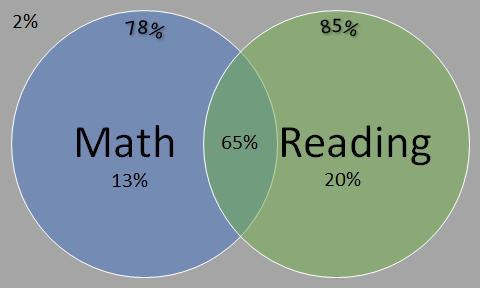
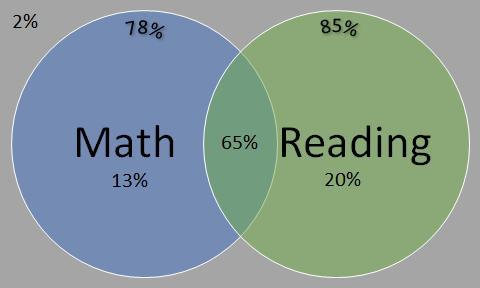
To tackle this problem effectively, drawing a Venn diagram is recommended. Create a rectangle representing all fourth-graders, and include two overlapping circles within it. One circle should indicate reading proficiency, occupying 85% of the total area (including the overlap), while the other represents math proficiency, covering 78% of the area (including overlap). The intersection accounts for 65% of the total.
a. Given that 65% is the overlap and 78% are proficient in math, the percentage of students proficient in math but not in reading is calculated by:
78% − 65% = 13%
b. Since the overlap is 65% and 85% are proficient in reading, the percentage proficient in reading but not math is obtained by:
85% − 65% = 20%
c. To find the percentage of students who are not proficient in either reading or math, subtract the percentages of those proficient in only reading, only math, and both from 100%:
100% − 20% − 13% − 65% = 2%
Refer to the diagram provided (not to scale).