answer.
Ask question
Login Signup
Ask question
All categories
  • English
  • Mathematics
  • Social Studies
  • Business
  • History
  • Health
  • Geography
  • Biology
  • Physics
  • Chemistry
  • Computers and Technology
  • Arts
  • World Languages
  • Spanish
  • French
  • German
  • Advanced Placement (AP)
  • SAT
  • Medicine
  • Law
  • Engineering
lozanna
1 month ago
13

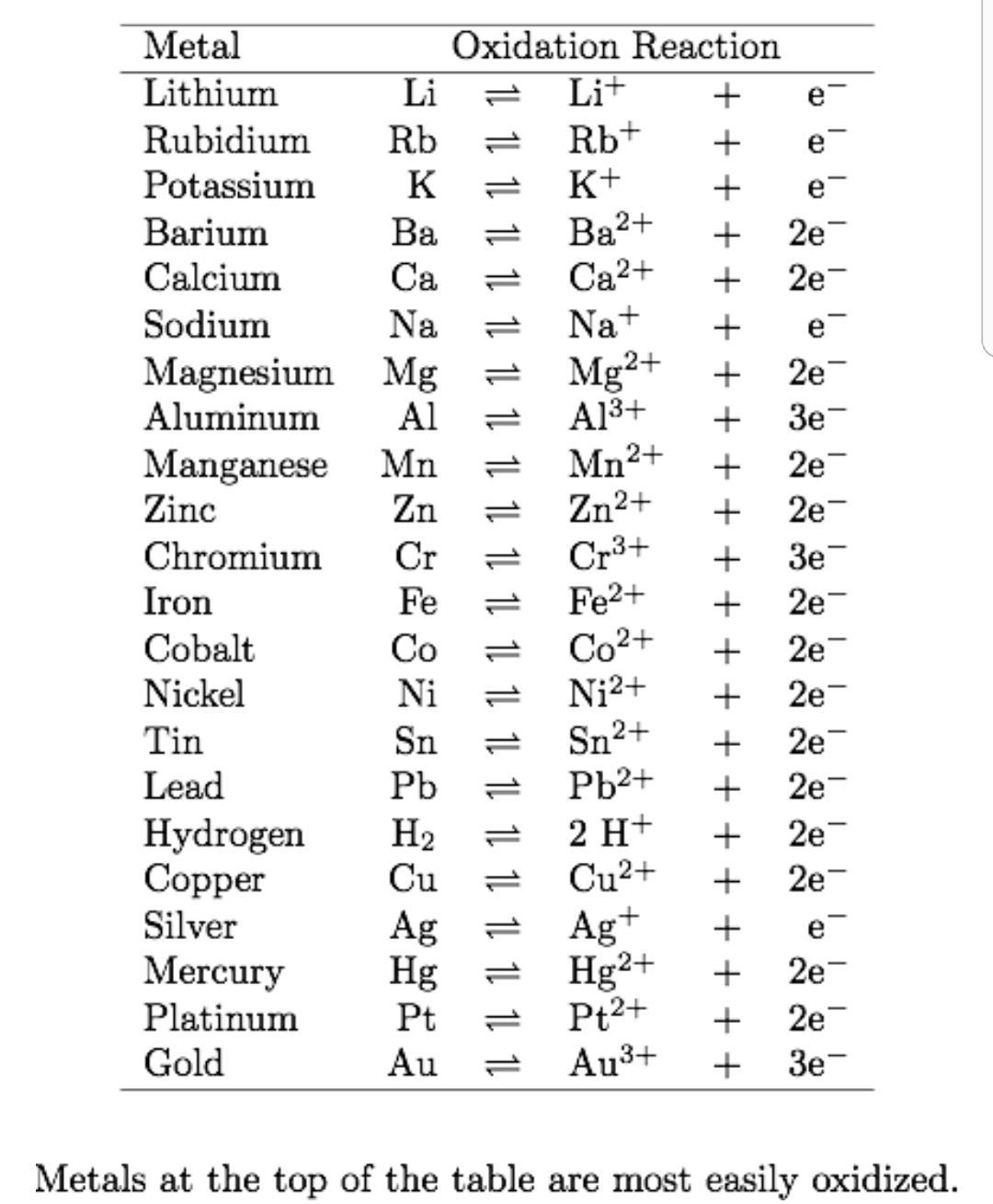
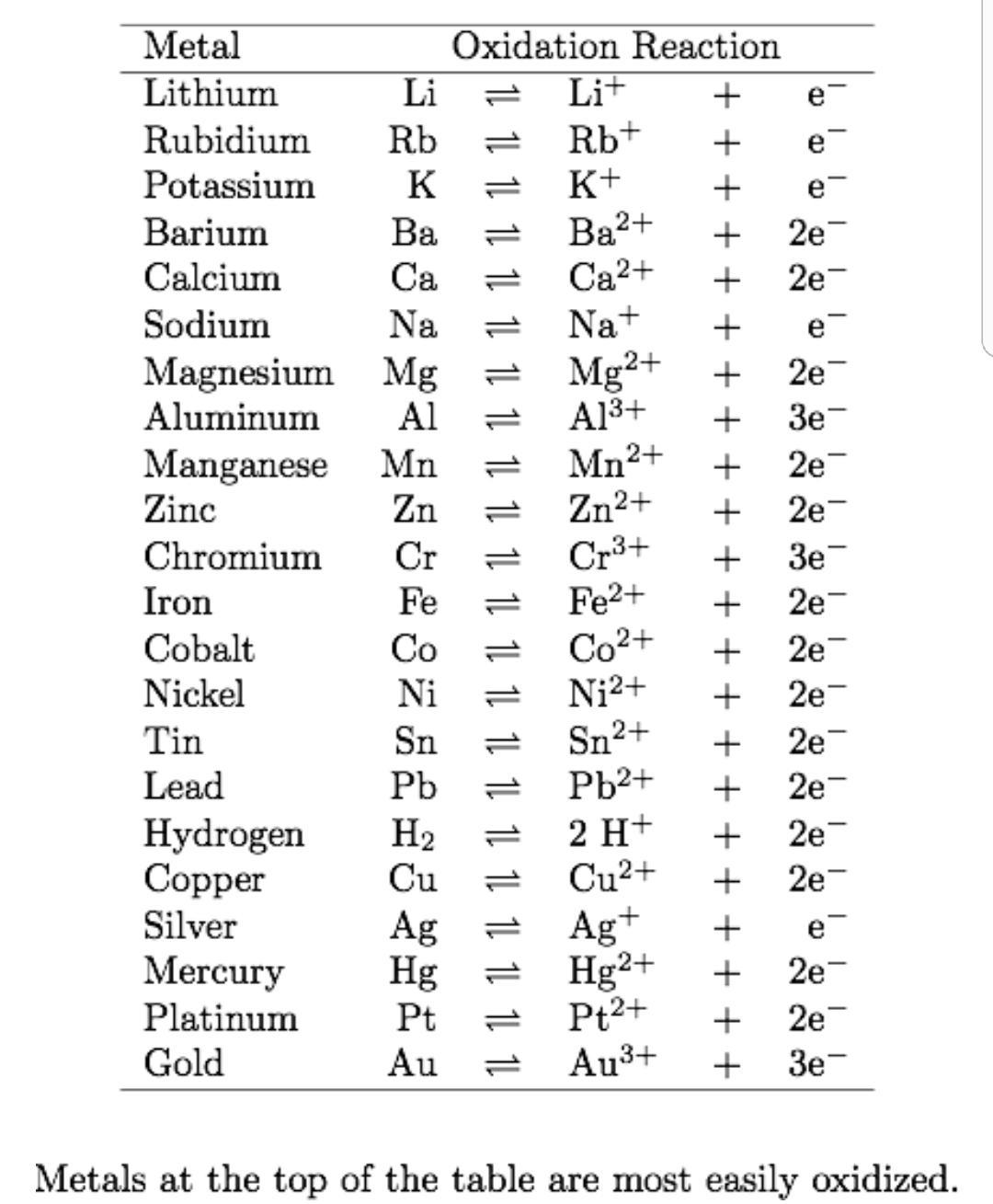
Which pairs of reactants will result in a chemical reaction? Refer to the activity series as needed. Pb ( s ) + MgCl 2 ( aq ) Pb

(s)+MgCl2(aq) Al ( s ) + AgClO 3 ( aq ) Al(s)+AgClO3(aq) Cd ( s ) + CuNO 3 ( aq ) Cd(s)+CuNO3(aq) Pt ( s ) + CoBr 2 ( aq )

Chemistry
1 answer:
alisha [2.8K]1 month ago
4 0

Answer:

Al (s) + AgClO3 (aq) will undergo a chemical reaction.

Al(s) + 3AgClO₃(aq) -----> Al(ClO₃)₃(aq) + 3Ag(s)

Cd(s) + CuNO3(aq) will also engage in a chemical reaction.

Cd(s) + 2CuNO₃ -----> Cd(NO₃)₂ + 2Cu

Explanation:

In chemical reactions, metal elements positioned lower in the activity series typically cannot replace those positioned higher in the series.

Metals located lower on the activity series are less likely to oxidize.

The activity series is referenced in this solution. (Note: While Cadmium is not directly illustrated, it falls between Iron (Fe) and Cobalt (Co) within the series.)

- Lead is significantly lower than Magnesium in the activity series, so it cannot displace Mg2+ ions in a solution.

- Aluminium ranks higher than Silver in the series; thus, it can easily oxidize and replace Silver ions from its solution.

- Cadmium is capable of displacing Copper in solution since it ranks higher than Copper in the activity series.

- Platinum is unable to displace Cobalt from a solution, as it ranks lower than Cobalt in the activity series.

You might be interested in
Hydrogen has three isotopes with mass numbers of 1, 2, and 3 and has an average atomic mass of 1.00794 amu. This information ind
VMariaS [2860]

The answer is actually 3, believe me.

Explanation:

7 0
1 month ago
Read 2 more answers
Marianne designs an experiment involving electrically charged objects. She wants to know which objects will be attracted to a ne
castortr0y [2906]

Answer:

The generation of static electricity occurs when two surfaces are rubbed together. This process causes a transfer of electrons, resulting in a build-up of negative charge. For instance, when you shuffle on a carpet, the friction creates multiple contact points which allow electrons to move onto you, thus accumulating a static charge. Touching another individual or object can lead to a sudden discharge, experienced as an electric shock.

In a similar way, rubbing a balloon against your hair generates opposite static charges on both your hair and the balloon. As you gently pull the balloon away from your head, the attraction between these opposite charges can be observed, causing your hair to rise.

Materials

• Balloon

• Woolen item (like a sweater, scarf, or yarn ball)

• Stopwatch

• Wall

• Partner (optional)

Preparation

• Inflate the balloon and secure the end.

• Have your partner ready to time with the stopwatch.

Procedure

• Grip the balloon with minimal hand coverage, such as holding it with just your thumb and index finger, or by its tied neck.

• Rub the balloon on the wool item once, making sure to go in one direction only.

• Press the rubbed side of the balloon against the wall and let go. Is it adhering to the wall? If it's stuck, your partner should start the stopwatch to measure how long it stays there. If it doesn’t stick, continue to the next step.

• Briefly touch the balloon to a metal object. Why is this step necessary?

• Repeat this procedure, but each time increase the number of rubs against the woolly item, ensuring the direction remains the same (do not rub back and forth).

Observations and results

As you increase the number of times you rub the balloon on the woolly material, does the duration of its adhesion to the wall increase?

Wool is an excellent conductor; it easily relinquishes electrons. When you rub wool on a balloon, electrons move from the wool to the surface of the balloon, imparting a negative charge to the rubbed area. Balloons, made from rubber, act as insulators, which means not all areas of the balloon will have a negative charge—only where it was rubbed will have a negative charge, while the rest of the balloon remains neutral.

Once the balloon is sufficiently charged negatively by repeated rubbing, it will adhere to the wall. Though the wall typically has a neutral charge, its internal charges can realign such that a positively charged region can attract the negatively charged balloon. Since the wall is also an insulator, the charge does not dissipate instantly. However, when the balloon is in contact with a metal object, the excess electrons from the balloon flow into the metal quickly, making the balloon lose its attraction and peel away.

HOPE IT HELPS

PLEASE MARK ME BRAINLIEST

6 0
1 month ago
Read 2 more answers
The recommended daily allowance (rda of calcium is 1.2 g. calcium carbonate contains 12.0% calcium by mass. how many grams of ca
eduard [2645]
1) Calcium carbonate comprises 40.0% calcium by weight.
M(CaCO₃)=100.1 g/mol
M(Ca)=40.1 g/mol
w(Ca)=40.1/100.1=0.400 (which is 40.0%)!

2) The mass fraction mentioned is superfluous information.

3) The resulting solution is:

m(Ca)=1.2 g

m(CaCO₃)=M(CaCO₃)*m(Ca)/M(Ca)

m(CaCO₃)=100.1g/mol*1.2g/40.1g/mol=3.0 g
4 0
1 month ago
Read 2 more answers
The volume of a gas at 6.0 atm is 2.5 L. What is the volume of the gas at 7.5 atm at the same temperature?
castortr0y [2906]

Greetings!

The result is:

The new volume is: 2L

Rationale:

Because the temperature remains constant, we can apply Boyle's Law to solve this issue.

Boyle's Law stipulates that:

P_{1}V_{1}=P_{2}V_{2}

Where,

P is the gas's pressure.

V is the gas's volume.

According to the information provided:

V_{1}=2.5L\\P_{1}=6.0atm\\P_{2}=7.5atm

Let's put the values into the equation:

2.5L*6.0atm=7.5atm*V_{2}

2.5L*6.0atm=7.5atm*V_{2}\\\\V_{2}=\frac{2.5L*6.0atm}{7.5atm}=\frac{15L.atm}{7.5atm}=2L

Consequently, the new volume is: 2L

Wishing you a lovely day!

7 0
1 month ago
Enter the net ionic equation representing solid chromium (iii) hydroxide reacting with nitrous acid. express your answer as a ba
Anarel [2728]

The net ionic equation for the reaction between chromium (III) hydroxide and nitrous acid is:

Cr(OH)₃ (s) + 3H⁺ (aq) ⇒ Cr³⁺ (aq) + 3H₂O (l)

Additional Details

An electrolyte dissociates into ions in solution.

Chemical equations can also be represented with ionic species.

Strong electrolytes (fully ionized) are written as separate ions, whereas weak electrolytes (partially ionized) remain as intact molecules.

In ionic equations, spectator ions are those unchanged by the chemical process—they are present both before and after the reaction.

Removing these spectators results in the net ionic equation.

Gases, solids, and water (H₂O) are written as molecules, without ionization.

Therefore, only dissolved compounds are represented by their ions (aq).

The problem involves chromium (III) hydroxide reacting with nitrous acid.

The reaction occurring is:

Cr(OH)₃ (s) + 3HNO₂ (aq) ⇒ Cr(NO₂)₃ (aq) + 3H₂O (l)

Chromium (III) hydroxide is a solid and remains un-ionized, as does water.

Thus, the ionic equation is:

Cr(OH)₃ (s) + 3H⁺ (aq) + 3NO₂⁻ (aq) ⇒ Cr³⁺ (aq) + 3NO₂⁻ (aq) + 3H₂O (l)

The ion 3NO₂⁻ is a spectator ion; removing it yields the net ionic equation:

Cr(OH)₃ (s) + 3H⁺ (aq) ⇒ Cr³⁺ (aq) + 3H₂O (l)

5 0
1 month ago
Read 2 more answers
Other questions:
  • You've just solved a problem and the answer is the mass of an electron, me=9.11×10⁻³¹ kilograms. How would you enter this number
    5·1 answer
  • 45.0 g of Ca(NO3)2 are used to create a 1.3 M solution. What is the volume of the solution
    6·1 answer
  • A decorative "ice" sculpture is carved from dry ice (solid CO2) and held at its sublimation point of –78.5°C. Consider the proce
    10·1 answer
  • Determine the number of 3s electrons in na.
    12·1 answer
  • If a concentration of 10 fluorescent molecules per μm2of cell membrane is needed to visualize a cell under the microscope, how m
    5·1 answer
  • Convert 338 L at 63.0 atm to its new volume at standard pressure.
    14·1 answer
  • How many molecules of ethane (C2H6) are present in 0.334 g of C2H6?
    10·1 answer
  • Which of the following is most likely to form multiple (double or triple) bonds? 1. Li 2. Cl 3. N 4. H 5. F
    9·1 answer
  • H2PO4-(aq) ⇆ H+(aq) + HPO42-( which ion plays the role of hydrogen ion donor and which one plays the hydrogen ion acceptor in BP
    14·1 answer
  • A 10.1 g sample of NaOH is dissolved in 250.0 g of water in a coffee-cup calorimeter. The temperature increases from 23.0 °C to
    14·2 answers
Add answer
Login
Not registered? Fast signup
Signup
Login Signup
Ask question!