answer.
Ask question
Login Signup
Ask question
All categories
  • English
  • Mathematics
  • Social Studies
  • Business
  • History
  • Health
  • Geography
  • Biology
  • Physics
  • Chemistry
  • Computers and Technology
  • Arts
  • World Languages
  • Spanish
  • French
  • German
  • Advanced Placement (AP)
  • SAT
  • Medicine
  • Law
  • Engineering
SIZIF
21 day ago
8

In triangle JKL, sin(b°) = three fifths and cos(b°) = four fifths. If triangle JKL is dilated by a scale factor of 2, what is ta

n(b°)? triangle KL in which angle K is a right angle and angle L measures b degrees tan(b°) = five thirds tan(b°) = four thirds tan(b°) = three fourths tan(b°) = five fourths

Mathematics
1 answer:
Inessa [9K]21 day ago
6 0

Answer:

Tan(b°) = 3/4, which is equivalent to three fourths (C).

Step-by-step explanation:

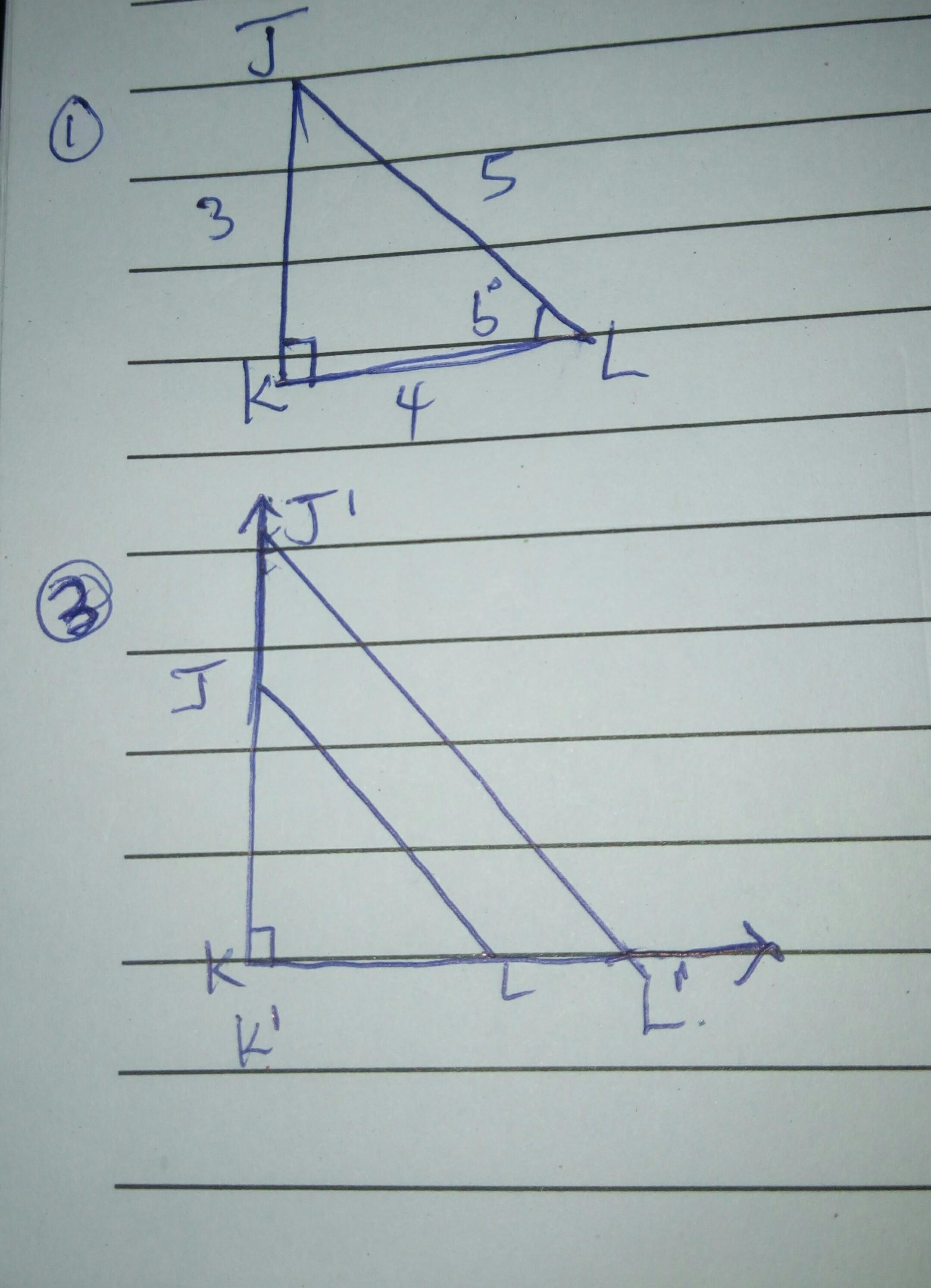
Triangle JKL is a right triangle with angle K being the right angle and angle L equal to b°.

We will employ SOHCAHTOA principles from trigonometry to calculate the sides' values.

For triangle ∆JKL:

Sin(b°) = opposite/hypotenuse

Sin(b°) = 3/5

Cos(b°) = adjacent/hypotenuse

Cos(b°) = 4/5

Tan(b°) = 3/4.

From the earlier information, we have the values for each side of triangle ∆JKL.

Please refer to the attached diagram for the triangle (1).

Triangle ∆JKL is scaled with a factor of 2.

This implies multiplying each side of ∆JKL by 2, resulting in:

Opposite side = 2(3) = 6

Adjacent side = 2(4) = 8

Hypotenuse = 2(5) = 10.

To find tan(b°) for the new triangle, we use the tangent ratio:

Tan(b°) = opposite/adjacent.

Tan(b°) = 6/8.

Tan(b°) = 3/4.

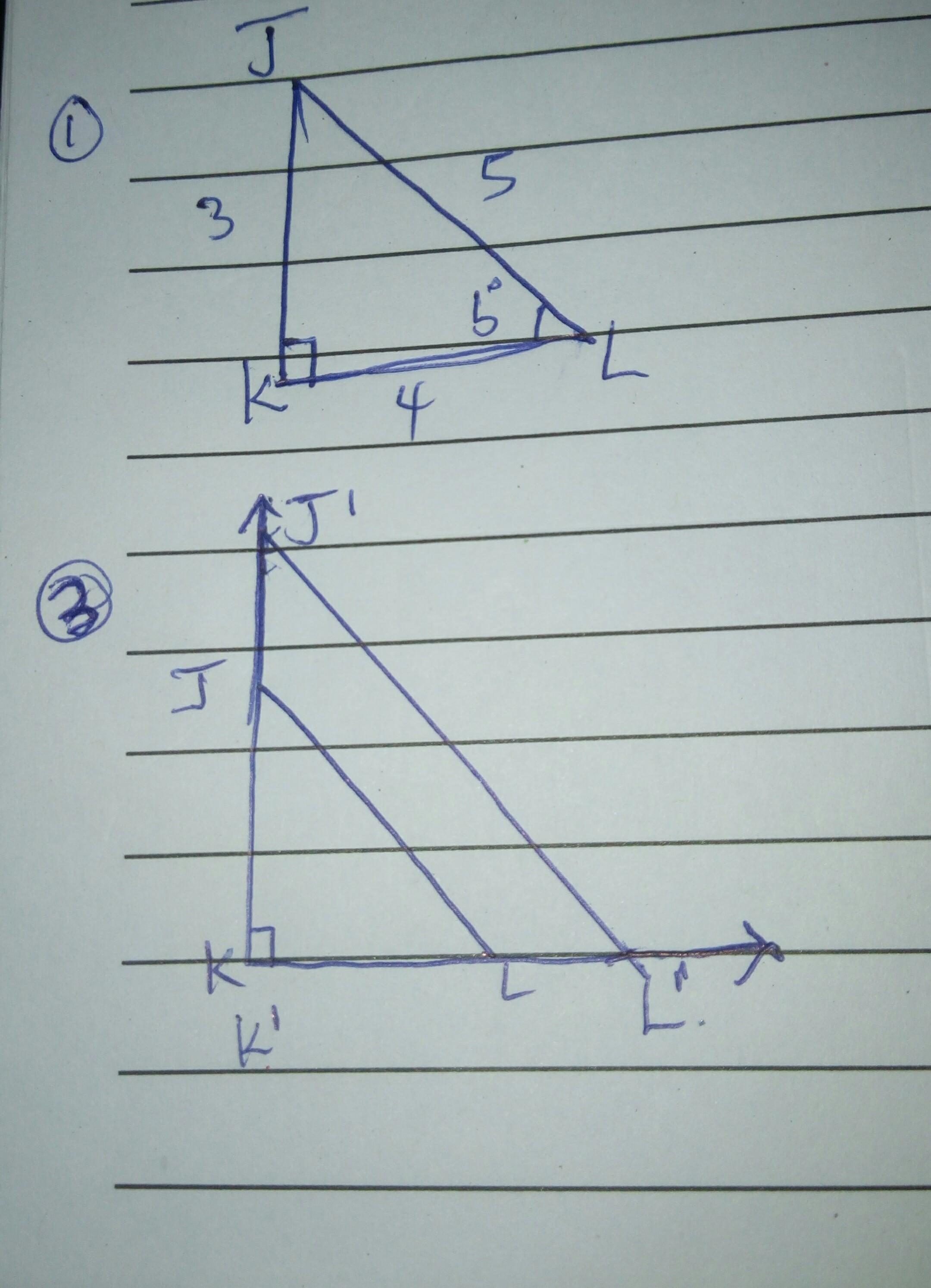
Find the diagram for the new triangle included (2).

Diagram 3 provides a depiction of both triangles.

As shown, the angle remains unchanged when a triangle is scaled by a factor.

Thus, we conclude that tan(b°) = three fourths (C).

You might be interested in
Alejandro surveyed his classmates to determine who has ever gone surfing and who has ever gone snowboarding. Let A be the event
tester [8851]

Answer:

\text{A and B are independent events}, P(A|B)=P(A)=0.16

Step-by-step explanation:

To establish independence between two events, we must understand the concept of independence:

Events are deemed independent if P(A|B)=P(A), which means that the occurrence of one does not influence the probability of the other event.

In this situation, the only selection that aligns with the independence criterion is P(A|B)=P(A)=0.16. Other options do not comply with the independent events definition.

4 0
18 days ago
Read 3 more answers
luna mixes 3/4 cup of orange juice with 3/8 cup of cranberry juice . she gives 5/8 cup of juice to mags . how much is left in lu
AnnZ [9117]
3/4 is equal to 6/8, and 3/8 plus 6/8 is 9/8. 9/8 minus 5/8 is 4/8 or 1/2.
8 0
4 days ago
Read 2 more answers
A student earns $7.50 per hour at her part-time job. She wants to earn at least $200.
Inessa [9009]

Answer: 7.50x should be greater than or equal to 200

Step-by-step explanation:

She aims to earn a minimum of $200.

5 0
21 day ago
Joe wants to paint the outside of a wooden box. He needs to find the surface area of the box
Zina [9184]

4 multiplied by 2 equals 8

4 multiplied by 1.5 equals 6

2 multiplied by 1.5 equals 3

8 multiplied by 2 equals 16

2 multiplied by 6 equals 12

2 multiplied by 3 equals 6

16 plus 12 plus 6 totals 34 ft

3 0
1 month ago
Read 2 more answers
An ANOVA procedure is used for data obtained from five populations. Five samples, each comprised of 20 observations, were taken
lawyer [9248]
E. All of the other options provided are incorrect. Step-by-step explanation: ANOVA, or analysis of variance, is employed to evaluate the variances among group averages within a dataset. The sum of squares is regarded as the total of squared deviations, defined as the distance between each individual observation and the overall mean. Assuming there are groups comprised of individuals, we can articulate the relevant variance formulas. In this instance, the numerator's degrees of freedom can be calculated as k - 1, where k equals the five groups. The denominator's degrees of freedom are determined through n - k, where n reflects the total number of observations across all groups. For this scenario, the numerator yields 4 and the denominator results in 95. Hence, E. None of the above answers is correct.
8 0
14 days ago
Other questions:
  • You toss a fair coin 10000 times. what are the odds of obtaining more than 5100 tails, approximately?
    6·1 answer
  • The sum of two polynomials is 8d5 – 3c3d2 + 5c2d3 – 4cd4 + 9. If one addend is 2d5 – c3d2 + 8cd4 + 1, what is the other addend?
    7·2 answers
  • You are given the coordinates of a triangle and
    10·2 answers
  • Assemble the proof by dragging tiles to the statements and reasons columns.<br><br> PLEASE HELP
    9·2 answers
  • Determine the rate of change for the equation.<br> 6y = 8x - 40
    5·1 answer
  • Which summation formula represents the series below? 13 + 9 + 5 + 1
    5·2 answers
  • 9. The purpose of statistical inference is to provide information about the.
    11·1 answer
  • Rate at which risk of down syndrome is changing is approximated by function r(x) = 0.004641x2 − 0.3012x + 4.9 (20 ≤ x ≤ 45) wher
    6·1 answer
  • Miranda bought a square frame that has an area of 30 square inches what is the approximate side lenght of the frame
    7·2 answers
  • Madame Dubois bought 20 pearl necklaces for $500. Becoming bored quickly, she sold 3/4 of them at $40 each. She sold the rest at
    7·2 answers
Add answer
Login
Not registered? Fast signup
Signup
Login Signup
Ask question!