answer.
Ask question
Login Signup
Ask question
All categories
  • English
  • Mathematics
  • Social Studies
  • Business
  • History
  • Health
  • Geography
  • Biology
  • Physics
  • Chemistry
  • Computers and Technology
  • Arts
  • World Languages
  • Spanish
  • French
  • German
  • Advanced Placement (AP)
  • SAT
  • Medicine
  • Law
  • Engineering
Stolb23
2 months ago
13

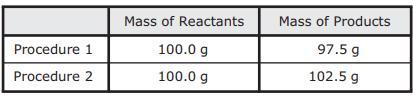
As part of an investigation, students combined substances in a beaker to observe chemical reactions. They performed two procedur

es. They measured the mass of each substance before and after each reaction. The table shows their observations.
Assuming the students did not make any careless errors, what likely explains these changes in mass?

A. Procedure 1: All the reactants were liquids that evaporated.
Procedure 2: A gas was formed as one product, and it escaped into the air.

B. Procedure 1: One of the reactants was converted to thermal energy.
Procedure 2: All the products were liquids.

C. Procedure 1: The reactants were liquids with different densities.
Procedure 2: The reactants were combined into only one product.

D. Procedure 1: One of the products was a gas that escaped into the air.
Procedure 2: A gas from the air reacted with one of the other reactants.

Chemistry
2 answers:
lorasvet [2.7K]2 months ago
8 0

Response:

D.

Justification:

KiRa [2.9K]2 months ago
3 0

Answer: it's D

Explanation: I took a test and answered correctly.

You might be interested in
Solving applied density problems Mr. Auric Goldfinger, criminal mastermind, intends to smuggle several tons of gold across Inter
KiRa [2933]

Answer:

thickness is 0.29 cm

Explanation:

To create a fake iron ball out of gold, we must ensure that its mass matches that of the iron ball. Therefore, we first find the volume of the iron ball using the provided diameter, applying the formula of 4/3 pi r^3.

Given the diameter d = 6 cm; thus, the radius r = 3 cm (d/2).

We calculate the volume of the iron ball: 4/3 * 3.14 * 3^3 = 113.04 cm^3.

The corresponding mass of the iron ball is the volume multiplied by its density: 113.04 * 5.15 g/cm^3 = 582.156 g.

This value represents the mass for the gold ball; now we determine the volume of the gold ball using its density.

Volume of gold ball = mass of gold ball/density of gold = 582.156 g/19.3 g/cm^3 = 30.1635 cm^3.

So this volume must correspond to a hollow sphere with an outer radius R = 3 cm and an unknown inner radius r.

Volume of the hollow ball can be represented as: 4/3 pi [R^3 - r^3].

Thus, 30.1635 cm^3 = 4/3 pi [3^3 - r^3].

30.1635 * 3/(4 * 3.14) = 27 - r^3.

Simplifying gives 7.2046 = 27 - r^3, resulting in r^3 = 19.7954.

Therefore, r = 2.7051 cm.

This indicates the thickness is the outer radius minus the inner radius: 3 - 2.7051 = 0.2949 cm.

Rounding to two significant figures yields

the thickness = 0.29 cm.
8 0
2 months ago
How much CO2 (L) is produced when 2.10 kg of sodium bicarbonate reacts with excess hydrochloric acid at 25.0 °C and 1.23 atm? A)
KiRa [2933]

The equation representing the reaction between sodium bicarbonate and hydrochloric acid is as follows:

NaHCO_3_(_s_) + HCl_(_a_q_) \implies NaCl_(_a_q_) + CO_2_(_g_) + H_2O_(_l_)

The substances NaHCO_3 and HCl combine in a 1:1 ratio. Therefore, we calculate the quantity of sodium bicarbonate and its molar mass to determine the moles formed.

NaHCO_3_M_r = 22.99 + 1.008 + 12.011+ 3 \times 16.0= 84.01 g/mol.

2.1kg\ NaHCO_3 \times \frac{1000g}{kg} \times \frac{mol}{84.01g/mol} = 24.997\ mol.

We also recognize that the stoichiometric proportions are 1:1:1:1:1, which leads to the conclusion that the moles of CO_2 equal 24.977 moles.

Next, we apply the ideal gas equation PV=nRT, where P denotes pressure, V refers to volume, R is the gas constant, and T represents the temperature in kelvins. We rearrange to solve for V

PV= nRT \implies V= \frac{nRT}{P}= \frac{ 24.997\ mol \times 8.2507m^3\ atm \times 298.15K }{mol \times K \times 1.23 atm} = 49967\ m^3

The final answer should be expressed in liters, 1L = 1000\ m^3, hence

49967\ m^3 \times\frac{L}{1000\ m^3} =49.97L\ CO_2\ produced

6 0
2 months ago
Read 2 more answers
Complete the passage: During the process of polymerization, combine by sharing electrons. This process forms a , which is made o
castortr0y [3046]
Monomers combine through electron sharing during the polymerization process. This leads to the formation of a polymer, which consists of repeating units. The resulting substance has various applications.
9 0
1 month ago
Read 2 more answers
which intensive physical property is observed when droppings of a person seated inside a closed room has able to reach a person
lions [2927]

Answer:

The correct answer is "Speed".

Explanation:

  • An intensive or individualized physical property is identified when "speed" is observed as the excretion of an individual in a confined area, capable of reaching someone one meter away after sneezing or coughing.
  • This measure is represented in the unit of "meter per second", indicating its intensive nature.
5 0
3 months ago
Other questions:
  • A person loses 2.70 lbs in two weeks how many grams did he lose?
    6·2 answers
  • a movable chamber has a volume of 18.5 L (at temperature of 18.5 C) assuming no gas escapes and the pressure remains constant wh
    6·1 answer
  • summarize what you read on the two articles by identifying the advantages and disadvantages of using plastics
    11·2 answers
  • An atom has an average atomic mass of about 24.3 amu. What is the chemical
    7·2 answers
  • A. Use average bond energies together with the standard enthalpy of formation of C(g) (718.4 kJ/mol ) to estimate the standard e
    11·1 answer
  • Which correctly summarizes the trend in electron affinity?it tends to be very high for group 2.it tends to be more negative acro
    6·2 answers
  • Write a brief passage describing a neutral atom of nitrogen-14 (N-14). Describe the number of protons, neutrons, and electrons i
    9·2 answers
  • Calculate the mass of hydrazine (N2H4) that contains a billion (1.000 x 10^9) hydrogen atoms.
    7·2 answers
  • A bird on a long migration flies 63 kilometers per hour for 2900 kilometers. How long does he fly?
    11·1 answer
  • What is the boiling point of cyclohexane at 620 mm hg?
    15·1 answer
Add answer
Login
Not registered? Fast signup
Signup
Login Signup
Ask question!
