answer.
Ask question
Login Signup
Ask question
All categories
  • English
  • Mathematics
  • Social Studies
  • Business
  • History
  • Health
  • Geography
  • Biology
  • Physics
  • Chemistry
  • Computers and Technology
  • Arts
  • World Languages
  • Spanish
  • French
  • German
  • Advanced Placement (AP)
  • SAT
  • Medicine
  • Law
  • Engineering
atroni
2 months ago
9

Scientists used cells called fibroblasts to study factors that cause nondividing cells in the G0 stage of the cell cycle to reen

ter the cell cycle and undergo mitosis. In a laboratory, fibroblasts typically grow and divide when they are cultured in a growth medium that contains 10% serum (the liquid part of blood that remains after blood clots). If fibroblasts are cultured for 48 hours in the absence of serum (serum-starvation), they stop dividing and enter the G0 stage of the cell cycle.
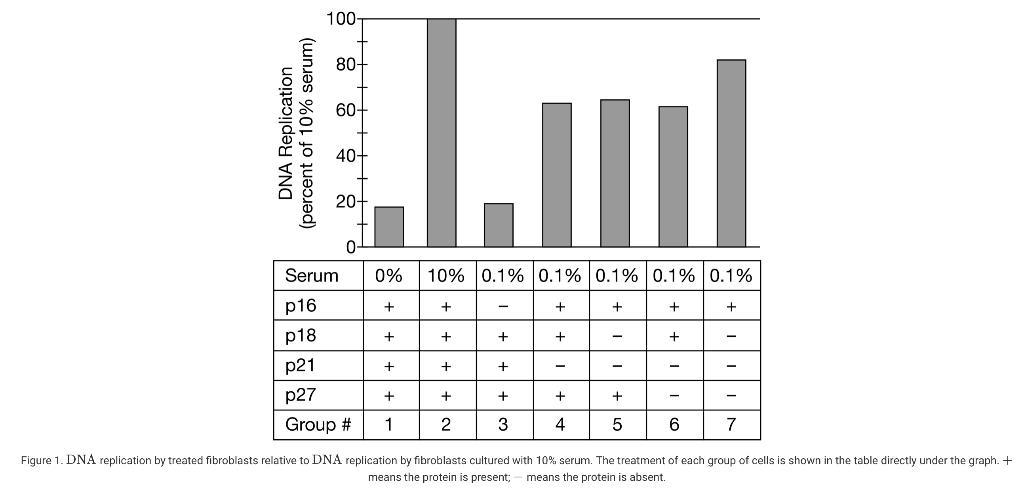
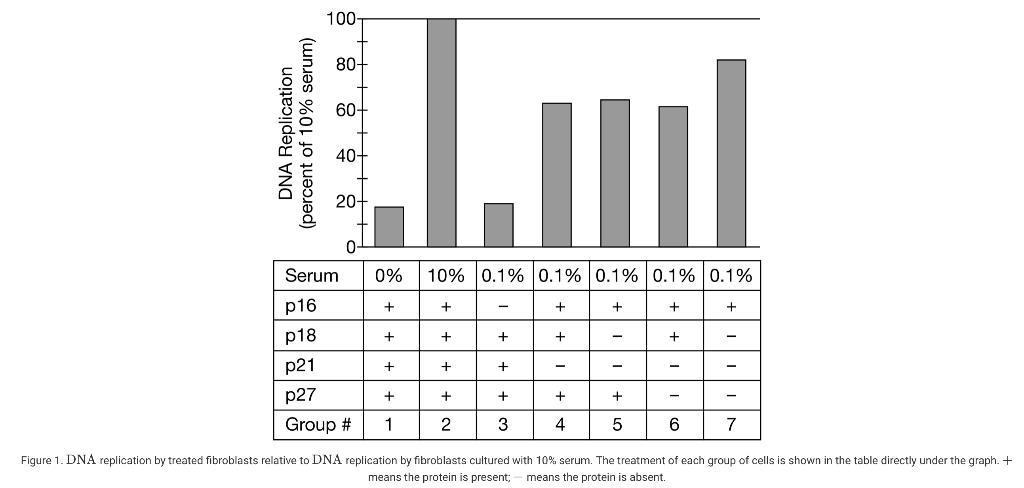
The scientists divided serum-starved fibroblasts into groups to which they added no serum, 10% serum, or 0.1% serum. Each of the groups with 0.1% serum was also treated to block the production of only one or combinations of four proteins (p16, p18, p21, and p27) that are inhibitors of cyclin-dependent kinases. The scientists grew the fibroblasts for 48 hours and then measured the amount of DNA replication taking place to determine whether the cells had reentered the cell cycle. The scientists compared each group of cells to the group cultured with 10% serum and plotted the data (Figure 1).

Figure 1. DNA replication by treated fibroblasts relative to DNA replication by fibroblasts cultured with 10% serum. The treatment of each group of cells is shown in the table directly under the graph. + means the protein is present; − means the protein is absent.
(a) Based on the data for the groups of cells cultured with 0.1% serum (groups 3 to 7), identify which of the four proteins tested do(does) not appear to play a role in blocking cell cycle entry by fibroblasts.


(b) Based on the data for the groups of cells cultured with 0.1% serum (groups 3 to 7), identify the groups(s) most likely to include cells undergoing mitosis.


(c) Neurons (nerve cells) of the central nervous system (brain and spinal cord) are in G0 of the cell cycle and generally do not divide in response to an injury. The scientists predict that they can use the data from this experiment to help them treat individuals who suffer from spinal cord injuries. Provide reasoning to support the scientists’ prediction.

Biology
1 answer:
Rainbow [2.3K]2 months ago
3 0

Answer:

a)

Based on observations from the cell groups, the protein p16 seems to have no significant role in preventing fibroblasts from entering the cell cycle. This finding is illustrated in group 7, where the DNA replication rate is nearly as high as that in the 10% serum condition, despite the presence of p16 alone.

In other groups (3 to 6), any additional proteins have always resulted in reduced DNA replication compared to fibroblasts cultured in 10% serum.

b)

Groups 4 to 7 demonstrate a higher likelihood of containing cells that are dividing, as evidenced by their increased DNA replication rates relative to group 1, which has 0% serum. This group, having been cultured for 48 hours without serum (serum-starvation), halts division and transitions into the G0 phase of the cell cycle.

c)

This data is pivotal in identifying which proteins trigger cellular entry into the cycle. For healing post-injury, cellular division and repair are crucial, which can be stimulated by the appropriate protein. Additionally, it will clarify which proteins hinder cell cycle entry.

Note: Figure is attached for reference

You might be interested in
The rate of demand for energy in the body determines whether the body will use aerobic or
Rainbow [2354]

Explanation:

Isabella: 50-meter freestyle - limited oxygen supply over a brief duration

  • anaerobic cellular metabolism
  • partial breakdown of glucose results in: lactic acid
  • yields 2 ATP molecules per gram of glucose

Tyler: half marathon- sufficient oxygen supply to tissues over an extended period

  • aerobic cellular metabolism
  • full glucose breakdown
  • yields 36 ATP molecules per gram of glucose
  • waste products: H2O, CO2

Further Explanation:

in summary: C6H12O6 (glucose) + 6 O2 → 6 CO2 + 6 H2O + ≈38 ATP

Mitochondria, which are small membrane-bound organelles in all eukaryotic cells, generate most of the chemical energy necessary for cellular biochemical processes. This energy is stored as ATP, which is synthesized in the mitochondria. ATP production through respiration in the mitochondria involves oxygen in the Krebs’ or Citric acid cycle, utilizing pyruvate oxidation (which occurs through glycolysis in the cytoplasm).

Oxidative phosphorylation refers to a mechanism where the NADH and FADH2 produced earlier in the respiration process donate electrons to the electron transport chain, reverting to their original forms, NADH+ and FAD. The flow of electrons through the chain releases energy that is utilized to pump protons out of the mitochondrial matrix.

This creates a gradient with a varying number of protons on each side of the membrane, allowing protons to flow back into the matrix via the ATP synthase enzyme, converting ADP into ATP. At the electron transport chain's conclusion, three oxygen molecules accept electrons and protons, culminating in water formation...

  • Glycolysis happens in the cytoplasm, using 2 ATP to split glucose into 2 pyruvates, yielding 4 ATP and 2 NADH molecules (resulting in a net ATP gain of 2)
  • The Citric acid or Krab cycle occurs in the mitochondrial matrix, producing 6 CO2 by combining oxygen with carbon from pyruvate, along with 2 ATP, 8 NADH, and 2 FADH2.
  • The electron transport chain operates at the inner mitochondrial membrane, generating 34 ATP, with electrons merging with H+ derived from 10 NADH and 4 FADH2, replenishing electron acceptors and 3 oxygens to yield 6 H2O, 10 NAD+, and 4 FAD.

In specific cellular conditions, aerobic respiration may be impeded due to various reasons:

  • - absence of inorganic final electron acceptors
  • - incomplete or non-existent electron transport system
  • - lack of necessary genes for enzymes in the Kreb's cycle

Consequently, cells resort to alternative methods for ATP energy production and to regenerate NAD+, an oxidized form of NADH that serves as the primary electron carrier during glycolysis. Pyruvate, generated in the cytoplasm through glycolysis, also acts as an electron acceptor in the fermentation process.

Learn more about cellular life at

Learn more about cellular respiration at

8 0
2 months ago
A population of ground squirrels has an annual per capita birth rate of 0.06 and an annual per capita death rate of 0.02. Using
Rainbow [2354]

Response:

Each year, the population increases by 40 squirrels.

Details:

The annual death rate is 0.02 per person, with a birth rate of 0.06. For a population of 1000, the annual deaths amount to 1000* 0.02 = 20. Conversely, the yearly births total 1000* 0.06 = 60. Therefore, the net addition to the squirrel population each year is 40.

5 0
1 month ago
How do energy and information cells relate to eachother
lana [2441]

Answer:

One could cheekily remark that both are cells.

7 0
2 months ago
Read 2 more answers
Consider the aquatic michigan food web. notice the non-native predator, the sea lamprey, at the top left corner. explain how the
s2008m [2378]
The sea lamprey is identified as a non-native species within Michigan's aquatic food web. This invasive species disrupts the ecosystem by competing for food resources with native predators. As competition increases, natural prey species will struggle with reproduction, likely leading to a sharp decline in their population, potentially resulting in extinction.
8 0
24 days ago
A group of students wants to study the rate of photosynthesis under various conditions. They use a blender to mechanically disru
11111nata11111 [2571]

Answer:

B

Explanation:

The statement that best elucidates the findings indicates that the rate of photosynthesis is maximal under direct sunlight and minimal under infrared light.

DPIP generally substitutes and fulfills the role of NADPH in the light-dependent reactions of photosynthesis. Thus, it becomes colorless due to reduction, and the rate of photosynthesis can be tracked based on the degree of the dark blue hue’s fading.

Consequently, the clearer the liquid in the illustration, the higher the rate of photosynthesis. The color transition progressed from dark blue to clear under direct sunlight, from dark blue to almost colorless under indirect sunlight, and from dark blue to slightly lighter under infrared exposure. This distinctly shows that the highest rate of photosynthesis occurs in direct sunlight, the lowest in infrared light, with indirect sunlight yielding an intermediate rate.

The correct answer is B.

4 0
19 days ago
Other questions:
  • Explain how to focus a microscope using the high-power lens. Include any safety issues you need to be aware of.
    13·2 answers
  • Choose the phrase that completes the passage. When Harrison is walking home from work, he is accosted by a group of teens. Harri
    14·2 answers
  • What are some shared characters among rabbits and perch?
    6·2 answers
  • Tyler has just been released from a drug rehabilitation center where he was treated for heroin addiction. His therapist recommen
    5·1 answer
  • 3. From problem 2, suppose another boy, Boy C pulls the heavy cabinet with 5 N
    11·1 answer
  • Drag the labels to complete these sentences discussing the relationship between the work of Louts Pasteur and Joseph Lister. In
    8·1 answer
  • Which term names the energy-containing molecule that is the immediate result of photosynthesis? A. ATP B. carbon dioxide C. wate
    12·1 answer
  • When Mendel crossed the pollen from a plant with green pods with a plant with yellow seed pods, all of the offspring had green s
    5·2 answers
  • How does an f+ cell differ from an hfr cell? how does an f+ cell differ from an hfr cell? hfr strains have the f plasmid integra
    15·1 answer
  • Organisms that live on land rarely compete for a.food B.space c.water b.oxygen
    7·2 answers
Add answer
Login
Not registered? Fast signup
Signup
Login Signup
Ask question!