answer.
Ask question
Login Signup
Ask question
All categories
  • English
  • Mathematics
  • Social Studies
  • Business
  • History
  • Health
  • Geography
  • Biology
  • Physics
  • Chemistry
  • Computers and Technology
  • Arts
  • World Languages
  • Spanish
  • French
  • German
  • Advanced Placement (AP)
  • SAT
  • Medicine
  • Law
  • Engineering
pychu
16 days ago
9

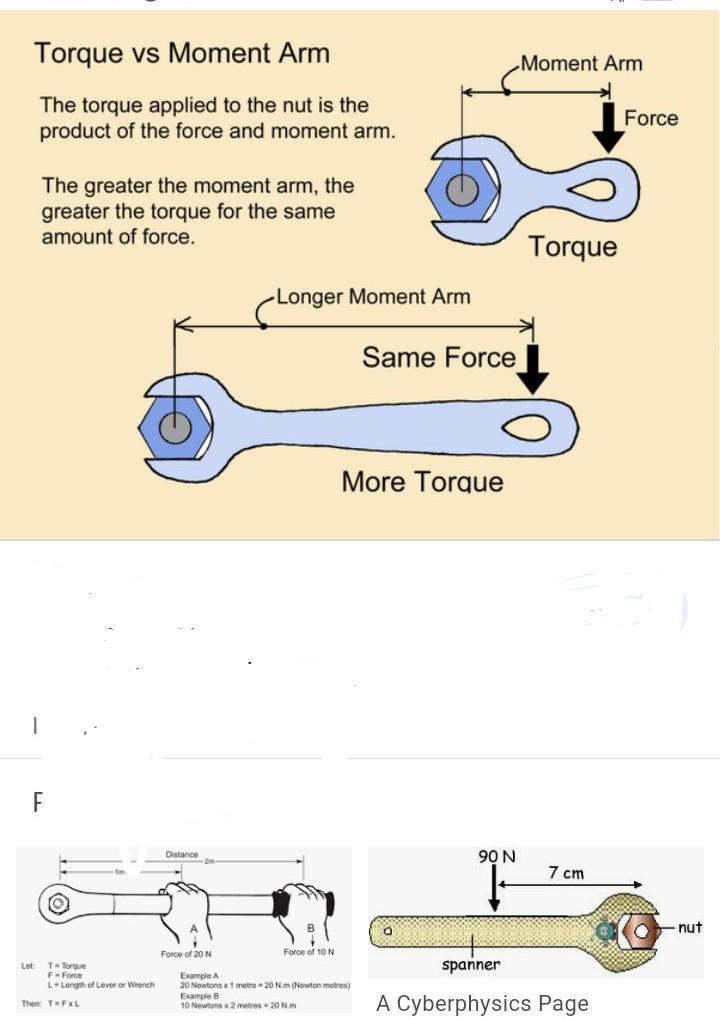
there is a rusted nut we have a two spanners each of i 15 cm and 20 CM respectively which spanner is suitable to open the nut an

d why​

Physics
1 answer:
Maru [2.3K]16 days ago
8 0

Answer:

A 20 cm spanner is appropriate for loosening this nut because it allows for greater leverage when applying force to the rusted nut. Increased perpendicular distance between the force and the axis of rotation results in a larger moment.

I believe this answer will assist you.....

Thank you ☺️☺️☺️

You might be interested in
A sculptor has asked you to help electroplate gold onto a brass statue. You know that the charge carriers in the ionic solution
Maru [2355]

Answer:

Explanation:

Amount of gold deposited = 0.5 g

Gold's molar mass = 197 g/mol

Time duration, t = 6 hours

= 6 × 3600

= 12600 s

Calculation of moles: mass/molar mass

= 0.5/197

= 0.00254 mole

Assuming

Au --> Au+ + e-

Faraday's constant = 9.65 x 10^4 C mol-1

Charge, Q = 96500 × 0.00254

= 244.924 C

Relation: Q = I × t

Thus, I = 244.924/12600

= 0.011 A

= 11.34 mA.

6 0
8 days ago
Ronnie kicks a playground ball with an initial velocity of 16 m/s at an angle of 40° relative to the ground. What is the approxi
Softa [2029]
The calculation for the horizontal component is performed as follows:
Vhorizontal = V · cos(angle)

For your instance, Vhorizontal = 16 · cos(40) equates to 12.3 m/s

Conclusion: 12.3 m/s
7 0
1 month ago
Read 2 more answers
A charged wire of negligible thickness has length 2L units and has a linear charge density λ. Consider the electric field E-vect
Softa [2029]

Answer:

E=2K\lambda d\dfrac{L }{d^2\sqrt{L^2+d^2}}

Explanation:

Consider the following:

Length= 2L

Linear charge density=λ

Distance= d

K=1/(4πε)

The electric field measured at point P

E=2K\int_{0}^{L}\dfrac{\lambda }{r^2}dx\ sin\theta

sin\theta =\dfrac{d}{\sqrt{d^2+x^2}}

r^2=d^2+x^2

Thus,

E=2K\lambda d\int_{0}^{L}\dfrac{dx }{(x^2+d^2)^{\frac{3}{2}}}

Now, by applying integration to the equation above

E=2K\lambda d\dfrac{L }{d^2\sqrt{L^2+d^2}}

4 0
25 days ago
Suppose a new asteroid was recently discovered which takes 557 months to orbit the Sun once (that's equal to 16,700 days or 46.4
Keith_Richards [2256]

Answer:

The average distance of the new asteroid from the Sun is estimated to be (2.02 × 10⁶) km.

Explanation:

The orbital speed of planets varies based on their distance from the Sun, which also affects their orbital period.

With its 557 months, equivalent to 46.4 years for an orbit around the Sun, the new asteroid's speed is situated between the orbital speeds of Saturn and Uranus.

Uranus orbits the Sun in 84 years at 24.61 km/hour,

while Saturn completes its orbit in 29.4 years at 34.82 km/hour.

To interpolate the speed for our asteroid at 46.4 years,

we denote its speed as x.

84 years ----> 24.61 km/h

46.4 years ----> x km/h

29.4 years -----> 34.82 km/h

Setting up the proportion:

(84 - 46.4)/(46.4 - 29.4) = (24.61 - x)/(x - 34.82)

Solving for x gives the asteroid's speed as 31.64 km/hr.

To find the average speed, use the formula:

Average speed = (total distance)/(time taken).

The total distance covered equals the circumference of the orbit around the Sun = 2πR,

where R = distance from the asteroid to the Sun.

Time taken = 16700 days = 16700 × 24 hours = 400800 hours.

Thus, we find that 31.64 = (2πR)/400800.

From this, we get 2πR = 31.64 × 400800 = 12681312 km.

And, R = 12681312/(2π) = 2018293.5 km = (2.02 × 10⁶) km.

8 0
18 days ago
Assume you are driving 20 mph on a straight road. Also, assume that at a speed of 20 miles per hour, it takes 100 feet to stop.
Maru [2355]

Answer:900 feet

Explanation:

Given

Velocity \left ( V_1\right )=20 mph\approx 29.334 ft/s

It takes 100 feet to come to a stop.

Utilizing the equation of motion

v^2-u^2=2as

Where

v,u=Final and initial velocities

a=acceleration

s=distance traveled

0-\left ( 29.334\right )^2=2\left (-a\right )\left ( 100\right )

a=\frac{29.334^2}{2\times 100}=4.302 ft/s^2

When the speed is 60 mph \approx 88.002 ft/s

v^2-u^2=2as

0-\left ( 88.002\right )^2=2\left ( -4.302\right )\left ( s\right )

s=900.08 feet

8 0
29 days ago
Read 2 more answers
Other questions:
  • A force is applied to a block sliding along a surface (Figure 2). The magnitude of the force is 15 N, and the horizontal compone
    8·2 answers
  • You, Archimedes, suspect that the king’s crown is not solid gold but is instead gold-plated lead. To test your theory, you weigh
    9·1 answer
  • A ferris wheel of radius 100 feet is rotating at a constant angular speed Ï rad/sec counterclockwise. using a stopwatch, the rid
    7·1 answer
  • A satellite revolves around a planet at an altitude equal to the radius of the planet. the force of gravitational interaction be
    14·2 answers
  • Calculate the average time it took the car to travel 0.25 and 0.50 meters with three washers attached to the pulley. Record the
    10·3 answers
  • A marble rolls with a velocity of 10 mm/s [E] on a game board that is being pulled [60o N of E] at 40.0 mm/s. What is the veloci
    10·1 answer
  • A current of 0.001 A can be felt by the human body. 0.005 A can produce a pain response. 0.015 A can cause a loss of muscle cont
    9·1 answer
  • A pulley in the shape of a solid cylinder of mass 1.50 kg and radius 0.240 m is free to rotate around a horizontal shaft along t
    10·1 answer
  • Compare and contrast the strength of the forces between two objects with a mass of 1 kg each, a charge of 10
    8·1 answer
  • The distance between two slits is 1.50 *10-5 m. A beam of coherent light of wavelength 600 nm illuminates these slits, and the d
    8·1 answer
Add answer
Login
Not registered? Fast signup
Signup
Login Signup
Ask question!