answer.
Ask question
Login Signup
Ask question
All categories
  • English
  • Mathematics
  • Social Studies
  • Business
  • History
  • Health
  • Geography
  • Biology
  • Physics
  • Chemistry
  • Computers and Technology
  • Arts
  • World Languages
  • Spanish
  • French
  • German
  • Advanced Placement (AP)
  • SAT
  • Medicine
  • Law
  • Engineering
Aleks04
2 months ago
9

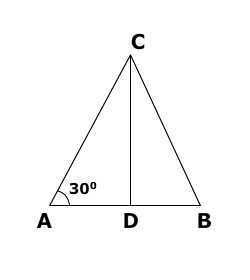
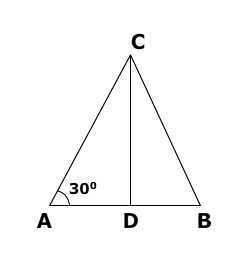
In isosceles △ABC (AC = BC) with base angle 30° CD is a median. How long is the leg of △ABC, if sum of the perimeters of △ACD an

d △BCD is 20 cm more than the perimeter of △ABC?

Mathematics
2 answers:
Leona [12.6K]2 months ago
8 0

Important details about isosceles triangle ABC:

  • The median CD, which is drawn to the base AB, also acts as an altitude to that base in the isosceles triangle (CD⊥AB). This indicates that triangles ACD and BCD are congruent right triangles, each with hypotenuses AC and BC.
  • In isosceles triangle ABC, the sides AB and BC are equal, meaning AC=BC.
  • The base angles at AB are equal, m∠A=m∠B=30°.

1. Consider the right triangle ACD. The angle adjacent to side AD is 30°, which dictates that the hypotenuse AC is double the length of the opposite side CD relating to angle A.

AC=2CD.

2. Now, for right triangle BCD, the angle next to side BD is also 30°, so hypotenuse BC is twice the opposite leg CD linked to angle B.

BC=2CD.

3. To calculate the perimeters of triangles ACD, BCD, and ABC:

P_{ACD}=AC+CD+AD=2CD+CD+AD=3CD+AD;

P_{BCD}=BC+CD+BD=2CD+CD+AD=3CD+AD;

P_{ABC}=AC+BC+AB=2CD+2CD+AD+BD=4CD+2AD.

4. If the total of the perimeters of triangles ACD and BCD is 20 cm greater than the perimeter of triangle ABC, then

P_{ACD}+P_{BCD}=P_{ABC}+20,\\ \\3CD+AD+3CD+AD=4CD+2AD+20,\\ \\6CD+2AD=4CD+2AD+20,\\ \\2CD=20.

5. Given that AC=BC=2CD, the lengths of legs AC and BC of the isosceles triangles are 20 cm.

Answer: 20 cm.

Svet_ta [12.7K]2 months ago
4 0

We know that AC = BC.

Let's denote AC = BC = x.

Now, the perimeter of triangle Δ ABC is AC + BC + AB = 2x + AB.

The combined perimeter of triangles Δ ACD and Δ BCD = [AC + (AB/2) + CD] + [BC + (AB/2) + CD]

                                                                          = 2 AC + AB + 2 CD

                                                                          = 2x + AB + 2 CD

According to the given information, this total exceeds the perimeter of Δ ABC by 20 cm.

Thus, 2x + AB + 2 CD = 2x + AB + 20.

2x + AB + 2 CD - 2x - AB = 20.

2 CD = 20.

Therefore, CD = 10 cm.

Thus, the length of the leg of Δ ABC equals 10 cm.

You might be interested in
Add the two expressions.<br><br> −4.2x+3 and 2.5x−6<br><br> Enter your answer in the box.
babunello [11817]

Answer:

 -1.7x -3

Step-by-step explanation:

−4.2x+3 +2.5x−6

I prefer to align them one above the other.

−4.2x+3

 2.5x−6

------------------

 -1.7x -3

4 0
2 months ago
1. X^4(dy/dx) +x^3y =- sec (xy)<br><br>Integral by separation of variables? <br>​
PIT_PIT [12445]

Answer:

Step-by-step explanation:

Considering the differential equation x^4(dy/dx) + x^3y = -sec(xy). We will solve it employing the method of separation of variables;

x^{4} \frac{dy}{dx} +x^{3}y = -sec(xy)\\x^{3}(x\frac{dy}{dx} + y) = -sec(xy)\\let \ v=xy\\\frac{dv}{dx} = x\frac{dy}{dx} + y(implicit \ in\ nature)\\

By substituting v and dv/dx into the previous equation, we acquire;

x^{3}\frac{dv}{dx} = -secv

We then separate the variables:

-\frac{dv}{secv} = \frac{dx}{x^{3} }

-cosvdv = x^{-3}dx\\ integrating\ both\ sides\\-\int\limits {cosv} \, dv = \int\limits {x^{-3} } \, dx\\-sinv = \frac{x^{-2} }{-2} + C\\since\ v = xy\\-sinxy = \frac{x^{-2} }{-2} + C\\2sin(xy) = x^{-2} -2C\\2 sin(xy) = \frac{1}{x^{2} } -K (where\ K = 2C)\\

The end expression provides the solution to the differential equation.

8 0
2 months ago
The graph of f(x) = x2 is translated to form g(x) = (x – 5)2 + 1. Which graph represents g(x)?
Leona [12618]
<span>The graph will shift 5 units to the right and 1 unit upwards, forming a parabola that opens up with its vertex positioned at (5, 1).

Explanation:
The subtraction of 5 from x prior to squaring indicates a horizontal movement of 5 units to the right.

The addition of 1 signifies a vertical shift of 1 unit up.

This transformation follows the vertex form of a parabola, y=a(x-h)^2 + k, where (h, k) represents the vertex. In this case, h is 5 and k is 1, placing the vertex at (5, 1).</span>
6 0
2 months ago
Read 2 more answers
Other questions:
  • Suppose that 20% of the adult women in the United States dye or highlight their hair. We would like to know the probability that
    15·1 answer
  • Rain and Hantavirus in Mice Hantavirus is carried by wild rodents and causes severe lung disease in humans. A recent study1 on t
    6·1 answer
  • What is the sum of the infinite geometric series? Sigma-Summation Underscript n = 1 Overscript 4 EndScripts (negative 144) (one-
    5·2 answers
  • Which of the following represents the general term for the sequence 2, 4, 6, 8, 10, . . .?
    12·2 answers
  • an auto transport truck holds 12 cars. A car dealer plans to bring in 1006 new cars in June and July. if an auto transport truck
    8·2 answers
  • A factory produced 150 tons of steel in one year. The next year, the output increased to 180 tons. What is the percentage increa
    8·2 answers
  • Q.1 - Adam is ordering pizza for a company party that he needs to have catered. Company A charges $8 for each pizza and a delive
    12·2 answers
  • Evaluate −b2−2bx2−x when x=−2.
    14·1 answer
  • Nancy used 14 yards of fabric to make flags for one third of the drill team. How much fabric would Nancy need to make flags for
    9·2 answers
  • World grain production was 1241 million tons in 1975 and 2048 million tons in 2005, and has been increasing at an approximately
    15·1 answer
Add answer
Login
Not registered? Fast signup
Signup
Login Signup
Ask question!