Response:
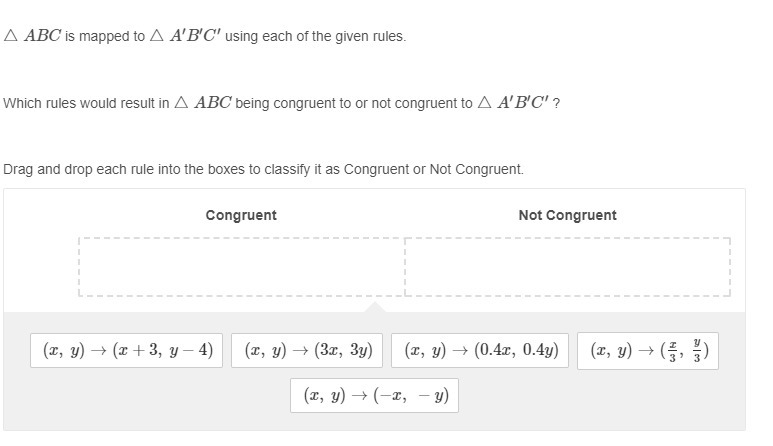
Congruent: (x, y)→(x+3, y-4); (x, y)→(-x, -y)
Not Congruent: (x, y)→(3x, 3y); (x, y)→(0.4x, 0.4y); (x, y)→(x/3, y/3)
Explanation in steps:
Transformations that yield congruent figures include translations, reflections, and rotations. In contrast, dilations result in figures that are not congruent.
The first transformation, (x, y)→(x+3, y-4), represents a translation 3 units right and 4 units down, leading to congruent figures since it merely shifts the figure.
The second transformation, (x, y)→(3x, 3y), indicates a dilation by a factor of 3, which enlarges the figure and therefore makes it non-congruent.
The third transformation, (x, y)→(0.4x, 0.4y), involves a dilation by a factor of 0.4, which shrinks the figure, leading to non-congruence.
The fourth transformation, (x, y)→(x/3, y/3), results in a dilation by a factor of 1/3, also shrinking the figure and rendering it non-congruent.
The fifth transformation, (x, y)→(-x, -y), reflects the figure, maintaining its size while modifying its orientation, thus ensuring congruence.