answer.
Ask question
Login Signup
Ask question
All categories
  • English
  • Mathematics
  • Social Studies
  • Business
  • History
  • Health
  • Geography
  • Biology
  • Physics
  • Chemistry
  • Computers and Technology
  • Arts
  • World Languages
  • Spanish
  • French
  • German
  • Advanced Placement (AP)
  • SAT
  • Medicine
  • Law
  • Engineering
tatiyna
1 month ago
9

An arc on a circle measures 250°. Within which range is the radian measure of the central angle? 0 to StartFraction pi Over 2 En

dFraction radians StartFraction pi Over 2 EndFraction to π radians π to StartFraction 3 pi Over 2 EndFraction radians StartFraction 3 pi Over 2 EndFraction to 2π radians
Mathematics
2 answers:
Inessa [12.5K]1 month ago
6 0
The range the radian measurement of the central angle falls into is π to 3π/2.
Inessa [12.5K]1 month ago
4 0
The central angle lies within the interval from π to 3π/2. To convert angles from degrees to radians, one must multiply the degree measure by 180/π. Similarly, converting radians to degrees requires multiplying the radian measure by 180°/π. For instance, π/2 translates to 90°, π rad converts to 180°, 3π/2 equates to 270°, and 2π corresponds to 360°. Consequently, an angle of 250 degrees, which is between 180 and 270, falls within the range of π to 3π/2.
You might be interested in
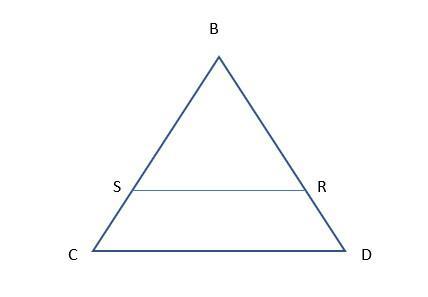
Line RS intersects triangle BCD at two points and is parallel to segment DC. Triangle B C D is cut by line R S. Line R S goes th
Zina [12379]

Answer:

The correct statements are;

1) ΔBCD is similar to ΔBSR

2) BR/RD = BS/SC

3) (BR)(SC) = (RD)(BS)

Step-by-step explanation:

1) Since RS is parallel to DC, we conclude that;

∠BDC = ∠BRS (Angles formed on the same side of the transversal)

Furthermore;

∠BCD = ∠BSR (Angles formed on the same side of the transversal)

∠CBD = ∠CBD (Reflexive property)

Thus;

ΔBCD ~ ΔBSR by the Angle-Angle-Angle (AAA) similarity criterion.

2) Given that  ΔBCD ~ ΔBSR, we obtain;

BC/BS = BD/BR → (BS + SC)/BS = (BR + RD)/BR = 1 + SC/BS = RD/BR + 1

1 + SC/BS = 1 + RD/BR thus, SC/BS = 1 + BR/RD - 1

SC/BS = RD/BR

By inverting both sides we find;

BR/RD = BS/SC

3) From BR/RD = BS/SC, we apply cross multiplication;

BR/RD = BS/SC leads to;

BR × SC = RD × BS → (BR)(SC) = (RD)(BS).

7 0
3 months ago
WNAE, an all-news AM station, finds that the distribution of the lengths of time listeners are tuned to the station follows the
Inessa [12570]

Answer:

a) P(X>20)=P(\frac{X-\mu}{\sigma}>\frac{20-\mu}{\sigma})=P(Z>\frac{20-15}{3.5})=P(z>1.43)

The probability can be determined using the complement rule, with the standard normal distribution, an excel sheet, or a calculator.

P(z>1.43)=1-P(z

b) P(X

This probability can also be calculated using the normal standard distribution, an excel sheet, or a calculator.

P(z

c) P(

For this one, the probability can likewise be derived from the standard normal distribution, excel, or a calculator, with specific adjustments:

P(-1.43

Step-by-step explanation:

Previous concepts

Normal distribution refers to a symmetric probability distribution centered around the mean, indicating that occurrences near the mean are more common than those far from it.

The Z-score is a statistic that represents a value's relationship to the average of a set of values, expressed in terms of how many standard deviations it is away from the mean.

Part a

Let X denote the random variable representing the lengths within a population, and for our case, the distribution for X is as follows:

X \sim N(15,3.5)

Where \mu=15 and \sigma=3.5

We seek the probability:

P(X>20)

The most effective way to solve this is by leveraging the normal distribution and the corresponding Z-score:

z=\frac{x-\mu}{\sigma}

By applying this formula, we can find the probability:

P(X>20)=P(\frac{X-\mu}{\sigma}>\frac{20-\mu}{\sigma})=P(Z>\frac{20-15}{3.5})=P(z>1.43)

Again, this probability can be obtained either using the complement rule, the standard normal distribution, or a calculator.

P(z>1.43)=1-P(z

Part b

P(X

This probability can also be computed using either the normal standard distribution, an excel sheet, or a calculator.

P(z

Part c

P(

In this case, the probability can similarly be acquired with the help of the standard normal distribution, an excel sheet, or a calculator, with particular adjustments:

P(-1.43

5 0
2 months ago
Milton is floating in an inner tube in a wave pool. He is 1.5 m from the bottom of the pool when he is at the trough of a wave.
lawyer [12517]
To tackle this sinusoidal question, we begin with the following: Using the formula; g(t)=offset+A*sin[(2πt)/T+Delay] According to sinusoidal theory, the duration from trough to crest is typically half of the wave's period. Here, T=2.5 The peak magnitude is calculated as: Trough-Crest=2.1-1.5=0.6 m amplitude=1/2(Trough-Crest)=1/2*0.6=0.3 The offset from the center of the circle becomes 0.3+1.5=1.8 As the delay is at -π/2, the wave will commence at the trough at [time,t=0]. Plugging these values into the formula gives: g(t)=1.8+(0.3)sin[(2*π*t)/2.5]-π/2] g(t)=1.8+0.3sin[(0.8πt)/T-π/2]
3 0
1 month ago
△ABC is mapped to △A′B′C′ using each of the given rules.
PIT_PIT [12445]

Response:

Congruent:  (x, y)→(x+3, y-4); (x, y)→(-x, -y)

Not Congruent:  (x, y)→(3x, 3y); (x, y)→(0.4x, 0.4y); (x, y)→(x/3, y/3)

Explanation in steps:

Transformations that yield congruent figures include translations, reflections, and rotations. In contrast, dilations result in figures that are not congruent.

The first transformation, (x, y)→(x+3, y-4), represents a translation 3 units right and 4 units down, leading to congruent figures since it merely shifts the figure.

The second transformation, (x, y)→(3x, 3y), indicates a dilation by a factor of 3, which enlarges the figure and therefore makes it non-congruent.

The third transformation, (x, y)→(0.4x, 0.4y), involves a dilation by a factor of 0.4, which shrinks the figure, leading to non-congruence.

The fourth transformation, (x, y)→(x/3, y/3), results in a dilation by a factor of 1/3, also shrinking the figure and rendering it non-congruent.

The fifth transformation, (x, y)→(-x, -y), reflects the figure, maintaining its size while modifying its orientation, thus ensuring congruence.


7 0
2 months ago
Read 2 more answers
Cameras R Us has a sale for 25% off camera bags, which is a discount of $20. Explain how you can set up a diagram to find the or
Zina [12379]

Answer:

Example Response: The diagram ought to consist of five columns; one for each 25% segment and an additional one for the total, since 25% represents 1

4

of 100%. There should be 2 rows, one designated for percentages and another for dollar figures.

Step-by-step explanation:

Edg2020

8 0
3 months ago
Read 2 more answers
Other questions:
  • Which equation represents the graphed function?
    6·2 answers
  • Rachel, Adam, Michelle, Hannah, and James are going to the movies. They have $65 to spend on tickets and snacks. Each movie tick
    6·2 answers
  • a product online for $299 and was charged an additional $10 for shipping and handling. The customer received a rebate of $99 and
    14·2 answers
  • What is the solution of the equation (x – 5)2 + 3(x – 5) + 9 = 0? Use u substitution and the quadratic formula to solve.
    14·2 answers
  • Kayson is looking at two buildings, building A and building B, at an angle of elevation of 40' Building Als 120 feet away, and b
    5·2 answers
  • Alexander invested $240 in an account paying an interest rate of 2.3% compounded
    10·1 answer
  • Oil flows back and forth between a small and large tank. When oil is moving into the large tank, the flow rate is
    11·2 answers
  • A hot air balloon can hold up to 300 pounds of weight. The balloon's pilot weighs 140 pounds. How many 20-pound bags of sand (b)
    13·2 answers
  • QUESTION 4 of 10: Your restaurant purchases 1,625 bottles of Chablis per year. The annual increase of purchases has been 6%. If
    10·2 answers
  • An auto parts manufacturer throws out gaskets with weights that are not within 0.06 pound of the mean weight of the batch. The w
    9·1 answer
Add answer
Login
Not registered? Fast signup
Signup
Login Signup
Ask question!