Answer:
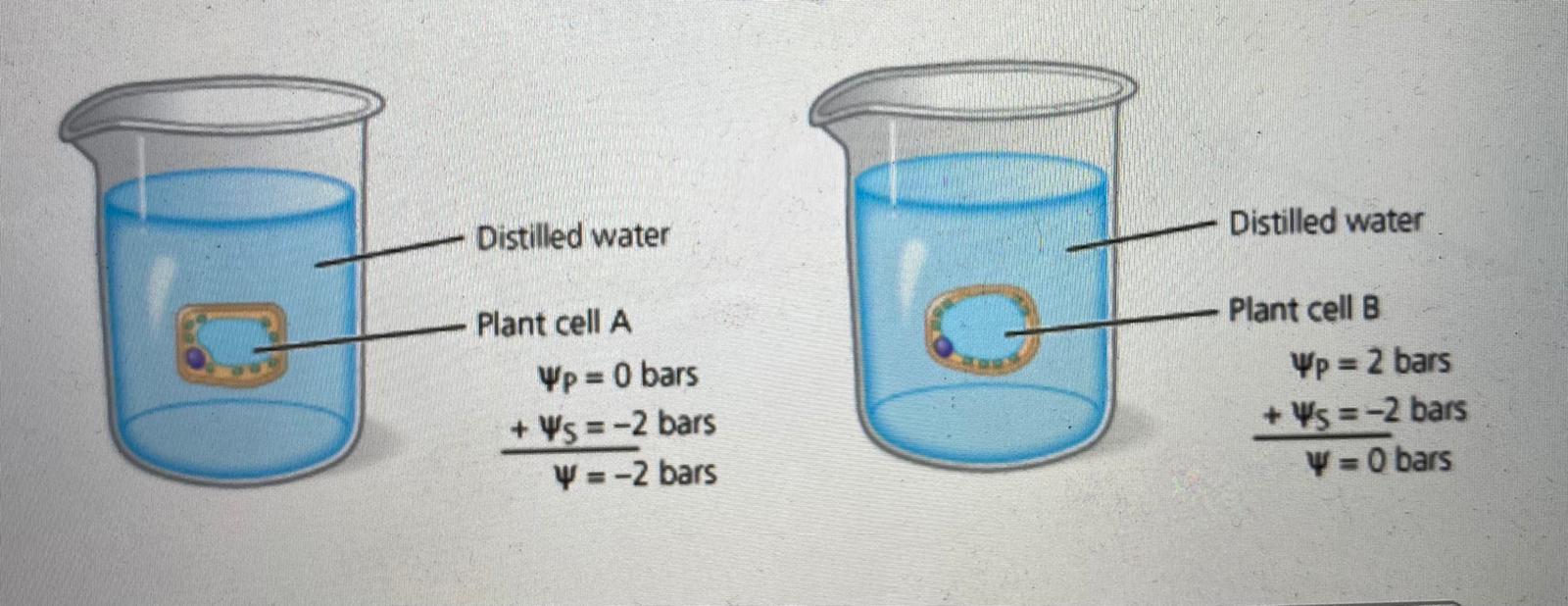
Plant cell A has a lower water potential compared to cell B. True
Plant cell B is isotonic regarding the fluid present in the beaker. True
The water potential of plant cell B increased due to a rise in solutes inside the cell. False
Plant cell B is in equilibrium with the fluid in the beaker. True
Plant cell A possesses a higher water potential than cell B. False
Plant cell A is in equilibrium with the fluid present in the beaker. False
Explanation:
Plant cell A has a lower water potential than cell B. True
This statement holds because the water potential of A is -2 bars, while B has a water potential of zero bars.
Plant cell B is isotonic to the fluid in the beaker. = True
Isotonic solutions have equal water potential. Given that the water potential of distilled water is zero and also that of plant cell B, it confirms that plant cell B is isotonic with the beaker fluid.
An increase in solutes within plant cell B does not elevate its water potential but instead diminishes it = False.
The increase of solute inside the cell leads to the reduction of water potential.
Plant cell B being at equilibrium with the beaker’s fluid is true = True
The equilibrium occurs as plant cell B's water potential is zero, with negative solute potential balanced by the positive pressure potential.
Plant cell A's water potential being higher than that of cell B is false = False.
The water potential for plant cell A is -2 bars, while plant cell B has a higher water potential of zero.
The statement that plant cell A is at equilibrium with the beaker's fluid is false = False.
Plant cell A isn’t balanced with the beaker fluid because its negative water potential causes water to move into the cell.