answer.
Ask question
Login Signup
Ask question
All categories
  • English
  • Mathematics
  • Social Studies
  • Business
  • History
  • Health
  • Geography
  • Biology
  • Physics
  • Chemistry
  • Computers and Technology
  • Arts
  • World Languages
  • Spanish
  • French
  • German
  • Advanced Placement (AP)
  • SAT
  • Medicine
  • Law
  • Engineering
gavmur
4 days ago
9

A motorist inflates the tires of her car to a pressure of 180 kPa on a day when the temperature is -8.0° C. When she arrives at

her destination, the tire pressure has increased to 245 kPa. What is the temperature of the tires if we assume that the tires do not expand?
Physics
1 answer:
kicyunya [2.2K]4 days ago
4 0
Utilize Gay-Lussac's law: P/T = constant. Here, P refers to pressure and T indicates temperature; the ratio P/T must remain unchanged. The initial values of pressure and temperature provided are: P = 180 kPa, T = -8.0°C, equating to 265.15K. Subsequently, for the final measurements: P = 245 kPa, T =?. We will set the initial and final P/T values equal and solve for T: 180/265.15 = 245/T, leading to T = 361K.
You might be interested in
Consider a 4-mg raindrop that falls from a cloud at a height of 2 km. When the raindrop reaches the ground, it won't kill you or
inna [2205]

Answer:

The work performed by air resistance totals -0.0782 J

Explanation:

Hello!

According to the principle of conservation of energy, the energy of a raindrop must remain constant.

At the outset, the raindrop possesses only gravitational potential energy:

PE = m · g · h

Where:

PE = potential energy.

m = mass of the raindrop.

g = gravitational acceleration (9.8 m/s²)

h = height.

Let's determine the initial potential energy of the raindrop:

(4 mg should be converted into kg: 4 mg · 1 kg / 1 × 10⁶ mg = 4 × 10⁻⁶ kg)

PE = 4 × 10⁻⁶ kg · 9.8 m/s² · 2000 m

PE = 0.0784 J

As the raindrop descends, some of its potential energy converts into kinetic energy while the rest is lost to the air resistance. Upon reaching the ground, all initial potential energy has been either turned into kinetic energy or spent overcoming air resistance:

initial PE = final KE + Work by air

Where:

KE = kinetic energy.

Work by air = work done by air resistance.

The kinetic energy at ground level is computed as follows:

KE = 1/2 · m · v²

Where:

m = mass

v = velocity

<pThus:

KE = 1/2 · 4 × 10⁻⁶ kg · (10 m/s)²

KE = 2 × 10⁻⁴ J

Now, we can find the work done by air resistance:

initial PE = final KE + Work by air

0.0784 J = 2 × 10⁻⁴ J + Work by air

Work by air = 0.0784 J - 2 × 10⁻⁴ J

Work by air = 0.0782 J

Since work is performed in the opposite direction to movement, this results in a negative value. Therefore, the work done by air resistance is -0.0782 J.

5 0
29 days ago
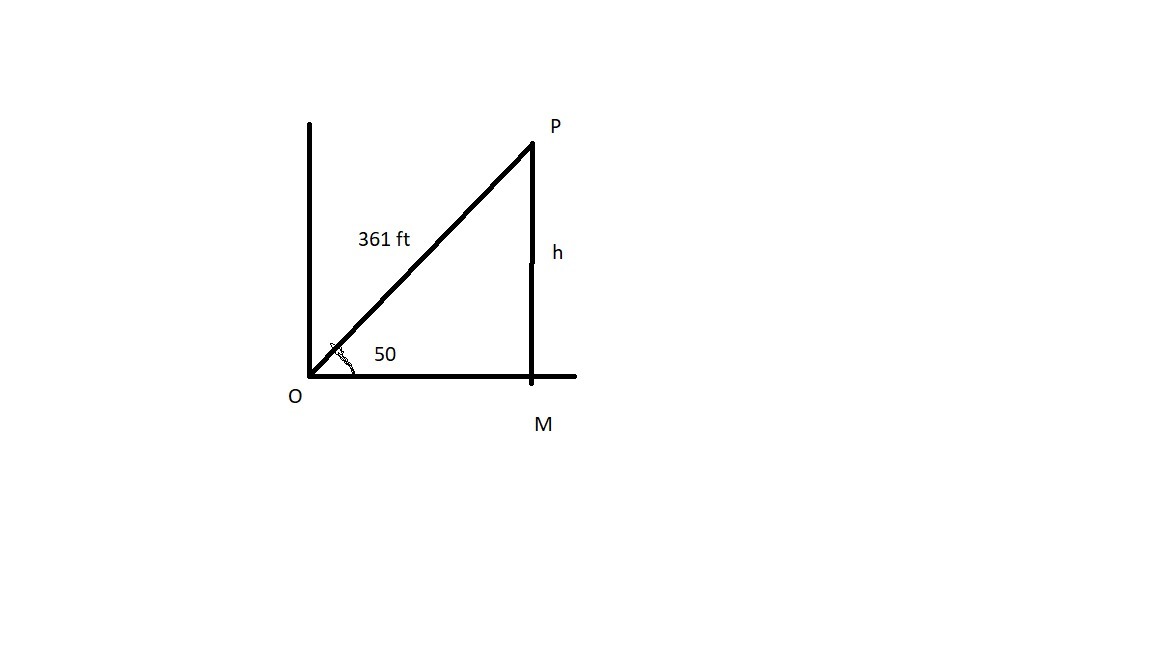
Suppose Sammy Sosa hits a home run which travels 361. ft (110. m). Leaving the bat at 50 degrees above the horizontal, how high
Yuliya22 [2420]

Response:

The horizontal span of Sosa is 276.526 ft or 84.28 meters.

Explanation:

As illustrated in the diagram, let point O denote Sosa's starting position. She travels 361 ft at a 50-degree angle relative to the horizontal.

sin 50 = \frac{OM}{OP}

0.7660 = h / 361

h = 276.526 ft

h = 84.28 meters

The horizontal distance of Sosa is 276.526 ft or 84.28 meters.

5 0
6 days ago
Two planets having equal masses are in circular orbit around a star. Planet A has a smaller orbital radius than planet B. Which
serg [2593]

Answer:

Explanation:

To approach this problem, we need to understand two key concepts.

First, the gravitational force on an object in orbit equals its mass multiplied by centripetal acceleration.

Secondly, Newton's law of universal gravitation defines the force between two masses: Fg = mMG/r², where Fg denotes gravitational force, m and M signify the masses, G represents the gravitational constant, and r indicates the distance separating the two masses.

Thus:

Fg = m v²/r

mMG/r² = m v²/r

v² = MG/r

Potential energy for each planet is expressed as:

PE = mgr = m (MG/r²) r = mMG/r

Kinetic energy for each planet is computed as:

KE = 1/2 mv² = 1/2 m (MG/r) = 1/2 mMG/r

Total mechanical energy is calculated as:

ME = PE + KE = 3/2 mMG/r

Since both planets share the same mass, the only variable is their orbital radius. Consequently, Planet A, with a smaller radius, possesses greater potential, kinetic, and mechanical energy.

6 0
1 month ago
A box sliding on a horizontal frictionless surface runs into a fixed spring, compressing it a distance x1 from its relaxed posit
serg [2593]

Answer:

x₂=2×1

Explanation:

According to the work-energy theorem, we can assume that the gravitational potential energy at the lowest point of compression is zero since the kinetic energy change is 0;

mgx-(kx)²/2 =0 where m refers to the object's mass, g indicates the acceleration due to gravity, k denotes spring constant, and x represents the spring's compression.

mgx=(kx)²/2

x=2mg/k----------------compression when the object is at rest

However, ΔK.E =-1/2mv²⇒kx²=mv² -----------where v symbolizes the object's velocity and K.E signifies kinetic energy

Thus, if kx²=mv² then

v=x *√(k/m) ----------------where v=0

<pDoubling v results in multiplying x *√(k/m) by 2, leading to x₂ being double x₁

7 0
1 month ago
Considering the activity series given for nonmetals, what is the result of the below reaction? Use the activity series provided.
ValentinkaMS [2425]

Response: The result would be no reaction.

Clarification:

7 0
9 days ago
Read 2 more answers
Other questions:
  • Find the object's speeds v1, v2, and v3 at times t1=2.0s, t2=4.0s, and t3=13s.
    6·2 answers
  • A semi is traveling down the highway at a velocity of v = 26 m/s. The driver observes a wreck ahead, locks his brakes, and begin
    15·1 answer
  • A compressed spring has 16.2J of elastic potential energy when it is compressed 0.30m . What is the spring constant of the sprin
    6·1 answer
  • The magnitude of the force associated with the gravitational field is constant and has a value FF . A particle is launched from
    14·1 answer
  • What is the Physics Primer?
    15·2 answers
  • The radius of the earth's orbit around the sun (assumed to be circular) is 1.50 108 km, and the earth travels around this orbit
    9·1 answer
  • Two racecars are driving at constant speeds around a circular track. Both cars are the same distance away from the center of the
    14·1 answer
  • "a very light ideal spring stretches by 21.0 cm when it is used to hang a 135-n object. what is the weight of a piece of electro
    11·2 answers
  • A rear window defroster consists of a long, flat wire bonded to the inside surface of the window. When current passes through th
    5·2 answers
  • You catch a volleyball (mass 0.270 kg) that is moving downward at 7.50 m/s. In stopping the ball, your hands and the volleyball
    10·1 answer
Add answer
Login
Not registered? Fast signup
Signup
Login Signup
Ask question!