answer.
Ask question
Login Signup
Ask question
All categories
  • English
  • Mathematics
  • Social Studies
  • Business
  • History
  • Health
  • Geography
  • Biology
  • Physics
  • Chemistry
  • Computers and Technology
  • Arts
  • World Languages
  • Spanish
  • French
  • German
  • Advanced Placement (AP)
  • SAT
  • Medicine
  • Law
  • Engineering
marissa
13 days ago
12

Students work together during an experiment about Newton’s laws. The students use a setup that consists of a cart of known mass

connected to one end of a string that is looped over a pulley of negligible friction, with its other end connected to a hanging mass. The cart is initially at rest on a horizontal surface. Students have access to common laboratory equipment to make measurements of components of the system. The students double the mass that hangs from the string. They also replace the original cart with a new cart that has double the mass. By doubling both masses, how will the tension in the string and the acceleration of the cart change?

Physics
1 answer:
Yuliya22 [1.1K]13 days ago
8 0

Answer:

The tension in the string will increase by a factor of two, while the acceleration will not change.

Explanation:

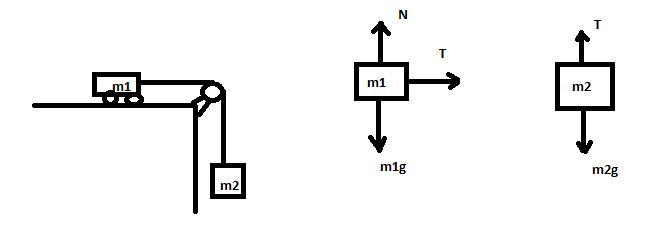
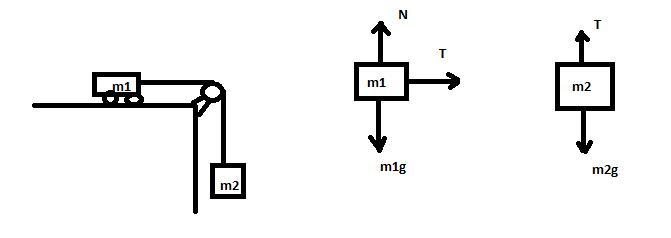
To approach this problem, we begin by sketching the situation and creating free body diagrams for both masses involved. (Refer to the attached image)

Let’s first examine the free body diagram for the cart. Assuming there’s no friction between the cart and the horizontal surface, and focusing solely on horizontal forces, we can write the force balance as follows:

\sum F_{1}=m_{1}a

Given that tension is the only horizontal force on the cart, we state:

T=m_{1}a

Next, consider the hanging mass, taking downward as the positive direction. Summing forces yields:

\sum F_{2}=m_{2}a

The two forces acting here are gravity and tension, so:

-T+m_{2}g=m_{2}a

Combining the two equations results in:

-m_{1}a+m_{2}g=m_{2}a

Solving for acceleration gives:

m_{1}a+m_{2}a=m_{2}g

a(m_{1}+m_{2})=m_{2}g

a=\frac{m_{2}g}{m_{1}+m_{2}}

This represents the acceleration for the original setup. What happens if both masses are doubled? Let’s analyze:

a_{double masses}=\frac{2m_{2}g}{2m_{1}+2m_{2}}

Factoring 2 out of the denominator produces:

a_{double masses}=\frac{2m_{2}g}{2(m_{1}+m_{2})}

Which simplifies to:

a_{double masses}=\frac{m_{2}g}{m_{1}+m_{2}}

You can observe this matches the original acceleration, confirming it remains unchanged.

Regarding tension, by substituting the doubled masses into the initial force expression:

T_{double}=2m_{1}a

The initial tension was:

T=m_{1}a

Therefore, doubling the masses causes the tension to double as well.
You might be interested in
Consider the uniform electric field \vec{E} =(4000~\hat{j}+3000~\hat{k})~\text{N/C} ​E ​⃗ ​​ =(4000 ​j ​^ ​​ +3000 ​k ​^ ​​ ) N/
kicyunya [1011]

Answer:

Electric flux is calculated as \phi=31562.63\ Nm^2/C

Explanation:

We start with the given parameters:

The electric field impacting the circular surface is E=(4000j+3000k)\ N/C

Our objective is to ascertain the electric flux passing through a circular region with a radius of 1.83 m situated in the xy-plane. The area vector is oriented in the z direction. The formula for electric flux is expressed as:

\phi=E{\cdot}A

\phi=(4000j+3000k){\cdot}Ak

Applying properties of the dot product, we calculate the electric flux as:

\phi=3000\times Ak

\phi=3000\times \pi (1.83)^2

\phi=31562.63\ Nm^2/C

Consequently, the electric flux for the circular area is \phi=31562.63\ Nm^2/C. Thus, this represents the required answer.

4 0
1 day ago
A small block of mass 200 g starts at rest at A, slides to B where its speed is vB=8.0m/s,vB=8.0m/s, then slides along the horiz
serg [1189]

Answer

Data provided:

mass of the block = 200 g = 0.2 Kg

Velocity at A = 0 m/s

Velocity at B = 8 m/s

distance of slide = 10 m

height of the block = 4 m

calculation for the block's potential energy

    P = m g h

    P = 0.2 x 9.8 x 4

    P = 7.84 J

kinetic energy calculated as

    KE = \dfrac{1}{2}mv^2

    KE = \dfrac{1}{2}\times 0.2 \times 7.84^2

    KE =6.14 J

Work done = P - KE

work = 7.84 - 6.14

work = 1.7 J

b) using the formula v² = u² + 2 a s

   0 = 8² - 2 x a x 10

   a = 3.2 m/s²

ma - μ mg = 0

 \mu = \dfrac{a}{g}

 \mu = \dfrac{3.2}{9.8}

 \mu = 0.327

7 0
8 days ago
A string is stretched by two equal but opposite forces f newton each what is tension in string
Maru [1053]

The string does not experience any force of tension, as it balances two forces acting in the same direction. Hence, the tension is zero.

Explanation:

If tension existed in the string, it would mean that two equal but opposite forces are exerting pull in contrary directions.

When a force of f newtons is applied from the right and another force of f newtons from the left, the resulting action occurs through one force. Because there is action on the same string in opposing directions, the tension in the string can only be equal to the magnitude of the string itself.

Therefore, the string indeed has no tension since it is dealing with two forces acting in the same direction. Thus, the tension is zero.

8 0
4 days ago
the minute hand on a clock is 9 cm long and travels through an arc of 252 degrees every 42 minutes. To the nearest tenth of a ce
Ostrovityanka [942]

Answer:

The distance covered by the minutes hand is 39.60 cm.

Explanation:

Note: A clock has a circular shape, where the minutes hand acts as the radius, and its motion creates an arc.

Length of an arc is calculated as ∅/360(2πr)

L = ∅/360(2πr).................... Equation 1π

Here, L represents the arc’s length, ∅ is the angle made by the arc, and r is the arc’s radius.

Given: ∅ = 252°, r = 9 cm, π = 3.143.

Upon substituting these values into equation 1,

L = 252/360(2×3.143×9)

L = 0.7×2×3.143×9

L = 39.60 cm.

Thus, the distance traversed by the minutes hand is 39.60 cm.

4 0
14 days ago
As computer structures get smaller and smaller, quantum rules start to create difficulties. Suppose electrons move through a cha
Softa [913]

Answer:

a) ∆x∆v = 5.78*10^-5

∆v = 1157.08 m/s

b) 4.32*10^{-11}

Explanation:

This problem can be addressed using Heisenberg's uncertainty principle, which is expressed as:

\Delta x\Delta p \geq \frac{\hbar}{2}

Where h represents Planck’s constant (6.62*10^-34 J s).

Assuming that the electron's mass remains the same, we proceed as follows:

\Delta x \Delta (m_ev)=m_e\Delta x\Delta v \geq \frac{\hbar}{2}

Utilizing the electron's mass (9.61*10^-31 kg) and the uncertainty in position (50 nm), we can compute ∆x∆v and ∆v:

\Delta x \Delta v\geq\frac{\hbar}{2m_e}=\frac{(1.055*10^{-34}Js)}{2(9.1*10^{-31}kg)}=5.78*10^{-5}\ m^2/s

\Delta v\geq\frac{5.78*10^{-5}}{50*10^{-9}m}=1157.08\frac{m}{s}

If we treat the electron like a classic particle, the time required to cross the channel is determined using the upper limit of the uncertainty in velocity:

t=\frac{x}{v}=\frac{50*10^{-9}m}{1157.08m/s}=4.32*10^{-11}s

6 0
6 days ago
Other questions:
  • A person is trying to judge whether a picture (mass = 1.10 kg) is properly positioned by temporarily pressing it against a wall.
    11·1 answer
  • On a day when the water is flowing relatively gently, water in the Niagara River is moving horizontally at 4.5 m/sm/s before sho
    7·1 answer
  • A carmaker has designed a car that can reach a maximum acceleration of 12 meters/second2. The car’s mass is 1,515 kilograms. Ass
    8·1 answer
  • A Styrofoam slab has thickness h and density ρs. When a swimmer of mass m is resting on it, the slab floats in fresh water with
    5·1 answer
  • An infinite sheet of charge, oriented perpendicular to the x-axis, passes through x = 0. It has a surface charge density σ1 = -2
    6·1 answer
  • Suggest reasons why poaching for subsistence is likely to be less damaging to the biodiversity of an area than poaching for prof
    9·1 answer
  • A cart moves along a track at a velocity of 3.5 cm/s. When a force is applied to the cart, its velocity increases to 8.2 cm/s. I
    6·2 answers
  • Marcus can drive his boat 24 miles down the river in 2 hours but takes 3 hours to return upstream. Find the rate of the boat in
    13·2 answers
  • An Object moving at a velocity of 30 m/s slows to a stop in 7 seconds. What was its acceleration
    12·1 answer
  • A dipole of moment 0.5 e·nm is placed in a uniform electric field with a magnitude of 8 times 104 N/C. What is the magnitude of
    11·1 answer
Add answer
Login
Not registered? Fast signup
Signup
Login Signup
Ask question!