Answer:Ix = Iy = a^4 / 12
Ixy = a^4 / 24
Step-by-step explanation:
Solution:-
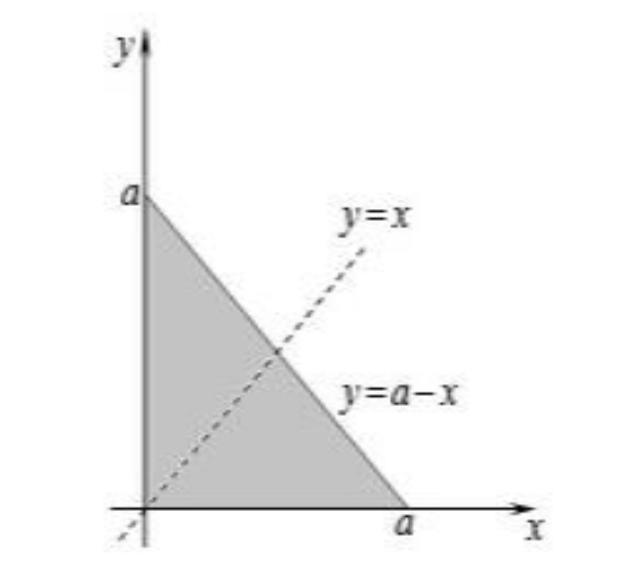
- Start by sketching the right-angled isosceles triangle as illustrated in the attachment.
- The density (ρ) functions multivariably based on coordinates (x and y). ρ ( x, y ) = k*(x^2 + y^2)
Here, k represents the coefficient of proportionality.
- The lamina and density are symmetrical across the line y = x. (refer to the attachment). The center of mass must be along this line.
- The coordinates of centroid ( xcm and ycm) are represented as:
- Given that xcm = ycm, these points lie along the line y = x.
- Compute the mass of the lamina (m):
- Evaluate the Moment (My):
![m = mass = \int \int {p(x,y)} \, dA = \int\limits^0_a \int\limits_0 {k*(x^2 + y^2)} \, dy.dx \\\\m = k\int\limits^a_0 {(x^2y + \frac{y^3}{3}) } \, dx|\limits^a^-^x_0 = k\int\limits^a_0 {(\frac{-4x^3}{3} + 2ax^2-ax^2+\frac{a^3}{3}) } \, dx\\\\m = k* [ \frac{-x^4}{3} + \frac{2ax^3}{3} - \frac{a^2x^2}{2} +\frac{a^3x}{3}] | \limits^a_0 \\\\m = k* [ \frac{-a^4}{3} + \frac{2a^4}{3} - \frac{a^4}{2} +\frac{a^4}{3}] = \frac{ka^4}{6}](https://tex.z-dn.net/?f=m%20%3D%20mass%20%3D%20%5Cint%20%5Cint%20%7Bp%28x%2Cy%29%7D%20%5C%2C%20dA%20%3D%20%5Cint%5Climits%5E0_a%20%5Cint%5Climits_0%20%7Bk%2A%28x%5E2%20%2B%20y%5E2%29%7D%20%5C%2C%20dy.dx%20%5C%5C%5C%5Cm%20%3D%20k%5Cint%5Climits%5Ea_0%20%7B%28x%5E2y%20%2B%20%5Cfrac%7By%5E3%7D%7B3%7D%29%20%7D%20%5C%2C%20dx%7C%5Climits%5Ea%5E-%5Ex_0%20%3D%20k%5Cint%5Climits%5Ea_0%20%7B%28%5Cfrac%7B-4x%5E3%7D%7B3%7D%20%20%2B%202ax%5E2-ax%5E2%2B%5Cfrac%7Ba%5E3%7D%7B3%7D%29%20%7D%20%5C%2C%20dx%5C%5C%5C%5Cm%20%3D%20k%2A%20%5B%20%5Cfrac%7B-x%5E4%7D%7B3%7D%20%2B%20%5Cfrac%7B2ax%5E3%7D%7B3%7D%20-%20%5Cfrac%7Ba%5E2x%5E2%7D%7B2%7D%20%2B%5Cfrac%7Ba%5E3x%7D%7B3%7D%5D%20%7C%20%5Climits%5Ea_0%20%20%20%5C%5C%5C%5Cm%20%3D%20k%2A%20%5B%20%5Cfrac%7B-a%5E4%7D%7B3%7D%20%2B%20%5Cfrac%7B2a%5E4%7D%7B3%7D%20-%20%5Cfrac%7Ba%5E4%7D%7B2%7D%20%2B%5Cfrac%7Ba%5E4%7D%7B3%7D%5D%20%3D%20%5Cfrac%7Bka%5E4%7D%7B6%7D)
- Determine ( xcm = ycm ):
xcm = ycm = ![M_y = \int \int {x*p(x,y)} \, dA = \int\limits^0_a \int\limits_0 {k*x*(x^2 + y^2)} \, dy.dx \\\\M_y = k\int\limits^a_0 x*{(x^2y + \frac{y^3}{3}) } \, dx|\limits^a^-^x_0 = k\int\limits^a_0 x*{(\frac{-4x^3}{3} + 2ax^2-ax^2+\frac{a^3}{3}) } \, dx\\\\M_y = k* [ \frac{-4x^5}{15} + \frac{ax^4}{2} - \frac{a^2x^3}{3} +\frac{a^3x^2}{6}] | \limits^a_0 \\\\M_y = k* [ \frac{-4a^5}{15} + \frac{a^5}{2} - \frac{a^5}{3} +\frac{a^5}{6}] = \frac{ka^5}{15}](https://tex.z-dn.net/?f=M_y%20%3D%20%5Cint%20%5Cint%20%7Bx%2Ap%28x%2Cy%29%7D%20%5C%2C%20dA%20%3D%20%5Cint%5Climits%5E0_a%20%5Cint%5Climits_0%20%7Bk%2Ax%2A%28x%5E2%20%2B%20y%5E2%29%7D%20%5C%2C%20dy.dx%20%5C%5C%5C%5CM_y%20%3D%20k%5Cint%5Climits%5Ea_0%20x%2A%7B%28x%5E2y%20%2B%20%5Cfrac%7By%5E3%7D%7B3%7D%29%20%7D%20%5C%2C%20dx%7C%5Climits%5Ea%5E-%5Ex_0%20%3D%20k%5Cint%5Climits%5Ea_0%20x%2A%7B%28%5Cfrac%7B-4x%5E3%7D%7B3%7D%20%20%2B%202ax%5E2-ax%5E2%2B%5Cfrac%7Ba%5E3%7D%7B3%7D%29%20%7D%20%5C%2C%20dx%5C%5C%5C%5CM_y%20%3D%20k%2A%20%5B%20%5Cfrac%7B-4x%5E5%7D%7B15%7D%20%2B%20%5Cfrac%7Bax%5E4%7D%7B2%7D%20-%20%5Cfrac%7Ba%5E2x%5E3%7D%7B3%7D%20%2B%5Cfrac%7Ba%5E3x%5E2%7D%7B6%7D%5D%20%7C%20%5Climits%5Ea_0%20%20%20%5C%5C%5C%5CM_y%20%3D%20k%2A%20%5B%20%5Cfrac%7B-4a%5E5%7D%7B15%7D%20%2B%20%5Cfrac%7Ba%5E5%7D%7B2%7D%20-%20%5Cfrac%7Ba%5E5%7D%7B3%7D%20%2B%5Cfrac%7Ba%5E5%7D%7B6%7D%5D%20%3D%20%5Cfrac%7Bka%5E5%7D%7B15%7D) ( ka^5 /15 ) / ( ka^4/6) =
( ka^5 /15 ) / ( ka^4/6) =
2a/5
- Now utilizing the relations for Ix, Iy and I: We find: Ix = bh^3 / 12 Iy = hb^3 / 12
Where, h = b = a.... (Right angle isosceles)
Ix = Iy = a^4 / 12
Ixy = b^2h^2 / 24
Ixy = a^4 / 24