answer.
Ask question
Login Signup
Ask question
All categories
  • English
  • Mathematics
  • Social Studies
  • Business
  • History
  • Health
  • Geography
  • Biology
  • Physics
  • Chemistry
  • Computers and Technology
  • Arts
  • World Languages
  • Spanish
  • French
  • German
  • Advanced Placement (AP)
  • SAT
  • Medicine
  • Law
  • Engineering
boyakko
13 days ago
5

A particular vendor uses the following approach to intrusion detection.16 The company maintains a large number of honeypots dist

ributed across the Internet. To a potential attacker, these honeypots look like vulnerable systems. Consequently, the honeypots attract many attacks and, in particular, new attacks tend to show up on the honeypots soon after— sometimes even during—their development. Whenever a new attack is detected at one of the honeypots, the vendor immediately develops a signature and distributes the resulting signature to all systems using its product. The actual derivation of the signature is generally a manual process.
a. What are the advantages, if any, of this approach as compared to a standard signature-based system?
b. What are the advantages, if any, of this approach as compared to a standard anomaly-based system?
c. Using the terminology given in this chapter, the system outlined in this problem would be classified as a signature-based IDS, not an anomaly-based IDS. Why?
d. The definition of signature-based and anomaly-based IDS are not standardized.17 The vendor of the system outlined in this problem refers to it as an anomaly-based IDS. Why might they insist on calling it an anomaly-based IDS, when your well-nigh infallible author would classify it as a signature-based system?
Computers and Technology
You might be interested in
Leah Jones is the IT manager at Rock Solid Outfitters, a medium-sized supplier of outdoor climbing and camping gear. Steve Allen
Natasha_Volkova [1026]

Answer:

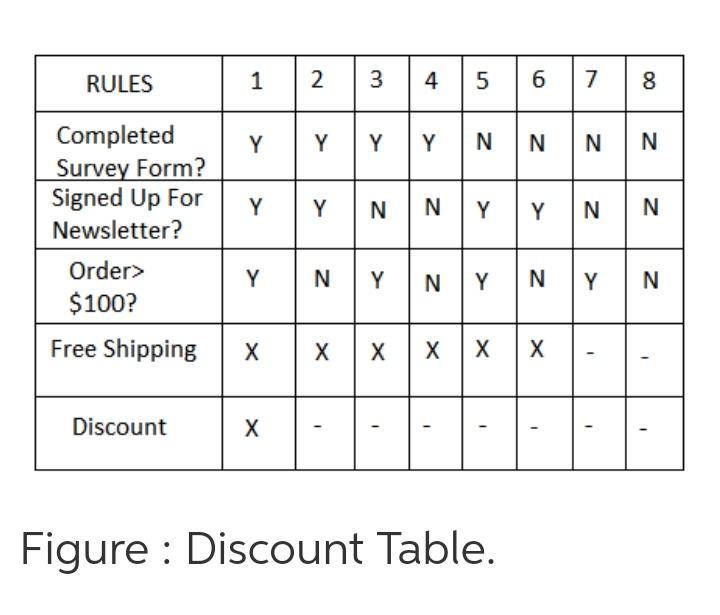
Step 1: Create a table reflecting the three potential scenarios and two possible outcomes. There should be a total of 8 distinct rules for the three varying conditions, structured similarly to the discount table shown here in the example: attached is the discount table

Step 2: The rules can now be made simpler by taking the following aspects into account:

a) When a consumer completes the survey form AND opts into the newsletter, according to Rules 1 and 2, they qualify for a discount if their order exceeds $100. This leads to two distinct rules being formulated while the third condition (order quantity) holds significance.

b) If the buyer fills out the survey form OR subscribes to the newsletter, as indicated by Laws 3, 4, 5, and 6, they will benefit from free shipping, regardless of the order amount. As a result, this situation can be divided into two individual rules, where at least one requirement is satisfied, but not both.

c) When a customer fails to meet any requirements, corresponding to Rules 7 and 8, the order value will not qualify for either free shipping or discount. This can be seen as a single law. The linked simplification table illustrates this.

7 0
2 months ago
Given: an int variable k, an int array current Members that has been declared and initialized, an int variable memberID that has
Natasha_Volkova [1026]

Answer:

The following C++ program is displayed below. No output is produced as per the requirements stated in the question.

#include <iostream>

using namespace std;

int main() {    

   // declaration and initialization of integer variables

   int k, memberID = 12, nMembers=5;

   bool isAMember;    

   // declaration and initialization of integer array

   int currentMembers[] = {12, 34, 56, 78, 90};    

   for(k=0; k<nMembers; k++)

   {

       if(memberID == currentMembers[k])

       {

           // if the member is found in the array, the loop exits using the break statement

           isAMember = true;

           break;

       }

       else

           isAMember = false;

   }    

   return 0;

}

Explanation:

The program starts with the declaration and initialization of integer variables, followed by the definition of an array that holds the identifiers of all members.

The Boolean variable is declared, although it isn't initialized at this point.

int k, memberID = 12, nMembers=5;

bool isAMember;

int currentMembers[] = {12, 34, 56, 78, 90};

Subsequently, the array containing the members' IDs is searched for the specific member ID. This action is performed using a for loop along with an if-else condition within that loop.

If the member ID exists in the array, the variable isAMember is set to true; otherwise, it is marked as false.

If isAMember is set to true, the break statement allows for the loop to be exited early.

for(k=0; k<nMembers; k++)

   {

       if(memberID == currentMembers[k])

       {

           isAMember = true;

           break;

       }

       else

           isAMember = false;

 }

The break statement is utilized since any other IDs in the array won't match the given member ID and thus, the variable isAMember would incorrectly be initialized to false even if the member ID is present in the array. Therefore, it's crucial to terminate the loop as soon as the matching member ID is located.

This program can be tested by utilizing different member ID values and varying the size of the array.


4 0
1 month ago
#Write a function called "angry_file_finder" that accepts a #filename as a parameter. The function should open the file, #read i
ivann1987 [1066]

Answer:

I am crafting a Python function:

def angry_file_finder(filename): #function definition, this function takes the file name as input

with open(filename, "r") as read: #the open() function is employed to access the file in read mode

lines = read.readlines() #readlines() yields a list of all lines in the file

for line in lines: #iterates through every line of the file

if not '!' in line: #checks if a line lacks an exclamation mark

return False # returns False if a line does not include an exclamation point

return True # returns true if an exclamation mark is present in the line

print(angry_file_finder("file.txt")) invokes the angry_file_finder function by supplying a text file name to it

Explanation:

The angry_file_finder function accepts a filename as its parameter. It opens this file in read mode utilizing the open() method with "r". Then it reads every line using the readline() function. The loop checks each line for the presence of the "!" character. If any line in the file lacks the "!" character, the function returns false; otherwise, it returns true.

There is a more efficient way to write this function without using the readlines() method.

def angry_file_finder(filename):

with open(filename, "r") as file:

for line in file:

if '!' not in line:

return False

return True

print(angry_file_finder("file.txt"))

The revised method opens the file in reading mode and directly uses a for-loop to traverse through each line to search for the "!" character. In the for-loop, the condition checks if "!" is absent from any line in the text file. If it is missing, the function returns False; otherwise, it returns True. This approach is more efficient for locating a character in a file.

7 0
1 month ago
Sketch the developments in multimedia. What do you expect to be the commercial impact of multimedia in the (near) future?
Natasha_Volkova [1026]

Answer:

Multimedia has become an essential and vital part of various sectors such as healthcare, education, entertainment, and marketing.

Explanation:

In the past, children primarily learned using textbooks, but now they engage with smart boards and other interactive digital devices that provide animated content.

The role of multimedia is crucial in entertainment, where there has been a significant increase in attendance for multimedia events.

Similarly, in the medical field, students can learn more effectively with the use of multimedia tools. Looking ahead, multimedia is expected to draw interest across all disciplines and its future seems promising.

4 0
2 months ago
On a typical microprocessor, a distinct I/O address is used to refer to the I/O data registers and a distinct address for the co
maria [1035]

Answer:

First I/O instruction format -> 256 ports

Second I/O instruction format -> 65536 ports

Explanation:

  • The initial instruction format can address 256 ports, computed from eight bits for port addressing as 2^8 = 256 ports.
  • The second instruction format allows for 65536 ports, which can be calculated using sixteen bits for addressing as 2^16 = 65536 ports.

Changing the opcode facilitates the selection between the first and second instruction format, allowing one input or output operation at a given moment.

5 0
2 months ago
Other questions:
  • Describe how the process of sampling, RGB pixels, and binary sequences work together to display a digital color image
    14·1 answer
  • Write a statement that reads a floating point value from standard input into temperature. Assume that temperature. has already b
    6·1 answer
  • According to the author, there are five hedging strategies organizations can pursue. One of them is: Select one: a. commit with
    5·1 answer
  • PLEASE HELP!!~~
    7·1 answer
  • A computer program is tested by 5 independent tests. If there is an error, these tests will discover it with probabilities 0.1,
    5·1 answer
  • Define a new object in variable sculptor that has properties "name" storing "Michelangelo"; "artworks" storing "David", "Moses"
    12·1 answer
  • The engineering firm you work for is submitting a proposal to create an amphitheater at a state park. Proposals must be submitte
    15·1 answer
  • Write a class for a Cat that is a subclass of Pet. In addition to a name and owner, a cat will have a breed and will say "meow"
    9·1 answer
  • Write a function in the cell below that iterates through the words in file_contents, removes punctuation, and counts the frequen
    6·1 answer
  • Which of the following image file formats uses lossy file compression?
    7·1 answer
Add answer
Login
Not registered? Fast signup
Signup
Login Signup
Ask question!