answer.
Ask question
Login Signup
Ask question
All categories
  • English
  • Mathematics
  • Social Studies
  • Business
  • History
  • Health
  • Geography
  • Biology
  • Physics
  • Chemistry
  • Computers and Technology
  • Arts
  • World Languages
  • Spanish
  • French
  • German
  • Advanced Placement (AP)
  • SAT
  • Medicine
  • Law
  • Engineering
Len
1 month ago
11

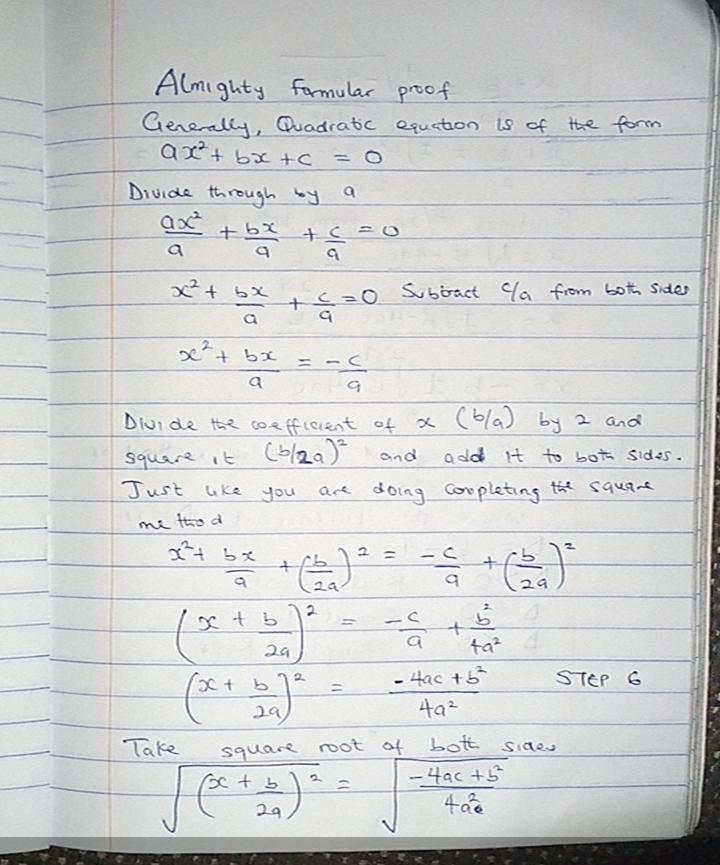
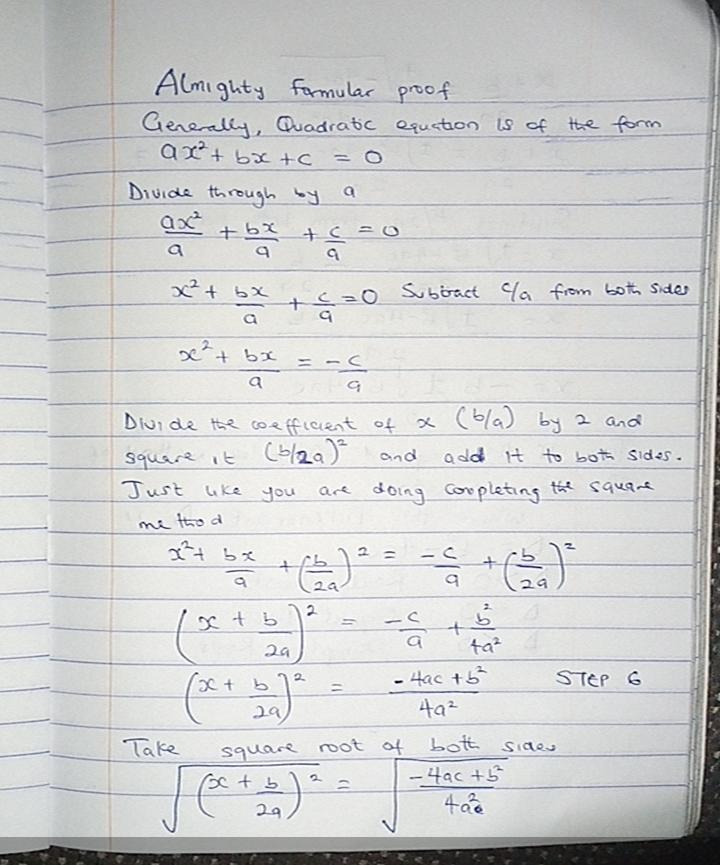
Two of the steps in the derivation of the quadratic formula are shown below. Step 6: StartFraction b squared minus 4 a c Over 4

a squared EndFraction = (x + StartFraction b Over 2 a EndFraction) squared Step 7: StartFraction plus or minus StartRoot b squared minus 4 a c EndRoot Over 1 a EndFraction = x + StartFraction b Over 2 a EndFraction Which operation is performed in the derivation of the quadratic formula moving from Step 6 to Step 7? subtracting StartFraction b Over 2 a EndFraction from both sides of the equation squaring both sides of the equation taking the square root of both sides of the equation taking the square root of the discriminant

Mathematics
2 answers:
babunello [11.8K]1 month ago
6 0

Explanation:

Step-by-step clarification:

Referring to step 6

(b² — 4ac) / 4a² = (x + b/2a)²

The mistake in the question is that it should be (x + b/2a)²

According to step 7

±√(b² —4ac) /2a = x + b/2a

The error in the question is that it should be divided by 2a, not 1a.

1. The transition from step 6 to step 7 involves taking the square roots of both sides

(b² — 4ac) / 4a² = (x + b/2a)²

Taking the square of both sides

√(b²—4ac) / √4a² = √(x + b/2a)²

√(b²—4ac) / 2a = x + b/2a

This forms step 7 correctly.

Next, subtracting b/2a from both sides

√(b²—4ac) / 2a - b/2a= x + b/2a -b/2a

√(b²—4ac) / 2a — b/2a = x

(√(b²—4ac)  — b)/2a = x

x = [—b ± √(b²—4ac)] / 2a

This gives the desired formula.

The discriminant is D = b²—4ac.
Svet_ta [12.7K]1 month ago
5 0

Explanation:

c

Detailed reasoning:

Square roots of both sides are extracted from the equation

You might be interested in
A cone-shaped water cup has a height of 3.3 inches and a diameter of 2.7 inches. One fluid ounce is equivalent to 1.8 cubic inch
lawyer [12517]
The capacity is approximately 3.5 fluid ounces. In order to determine this, we need to compute the volume of a cone-shaped cup. The formula for the volume of a cone is: 1/3 * π * r^2 * h, where r equals the diameter divided by 2, which gives 1.35 inches, and h equals 3.3 inches. After substituting these values, we find the volume to be V = 1/3 * 3.14 * 1.35^2 * 3.3 = 6.3 cubic inches. To convert cubic inches to fluid ounces, we use the relationship that 1 fluid ounce is equal to 1.8 cubic inches. Therefore, x fluid ounces equal to 6.3 cubic inches leads to x = 6.3 / 1.8, which results in 3.5 fluid ounces.
8 0
1 month ago
Read 2 more answers
A shipment of 20 similar laptop computers to a retail outlet contains 3 that are defective. If a school makes a random purchase
Svet_ta [12734]

Answer:

Step-by-step explanation:

The total count of laptops, N = 20

Defective laptops, n = 3

The school is purchasing 2 laptops

Case 1:

Both purchased laptops are non-defective

Probability of selecting 2 non-defective laptops

The count of non-defective laptops equals 20 - 3 = 17

Overall laptop count = 20

Probability, P = 17/20 = 0.85

Case 2:

One laptop is found defective

The probability of choosing 1 defective and 1 non-defective laptop

P' = 3/20 x 17/19 = 0.134

Case 3:

Both laptops are defective

Choosing 2 laptops from 3 = 3 C 2 = 3

Selecting 2 from 20 = 20 C 2 = 190

The probability of selecting two defective laptops equals 3 / 190 = 0.0158

P'' =

4 0
28 days ago
Which function in vertex form is equivalent to f(x) = 4 + x2 – 2x?
Svet_ta [12734]
The function in vertex form is evaluated to be.
7 0
28 days ago
Read 2 more answers
Jacob has a balance of $160 in her school lunch account, and he spends $10 per day for lunch. His sister Samantha has $40 in her
Zina [12379]
Jacob's lunch account will deplete in 16 days while Samantha's will run out in just 2 days. Step-by-step explanation:
5 0
28 days ago
James has t toy cars and Paul has 13 more. How many cars will James have if Paul gives him half of his cars?
zzz [12365]

James will retain his original t toy cars along with half of (t+13) cars, resulting in a total of...

... t + (t + 13/2) = (3t + 13)/2.... cars after receiving a gift from Paul.

6 0
1 month ago
Other questions:
  • Unless otherwise specified, the domain of a function f is assumed to be the set of all real numbers x for which f(x) is a real n
    8·1 answer
  • Ben has 400 counters in a bag. He gives 35 of the counters to Sonia 130 of the counters to Phil 75 of the counters to Lance What
    14·2 answers
  • The quotient of 9 3/4 and 5/8​
    9·2 answers
  • Parker invested $7,800 in an account
    10·1 answer
  • The growth of a species of fish in a lake can be modeled by the function ƒ(x) = 500(1.10)x, where x is time in months since Janu
    10·1 answer
  • A sample of 75 concrete blocks had a mean mass of 38.3 kg with a standard deviation of 0.6 kg.
    6·1 answer
  • In the figure, ∆ABD ≅ ∆CBD by Angle-Side-Angle (ASA). Which segments are congruent by CPCTC?
    15·2 answers
  • A man has a 10m X 10m square garden. In the center is a 2m X 2m square patch which he cannot use. He divides his usable space in
    12·1 answer
  • Kara and Lindsey both hike in separate directions from their campsite, with Kara hiking straight to the east and Lindsey hiking
    14·1 answer
  • Each big square below represents one whole.<br> What percent is represented by the shaded area?
    9·1 answer
Add answer
Login
Not registered? Fast signup
Signup
Login Signup
Ask question!