answer.
Ask question
Login Signup
Ask question
All categories
  • English
  • Mathematics
  • Social Studies
  • Business
  • History
  • Health
  • Geography
  • Biology
  • Physics
  • Chemistry
  • Computers and Technology
  • Arts
  • World Languages
  • Spanish
  • French
  • German
  • Advanced Placement (AP)
  • SAT
  • Medicine
  • Law
  • Engineering
Artist 52
1 month ago
12

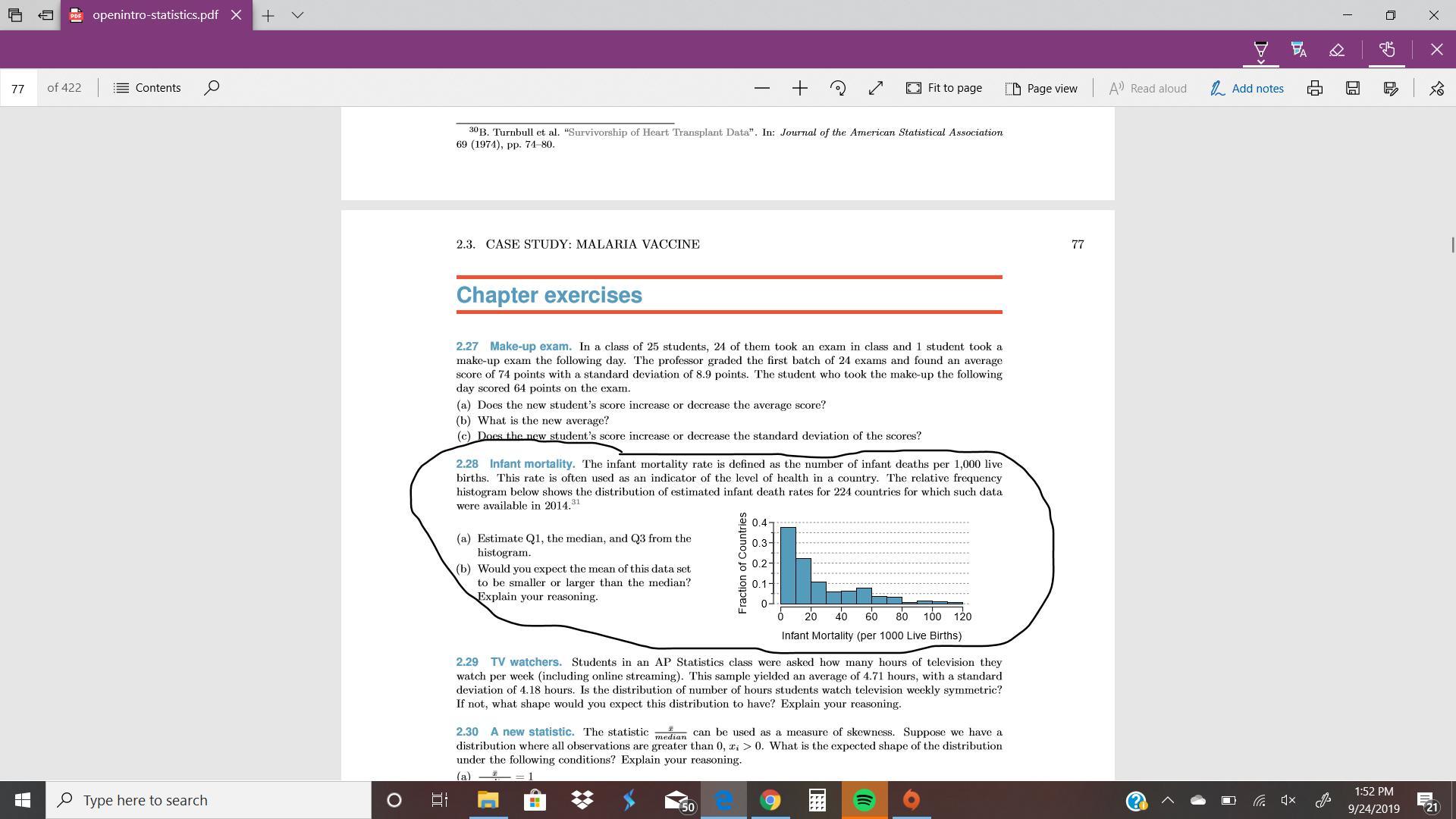
The infant mortality rate is defined as the number of infant deaths per 1,000 live births. This rate is often used as an indicato

r of the level of health in a country. The relative frequency histogram below shows the distribution of estimated infant death rates for 224 countries for which such data were available in 2014.31
(a) Estimate Q1, the median, and Q3 from the histogram.
(b) Would you expect the mean of this data set to be smaller or larger than the median? Explain your reasoning.
The graph that goes with it is in the picture.

Mathematics
1 answer:
tester [12.3K]1 month ago
8 0

(a)

Q1, or the first quartile, is at least 1/4 of the data points. It falls within the first bar, leading to an estimation of Q1=5. However, since this bar contains values ranging from 0 to around 9 or 10 (exactly unclear), and comprises almost 37% of the points, we might estimate Q1 slightly higher, around Q1=7.

The median must exceed half the points. With the first bar at 37% and the next at 22%, it is positioned roughly halfway in the second bar, giving median=15.

The third bar holds 11%, totaling 70% so far. The fourth bar includes 5%, placing us toward the end of the fourth bar for Q3, the third quartile, or 75th percentile, approximately Q3=40.

b

When data is significantly skewed to the left, as seen here, the median is typically lower than the mean. The 5% of data ranging from 80 to 120 averages around 100, contributing 5 to the mean, while 8% from 60 to 80 adds an additional 5.6, and 15% from 40 to 60 adds roughly 7.5. Consequently, the mean will likely be much higher than the median, which is around 15.

You might be interested in
P varies inversely with x. If P = 14 when x= 16, find the value of P when x = 21.
tester [12383]

Answer:

Option C. 32/3

Step-by-step explanation:

It is understood that

A relationship between two variables, x and y, signifies inverse variation if it can be represented as either p*x=k or p=k/x

It is also known that

For p=14, x=16

Determine the value of k

k=p*x

By substituting these values

k=(14)*(16)=224

This shows that

The equation equals

p=\frac{224}{x}

Calculate the value of p when x=21

Substitute the given value of x into the equation

p=\frac{224}{21}

Simplify

Divide both the numerator and denominator by 7

p=\frac{32}{3}

7 0
12 days ago
Justin wants to buy plants for his property, and he can afford to spend at most $480. The local nursery sells holly bushes for $
lawyer [12517]

Answer: 10 holly bushes and 12 bayberry shrubs

Step-by-step explanation: use your brain or a calculator to figure out the cost of each type of plant and then total them up

3 0
1 month ago
An urn contains 3 red and 7 black balls. Players and withdraw balls from the urn consecutively until a red ball is selected. Fin
Leona [12618]

Correct question:

An urn holds 3 red and 7 black balls. Players A and B take turns withdrawing balls until a red one is chosen. Calculate the probability that A picks the red ball. (A goes first, followed by B, with no replacement of drawn balls).

Answer:

The likelihood that A picks the red ball is 58.33 %

Step-by-step explanation:

A will select the red ball if it is drawn 1st, 3rd, 5th, or 7th.

1st draw: 9C2

3rd draw: 7C2

5th draw: 5C2

7th draw: 3C2

Calculating for all possible scenarios gives us:

9C2 = (9!) / (7!2!) = 36

7C2 = (7!) / (5!2!) = 21

5C2 = (5!) / (3!2!) = 10

3C2 = (3!) / (2!) = 3

Adding these possibilities results in 36 + 21 + 10 + 3 = 70.

The total outcomes for selecting a red ball = 10C3

10C3 = (10!) / (7!3!)

= 120.

The probability that A selects the red ball is determined by dividing the sum of possible events by the overall outcomes.

P( A selects the red ball) = 70 / 120

= 0.5833

= 58.33 %

7 0
1 month ago
In the diagram, DG = 15, GF = 5, EH = 12, and DE = 8. To prove that △DFE ~ △GFH by the SSS similarity theorem using the informat
lawyer [12517]

Answer: C) HF measures 4 units and GH is 2 units.

Step-by-step explanation:

The SSS similarity theorem asserts that triangles are similar if the lengths of their corresponding sides are in proportion.

For triangles ΔDFE and ΔGFH:

DG equals 15, GF is 5, EH equals 12, and DE is 8.

To demonstrate the similarity of ΔDFE and ΔGFH according to the SSS similarity theorem, we require:

\frac{DF}{GF}=\frac{FE}{FH}=\frac{DE}{GH}\\\\\Rightarrow\frac{DG+GF}{GF}=\frac{FH+EH}{FH}=\frac{DE}{GH}\\\\\Rightarrow\frac{5+15}{5}=\frac{12+HF}{FH}=\frac{8}{GH}\\\\\Rightarrow\frac{20}{5}=\frac{12+HF}{FH}\ and\ \frac{20}{5}=\frac{8}{GH}\\\\\Rightarrrow4HF=12+HF\ and\ GH=\frac{8}{4}\\\\\Rightarrow3HF=12\ and\ GH=2\\\\\Rightarrow HF=4\ and\ GH=2

Thus, to confirm that △DFE is similar to △GFH utilizing the SSS similarity theorem and the data from the diagram, it is essential to establish that HF measures 4 units and GH measures 2 units.

5 0
1 month ago
Read 2 more answers
At the warm-up event for Oscar’s All Star Hot Dog Eating Contest, Al ate one hot dog. Bob then showed him up by eating three hot
Inessa [12570]

Answer: Zeno consumed 51 hot dogs.

The total number of hot dogs consumed was 676.

Step-by-step explanation:

Al started by eating one hot dog. Bob then outperformed him by devouring three hot dogs. Carl, not wanting to fall behind, ate five hot dogs. This pattern continued, with each participant consuming two hot dogs more than the previous one. This indicates that the quantity of hot dogs eaten by each contestant followed an arithmetic sequence.

The formula for finding the nth term in an arithmetic series is given by

Tn = a + (n - 1)d

Where

a denotes the first term in the sequence.

d signifies the common difference.

n stands for the total terms in the sequence.

<pBased on the details provided,

a = 1 hot dog

d = 3 - 1 = 2 hot dogs

We aim to find how many hot dogs the 26th contestant, T26, consumed. Thus,

T26 = 1 + (26 - 1)2 = 1 + 50

T26 = 51 hot dogs

The formula to calculate the sum of n terms in an arithmetic sequence is

Sn = n/2[2a + (n - 1)d]

Hence, to find the total number of hot dogs consumed by 26 contestants, S26 is calculated as

S26 = 26/2[2 × 1 + (26 - 1)2]

S26 = 13[2 + 50]

S26 = 13 × 52 = 676 hot dogs

5 0
1 month ago
Other questions:
  • B = 3 V/H solve for V
    14·2 answers
  • Assume that the flask shown in the diagram can be modeled as a combination of a sphere and a cylinder. Based on this assumption,
    12·1 answer
  • If (a^3+27)=(a+3)(a^2+ma+9) then m equals
    7·1 answer
  • The table compares x, the number of minutes of television Sam watched each day, to y, the number of minutes she spent exercising
    15·2 answers
  • Select the correct answer. Twenty students in Class A and 20 students in Class B were asked how many hours they took to prepare
    11·1 answer
  • On a number line, a number, b, is located the same distance from 0 as another number, a, but in the opposite direction. The numb
    15·1 answer
  • People at the state fair were surveyed about which type of
    6·1 answer
  • Zoe is planning to adopt 2 pets. She is equally likely to choose a dog or cat for each pet. Zoe modeled her choices with an expe
    15·1 answer
  • In a certain small town there were 50 babies born in one year. Of these 50 babies, 30 were girls and 20 were boys. To investigat
    15·1 answer
  • Jane is training for a triathlon. After swimming a few laps, she leaves the health club and bikes 16 miles south. She then runs
    6·1 answer
Add answer
Login
Not registered? Fast signup
Signup
Login Signup
Ask question!