answer.
Ask question
Login Signup
Ask question
All categories
  • English
  • Mathematics
  • Social Studies
  • Business
  • History
  • Health
  • Geography
  • Biology
  • Physics
  • Chemistry
  • Computers and Technology
  • Arts
  • World Languages
  • Spanish
  • French
  • German
  • Advanced Placement (AP)
  • SAT
  • Medicine
  • Law
  • Engineering
ololo11
8 days ago
13

There are seven boys and five girls in a class. The teacher randomly selects three different students to answer questions. The f

irst student is a girl, the second student is a boy, and the third student is a girl. Find the probability of this occuring.

Mathematics
2 answers:
Zina [3.9K]8 days ago
4 0

The probability of this scenario occurring is 7/66

Additional clarification

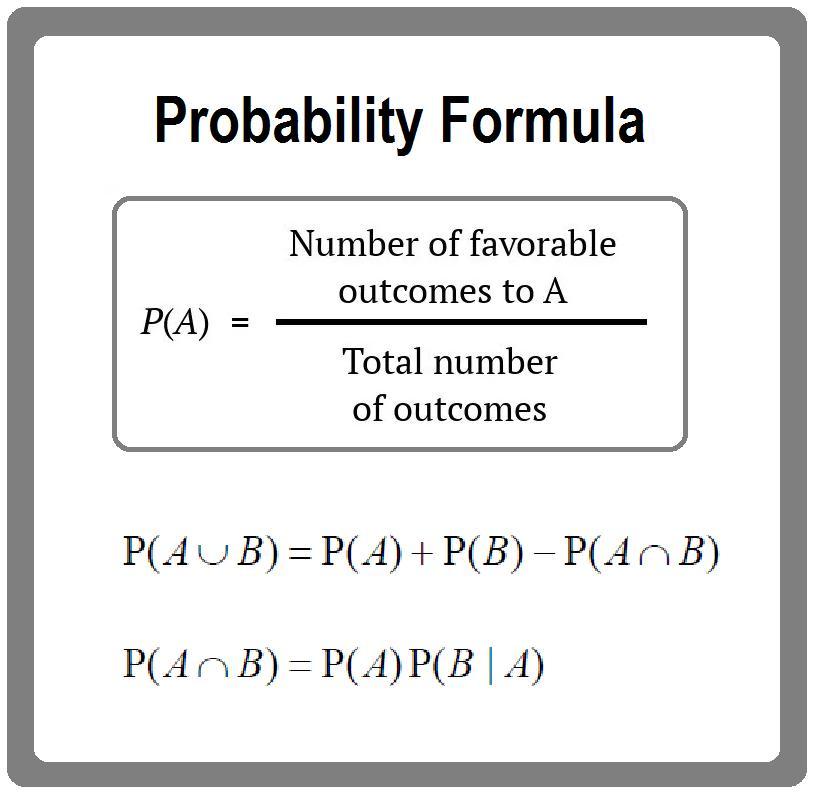
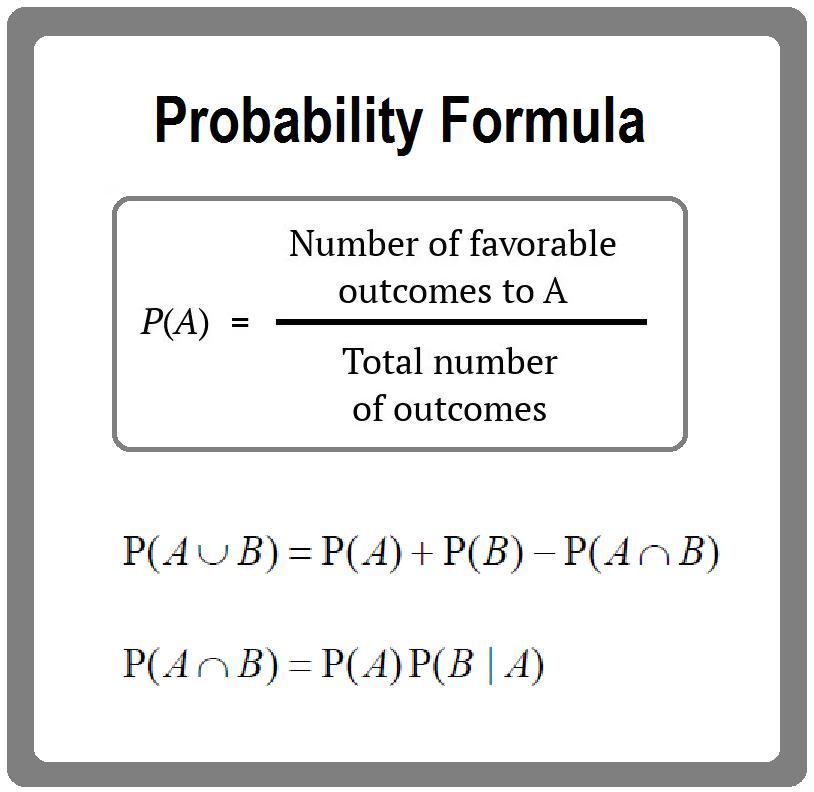
Probability is described as the chance of an event happening compared to the sample space.

\large { \boxed {P(A) = \frac{\text{Number of Favorable Outcomes to A}}{\text {Total Number of Outcomes}} } }

Permutation ( Arrangement )

Permutation signifies the various ways to arrange items.

\large {\boxed {^nP_r = \frac{n!}{(n - r)!} } }

Combination ( Selection )

Combination refers to the different ways to select items.

\large {\boxed {^nC_r = \frac{n!}{r! (n - r)!} } }

Let’s analyze the problem!

There are seven boys and five girls present in the class

yielding a total of 12 students.

The chance that the first selected is a girl

The likelihood of the first choice being a girl P(G₁):

P(G_1) = \boxed {\frac{5}{12}}

The odds of selecting a boy second P(B):

P(B) = \boxed {\frac{7}{11}}

The probability of picking a girl third P(G₂):

P(G_2) = \boxed {\frac{4}{10}}

The probability of the first selected being a girl, the second being a boy, and the third being a girl:

\large {\boxed {P(G_1 \cap B \cap G_2) = \frac{5}{12} \times \frac{7}{11} \times \frac{4}{10} = \frac{7}{66} } }

We can utilize permutations to derive this outcome.

From the 5 girls, arrange 2 for the first and third selections:

^5P_2 = \frac{5!}{(5-2)!} = \frac{5!}{3!} = 4 \times 5 = \boxed{20}

From the 7 boys, arrange 1 for the second choice:

^7P_1 = \frac{7!}{(7-1)!} = \frac{7!}{6!} = \boxed {7}

The total count of arrangements for choosing 3 distinct students from a group of 12:

^{12}P_3 = \frac{12!}{(12-3)!} = \frac{12!}{9!} = 10 \times 11 \times 12 = \boxed {1320}

The probability of first selecting a girl, then a boy, and again a girl:

\large {\boxed {P(G_1 \cap B \cap G_2) = \frac{20 \times 7}{1320} = \frac{7}{66} } }

Explore more

  • Different Birthdays:
  • Dependent or Independent Events:
  • Mutually exclusive:

Answer specifics

Level: High School

Subject: Mathematics

Section: Probability

Keywords: Probability, Sample, Space, Six, Dice, Die, Binomial, Distribution, Mean, Variance, Standard Deviation
Svet_ta [4.3K]8 days ago
4 0

The likelihood of selecting one girl is calculated as \frac{5}{12}. This is based on having 5 girls within a total of 12 students, and the probability of an event can be expressed as: \frac{\text{# of things you want}}{\text{# of things are possible}}.

Using the same reasoning, for the next student, we have reduced the number of students by 1, leading to 11 possible outcomes instead of 12, giving us:\frac{7}{11}, which represents the probability of selecting a boy as the second choice.

Lastly, the probability of choosing a girl for the third selection follows the same logic and is given as:\frac{4}{10}.

However, we must combine these individual probabilities to determine the likelihood of this specific sequence of selections occurring:

\frac{5}{12}*\frac{7}{11}*\frac{4}{10}=\frac{140}{1320}

This simplifies to:

\frac{7}{66}

You might be interested in
Finally, suppose m1→∞, while m2 remains finite. what value does the the magnitude of the tension approach?
AnnZ [3877]
The tension does not approach infinity.
<span>Let's analyze free body diagrams (FBDs) for each mass, considering the direction of motion of m₁ as positive.

For m₁: m₁*g - T = m₁*a

For m₂: T - m₂*g = m₂*a

Assuming a massless cord and pulley without friction, the accelerations are the same.

From the second equation: a = (T - m₂*g) / m₂

Substitute into the first:
m₁*g - T = m₁ * [(T - m₂*g) / m₂]
Rearranging:
m₁*g - T = (m₁*T)/m₂ - m₁*g
2*m₁*g = T * (1 + m₁/m₂)
2*m₁*m₂*g = T * (m₂ + m₁)
T = (2*m₁*m₂*g) / (m₂ + m₁)
Taking the limit as m₁ approaches infinity:
T = 2*m₂*g

This aligns with intuition since the greatest acceleration m₁ can have is -g. The cord then accelerates m₂ upward at g while gravity acts downward, leading to a maximum upward acceleration of 2*g for m₁.</span>
5 0
14 days ago
A students calculation was found to have a 15.6% error, and the actual value was determined to be 25.7 mL. What are the two poss
PIT_PIT [3919]
The true value is 25.7 ml.
The calculated error is 15.6%.
Thus, the error amount equals 0.156 times 25.7, which calculates to 4.0092 ml.

The percentage error indicates that the student's measurement could either exceed or fall short of the true value by this error amount.

This leads to two potential readings:
one possibility is: 25.7 + 4.0092 = 29.7092 ml
the other possibility is: 25.7 - 4.0092 = 21.6908 ml

8 0
9 days ago
Read 2 more answers
At the warm-up event for Oscar’s All Star Hot Dog Eating Contest, Al ate one hot dog. Bob then showed him up by eating three hot
Inessa [3907]

Answer: Zeno consumed 51 hot dogs.

The total number of hot dogs consumed was 676.

Step-by-step explanation:

Al started by eating one hot dog. Bob then outperformed him by devouring three hot dogs. Carl, not wanting to fall behind, ate five hot dogs. This pattern continued, with each participant consuming two hot dogs more than the previous one. This indicates that the quantity of hot dogs eaten by each contestant followed an arithmetic sequence.

The formula for finding the nth term in an arithmetic series is given by

Tn = a + (n - 1)d

Where

a denotes the first term in the sequence.

d signifies the common difference.

n stands for the total terms in the sequence.

<pBased on the details provided,

a = 1 hot dog

d = 3 - 1 = 2 hot dogs

We aim to find how many hot dogs the 26th contestant, T26, consumed. Thus,

T26 = 1 + (26 - 1)2 = 1 + 50

T26 = 51 hot dogs

The formula to calculate the sum of n terms in an arithmetic sequence is

Sn = n/2[2a + (n - 1)d]

Hence, to find the total number of hot dogs consumed by 26 contestants, S26 is calculated as

S26 = 26/2[2 × 1 + (26 - 1)2]

S26 = 13[2 + 50]

S26 = 13 × 52 = 676 hot dogs

5 0
9 days ago
Tim was given a large bag of sweets and ate one third of the sweets before stopping as he was feeling sick. The next day he ate
Leona [4166]

Answer: Initially, he had 27 sweets.

Step-by-step explanation: The most logical approach is to work backwards from what remained after the third day to the start of the first day.

On the third day, he consumed one-third of his sweets and was left with 8. If we let the total sweets on day three be denoted as a, then one-third of a equals what he ate and the two-thirds left equals 8, giving us:

8/a = 2/3

By cross-multiplying, we find:

8 x 3 = 2a

Therefore, 24 = 2a

This leads to a = 12.

Let the sweets on day two be represented as b. If he consumed one-third of b and was left with 12, we have the same structure; hence:

12/b = 2/3

Cross-multiplying gives:

12 x 3 = 2b

So, 36 = 2b, leading to b = 18.

Denote the number of sweets on day one as x. If one-third of x was eaten and 18 remained, we can set up the equation:

18/x = 2/3

Again, cross-multiplying results in:

18 x 3 = 2x

Which simplifies to 54 = 2x, yielding x = 27.

Thus, Tim received 27 sweets at the start.

3 0
12 days ago
On a fishing trip, you catch two fish . The weight of the first fish is shown (1.2lb). The second fish weighs at least 0.5 pound
PIT_PIT [3919]

Answer: 1.2 < 1.7x

Step-by-step explanation:

7 0
15 days ago
Other questions:
  • An ant arrives at the snail’s starting position at time minutes and follows the snail’s path. During the interval minutes, the a
    9·1 answer
  • A credit card contains 16 digits between 0 and 9. However, only 100 million numbers are valid. If a number is entered randomly,
    8·1 answer
  • If g(x)=4x^2-16 were shifted 5 units to the right and 2 down, what would the new equation be?
    9·2 answers
  • Find x if a =13 and C = 47 need help
    11·1 answer
  • LMN is a straight angle. Find m LMP and m NMP​
    6·1 answer
  • Lin made a mixture consisting of 24 ounces of instant tea and 12 ounces of green tea. Approximately how many milligrams of caffe
    7·2 answers
  • George took a nonstop flight from Dallas to
    9·1 answer
  • A rectangle has area 64 m2. Express the perimeter of the rectangle as a function of the length L of one of its sides. State the
    8·1 answer
  • The coordinates of the endpoints of and are A(x1, y1), B(x2, y2), C(x3, y3), and D(x4, y4). Which condition proves that ?
    13·3 answers
  • A market research firms conducts studies regarding the success of new products. The company is not always perfect in predicting
    13·1 answer
Add answer
Login
Not registered? Fast signup
Signup
Login Signup
Ask question!