answer.
Ask question
Login Signup
Ask question
All categories
  • English
  • Mathematics
  • Social Studies
  • Business
  • History
  • Health
  • Geography
  • Biology
  • Physics
  • Chemistry
  • Computers and Technology
  • Arts
  • World Languages
  • Spanish
  • French
  • German
  • Advanced Placement (AP)
  • SAT
  • Medicine
  • Law
  • Engineering
ElenaW
8 days ago
6

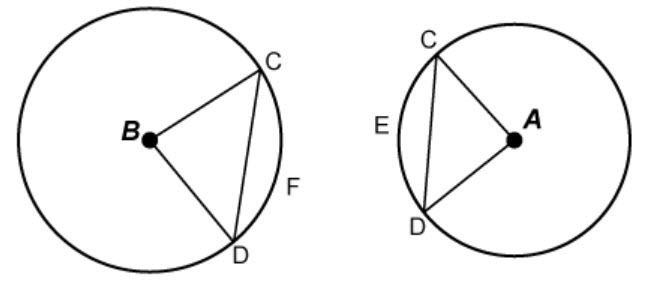
Find the area of segment CFD given the following information: radius = 8in, area of ΔCBD = 25.9in2, and m∠CBD = 54° Round your a

nswer to the nearest hundredths if necessary.
A. 4.26 in2
B. 20.10 in2
C. 3.23 in2
D. 17.90 in2

Mathematics
You might be interested in
Venetta buys 2 pounds of pistachios and 3 pounds of almonds. The pistachios cost $4 more per pound than the almonds. She pays a
babunello [11817]

Answer:

A. Combining one pound of pistachios with one pound of almonds costs $20.

C. Decreasing the almond quantity by one pound leads to a total price of $40.

E. The price p (in dollars) per pound of pistachios is represented by the equation 2p + 3(p – 4) = 48.

Step-by-step explanation:

Let:

x = cost per pound of pistachios

y = cost per pound of almonds

We know that

x = y + 4 (Equation A)

2x + 3y = 48 (Equation B)

Substitute x from Equation A into Equation B:

2(y + 4) + 3y = 48

2y + 8 + 3y = 48

5y = 48 – 8

y = 8

Find x:

x = 8 + 4 = 12

Therefore, pistachios cost $12 per pound and almonds cost $8 per pound.

Verify the statements:

Case A) One pound of each equals $20.

True, since 12 + 8 = 20.

Case B) Pistachios cost twice as much as almonds.

False, because 2 × 8 = $16 ≠ $12.

Case C) Reducing almond pounds by 1 yields $40 total.

True, as 2(12) + 2(8) = 24 +16 = 40.

Case D) The almond cost modeled by 2(a – 4) + 3a = 48.

False; it should be 2(a + 4) + 3a = 48.

Case E) The pistachio cost modeled by 2p + 3(p – 4) = 48.

True, since p = a + 4 implies a = p – 4.
8 0
4 months ago
Find the annual rate of growth (interest rate) on an account that was worth $200 in 1975 and $415.79 in 1990
tester [12383]
To find the percent change over time, use the following formula: PR = Percent Rate, VPresent = Present or Future Value, VPast = Past or Present Value. The annual percentage growth rate is calculated by dividing the percent growth by N, which is the number of years. The calculation (415.79 - 200) / 200 * 100 results in 107.89. The annual percentage growth rate is then 107.89 divided by 15, which equals 7.193.
8 0
3 months ago
Read 2 more answers
Of the 2000 students attending, every 5th student going into the basketball game is asked if the school should spend more money
babunello [11817]
The students likely won't care much about the spending because they aren't using their own money.
8 0
3 months ago
Other questions:
  • WNAE, an all-news AM station, finds that the distribution of the lengths of time listeners are tuned to the station follows the
    13·1 answer
  • A thumbtack that is tossed can land point up or point down. The probability of a tack landing point up is 0.2. A simulation was
    12·2 answers
  • Todd had 6 gallons of gasoline in his motorbike. After driving 150​ miles, he had 3 gallons left. Compute the​ slope, or rate of
    9·2 answers
  • The image is an example of which type(s) of symmetry
    12·2 answers
  • Which two sentences in this excerpt from John Steinbeck's "Symptoms" address the theme of soldiers being reluctant to talk about
    10·2 answers
  • Steve buys 2 lb of grapefruit and 3 lb of oranges for $7.20. Kennedy buys 4 lb of grapefruit and 2 lb of oranges for $8.80. Let
    6·1 answer
  • CC Paper Company makes various types of paper products. One of their products is a 30 mils thick paper. In order to ensure that
    11·1 answer
  • Line AB contains points A(4, 5) and B(9, 7). What is the slope of ? –negative StartFraction 5 Over 2 EndFraction –negative Start
    15·2 answers
  • A problem states: "There are 2 more horses than cows in a field. There are 16 animals in the field in all. How many horses are t
    12·1 answer
  • Divide: 83.5 ÷ 6.25 The first step in solving 83.5 ÷ 6.25 is to multiply the divisor and dividend by . The new division problem
    7·1 answer
Add answer
Login
Not registered? Fast signup
Signup
Login Signup
Ask question!
