answer.
Ask question
Login Signup
Ask question
All categories
  • English
  • Mathematics
  • Social Studies
  • Business
  • History
  • Health
  • Geography
  • Biology
  • Physics
  • Chemistry
  • Computers and Technology
  • Arts
  • World Languages
  • Spanish
  • French
  • German
  • Advanced Placement (AP)
  • SAT
  • Medicine
  • Law
  • Engineering
Pavel
1 month ago
7

 A bartender slides a beer mug at 1.50 m/s toward a customer at the end of a frictionless bar that is 1.20 m tall. The customer

makes a grab for the mug and misses, and the mug sails off the end of the bar.  (a) How far away from the end of the bar does the mug hit the floor?  (b) What are the speed and direction of the mug at impact?

Physics
1 answer:
serg [3.5K]1 month ago
4 0

Response:

a) The mug makes contact with the ground 0.7425m from the bar's end. b) |V|=5.08m/s θ= -72.82°

Clarification:

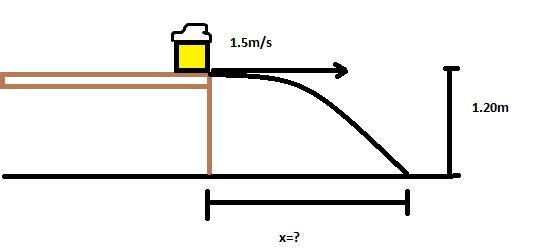
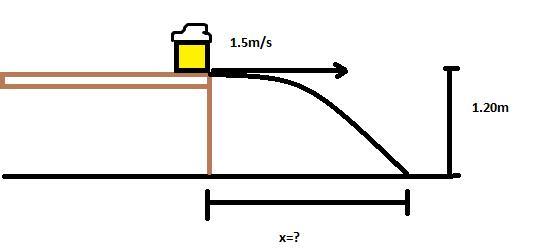
To address this issue, we begin with a diagram depicting the situation. (refer to the attached illustration).

a)

The illustration shows that the problem involves motion in two dimensions. To determine how far from the bar the mug lands, we need to find the time the mug remains airborne by examining its vertical motion.

To compute the time, we utilize the following formula with the known values:

y_{f}=y_{0}+v_{y0}t+\frac{1}{2}at^{2}

We have y_{f}=0 and v_{y0}=0, allowing us to simplify the equation to:

0=y_{0}+\frac{1}{2}at^{2}

Now, we can calculate for t:

-y_{0}=\frac{1}{2}at^{2}

-2y_{0}=at^{2}

\frac{-2y_{0}}{a}=t^{2}

t=\sqrt{\frac{-2y_{0}}{a}}

We know y_{0}=1.20m and a=g=-9.8m/s^{2}

The negative gravity indicates the downward motion of the mug. Hence, we substitute these values into the provided formula:

t=\sqrt{\frac{-2(1.20m)}{(-9.8m/s^{2})}}

Which results in:

t=0.495s

This time helps us evaluate the horizontal distance the mug traverses. Since:

V_{x}=\frac{x}{t}

Solving for x, we have:

x=V_{x}t

Substituting the known values yields:

x=(1.5m/s)(0.495s)

This calculates to:

x=0.7425m

b) With the time determining when the mug strikes the ground established, we can find the final velocity in the vertical direction using the formula:

a=\frac{v_{f}-v_{0}}{t}

The initial vertical velocity being zero simplifies our calculations:

a=\frac{v_{f}}{t}

Thus, we can determine the final velocity:

V_{yf}=at

Given that the acceleration equates to gravity (showing a downward effect), we substitute that alongside the previously found time:

V_{yf}=(-9.8m/s^{2})(0.495s)

This leads to:

V_{yf}=-4.851m/s

Now, we ascertain the velocity components:

V_{xf}=1.5m/s and V_{yf]=-4.851m/s

Next, we find the speed by calculating the vector's magnitude:

|V|=\sqrt{V_{x}^{2}+V_{y}^{2}}

<pThus:

|V|=\sqrt{(1.5m/s)^{2}+(-4.851m/s)^{2}

Yielding:

|V|=5.08m/s

Lastly, to ascertain the impact direction, we apply the equation:

\theta = tan^{-1} (\frac{V_{y}}{V_{x}})

<pFulfilling this provides:

\theta = tan^{-1} (\frac{-4.851m/s}{(1.5m/s)})

<pLeading to:

\theta = -72.82^{o}

You might be interested in
You are waiting to turn left into a small parking lot. a car approaching from the opposite direction has a turn signal on. you s
Sav [3153]
If the car from the opposite direction activates its turn signal, it is advisable to yield and allow that driver to turn before you initiate your own turn, as they have the right of way. This action can help avert potential complications and demonstrate courtesy on the road.
6 0
27 days ago
Three point charges are arranged on a line. Charge q3=+5.00x10^-9C and is at the origin. Charge q2=-3.00x10^-9C and is at x=+4.0
Sav [3153]

Answer:

The result is 0.750 NC

Explanation:

I am also taking the same test

5 0
17 days ago
Read 2 more answers
Physics students study a piano being pulled across a room on a rug. They know that when it is at rest, it experiences a gravitat
inna [3103]
The static frictional force exceeds the kinetic frictional force, indicating that the static frictional force is over 1200 N. Explanation: The frictional force opposes the motion of any object on a surface, caused by interactions between the surface molecules and the object. It is known that static friction is typically stronger than kinetic friction (this is the reason initiating motion requires more force than keeping it moving along a surface). Hence, option 3 correctly describes the situation.
3 0
28 days ago
A beaker contain 200mL of water<br> What is its volume in cm3 and m3
Sav [3153]
The volumes are 200cm3 and 0.0002m3
7 0
1 month ago
Read 2 more answers
A skateboarder is attempting to make a circular arc of radius r = 16 m in a parking lot. The total mass of the skateboard and sk
kicyunya [3294]

To address this question, we will utilize concepts linked to centripetal force, aligning it with the static frictional force acting on the object. Using this relationship, we can derive the velocity and input the known values. The defined values are:

r = 16m

m = 82kg

\mu_s = 0.63

The maximum velocity can be determined using centripetal force,

F_c = \frac{mv^2}{r}

Should be equal to,

\frac{mv^2}{r} = \mu_s mg

v = \sqrt{\mu_s gr}

v = \sqrt{(0.63)(9.8)(16)}

v = 9.93m/s

As a result, the highest speed achievable through the arc without slipping is 9.93m/s

3 0
1 month ago
Other questions:
  • A 2600-m-high mountain is located on the equator. how much faster does a climber on top of the mountain move than a surfer at a
    14·1 answer
  • Pure sodium metal placed in water will spark and ignite, as well as form bubbles and gas. What are the signs that this is a chem
    15·2 answers
  • A 7.0-kilogram cart, A, and a 3.0-kilogram cart, B, are initially held together at rest on a horizontal, frictionless surface. W
    7·1 answer
  • A cart moves along a track at a velocity of 3.5 cm/s. When a force is applied to the cart, its velocity increases to 8.2 cm/s. I
    6·2 answers
  • You ride a roller coaster with a loop-the-loop. Compare the normal force that the seat exerts on you to the force that Earth exe
    14·1 answer
  • Two balls of unequal mass are hung from two springs that are not identical. The springs stretch the same distance as the two sys
    12·1 answer
  • A weather balloon travels upward for 6 km whi le the wind blows it 10 km north and 8 km east. Approximately what is its final di
    14·1 answer
  • An Object moving at a velocity of 30 m/s slows to a stop in 7 seconds. What was its acceleration
    12·1 answer
  • The weight of a bucket is 186 N. The bucket is being raised by two ropes. The free-body diagram shows the forces acting on the b
    15·1 answer
  • A ladybug sits at the outer edge of a turntable, and a gentleman bug sits halfway between her and the axis of rotation. The turn
    7·2 answers
Add answer
Login
Not registered? Fast signup
Signup
Login Signup
Ask question!