answer.
Ask question
Login Signup
Ask question
All categories
  • English
  • Mathematics
  • Social Studies
  • Business
  • History
  • Health
  • Geography
  • Biology
  • Physics
  • Chemistry
  • Computers and Technology
  • Arts
  • World Languages
  • Spanish
  • French
  • German
  • Advanced Placement (AP)
  • SAT
  • Medicine
  • Law
  • Engineering
Vsevolod
4 days ago
5

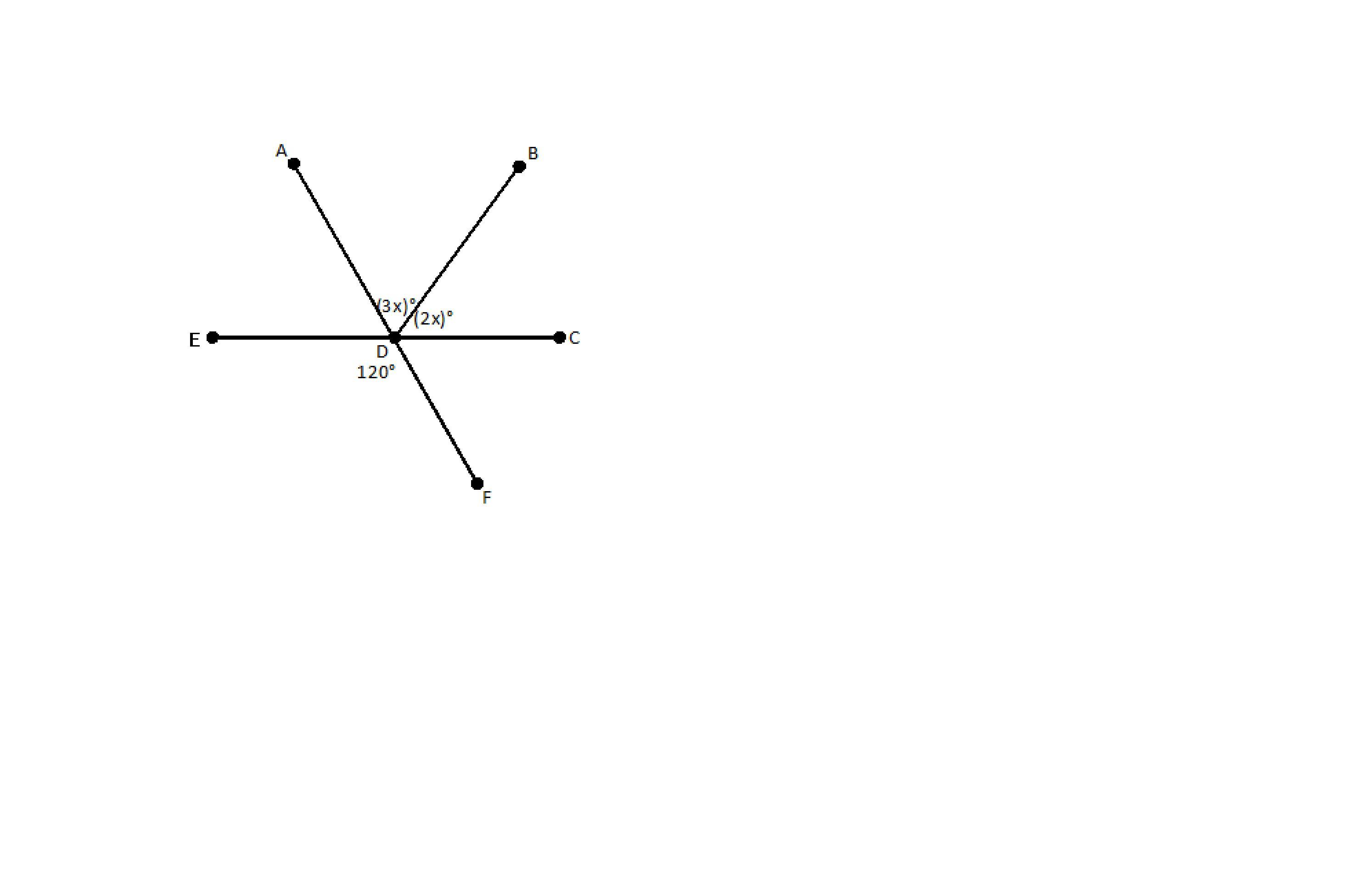
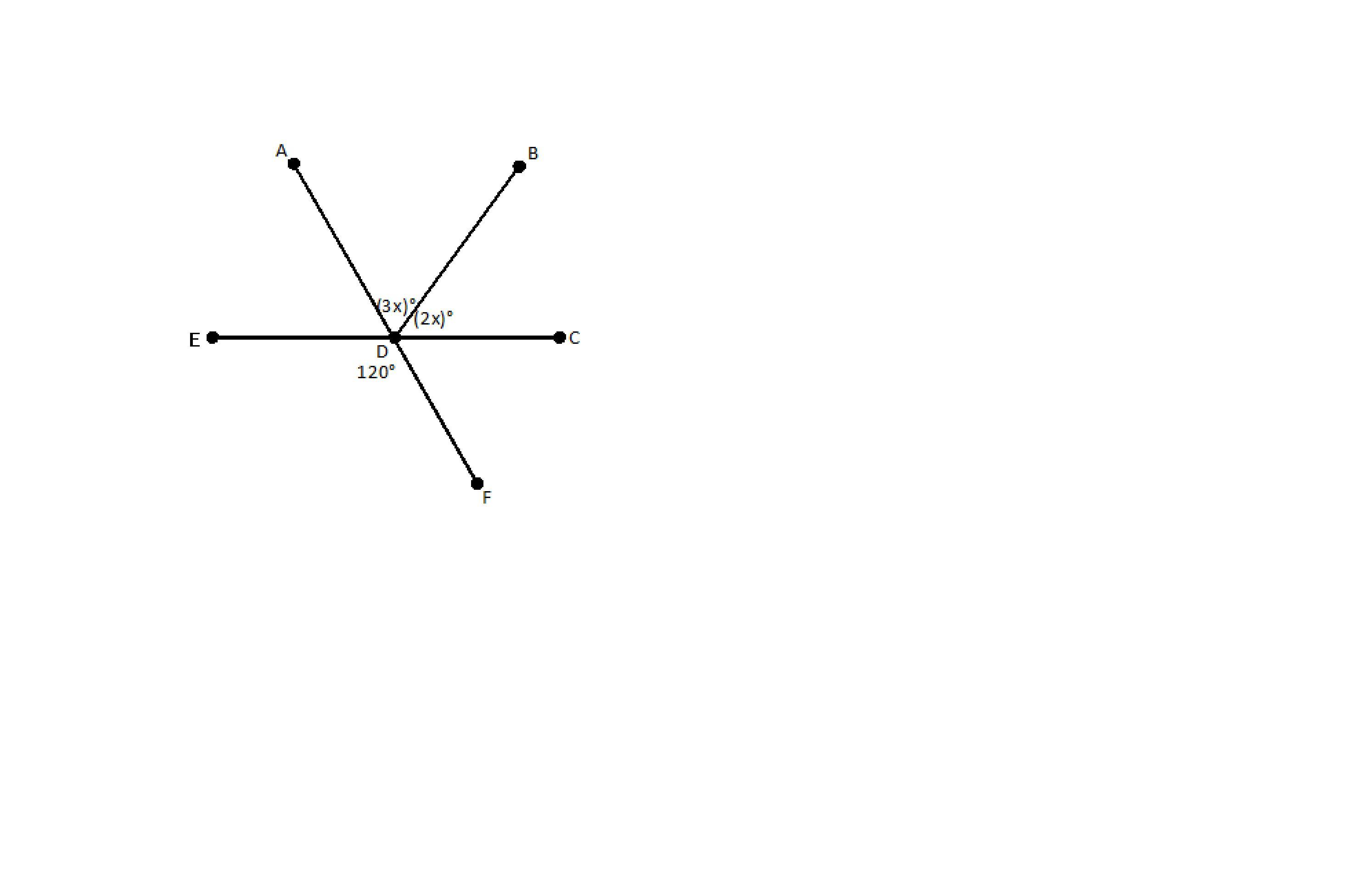
Given: mAngleEDF = 120°; mAngleADB = (3x)°; mAngleBDC = (2x)° Prove: x = 24 3 lines are shown. A line with points E, D, C inters

ects a line with points A, D, F at point D. A line extends from point D to point B in between angle A D C. Angle E D F is 120 degrees, angle C D B is (2 x) degrees, and angle B D A is (3 x) degrees. What is the missing reason in step 3? A 2-column table has 9 rows. Column 1 is labeled statements with entries measure of angle E D F = 120 degrees measure of angle A D B = (3 x) degrees measure of angle B D C = (2 x) degrees, angle E D F and angle A D C are vertical angles, angle E D F is-congruent-to angle A D C, measure of angle A D C = measure of angle A D B + measure of angle B D C, measure of angle E D F = measure of angle A D C, measure of angle E D F = measure of angle A D B + measure of angle B D C, 120 = 3 x + 2 x, 120 = 5 x, x = 24. Column 2 is labeled Reasons with entries given, def. of vert. angles, question mark, angle add. post., definition of congruency, substitution, substitution, addition, div, prop. of equality. vertical angles are congruent substitution definition of congruency definition of equality

Mathematics
2 answers:
AnnZ [3.8K]4 days ago
8 0

Answer:

2nd

Step-by-step explanation:

zzz [4K]4 days ago
6 0

Answer:

" Vertical angles are equal " ⇒ 2nd answer

Step-by-step explanation:

* Refer to the attached illustration

- Three lines intersect at point D.

- We have to identify the missing justification in step 3.

∵ Line FA intersects line EC at point D.

- When two lines cross, the angles created are referred to as

 vertical angles.

- By the vertical angles theorem, vertical angles are equal.

Thus, ∠ADC and ∠FDE are vertical angles.

Since vertical angles are equal

∴ ∠EDF ≅ ∠ADC

Thus, m∠EDF ≅ m∠ADC

Given that m∠EDF = 120°.

∵ m∠ADC is the sum of m∠ADB and m∠BDC.

Therefore, m∠ADB + m∠BDC = 120°.

∵ m∠ADB = (3x)° ⇒ given.

∵ m∠BDC = (2x)° ⇒ given.

Thus, 3x + 2x = 120 ⇒ combine like terms.

Thus, 5x = 120 ⇒ divide both sides by 5.

Thus, x = 24.

Column (1)                                                     Column (2)

m∠EDF = 120°                                               given

m∠ADB = 3 x                                                 given

m∠BDC = 2 x                                                 given

∠EDF and ∠ADC are vertical angles           definition of vertical angles

∠EDF is equal to ∠ADC                           vertical angles are equal

                                                                        equal  

m∠ADC = m∠ADB + m∠BDC                        angle addition principle.

m∠EDF = m∠ADC                                          definition of equality.

m∠EDF = m∠ADB + m∠BDC                         substitution.

120° = 3 x + 2 x                                               substitution.

120 = 5 x                                                         addition.

x = 24                                                           division.

∴ The missing justification is " vertical angles are equal "

- From the reasoning above, ∠ADC and ∠FDE are vertical angles and therefore they are equal according to the vertical angle theorem.

You might be interested in
How much profit was generated by the sales of gold label and black label combined?
lawyer [4008]
The profit produced by combining sales of gold label and black label equals the total of their individual profits. From the table \begin{array}{ccc}&\text{Number of bottles sold}&\text{Average profit (per bottle)}\\\text{Gold label}&1,000&\$2.75\end{array} you find the gold label's profit 1,000\cdot \$2.75=\$2,750. and similarly from another table \begin{array}{ccc}&\text{Number of bottles sold}&\text{Average profit (per bottle)}\\\text{Black label}&2,000&\$1.50\end{array} find the black label's profit 2,000\cdot \$1.50=\$3,000.. Adding these yields \$2,750+\$3,000=\$5,750.. Thus, option 5 is the correct choice.
8 0
17 days ago
Read 2 more answers
A survey of 100 people found that 35 people exercise in the morning, 45 people exercise in the afternoon, and 20 people exercise
Zina [3914]
Out of 100 surveyed individuals, 35 work out in the morning, 45 in the afternoon, and 20 at night.

Jim is accurate.....
The ratio of morning exercisers to the whole group is 35/100.
The ratio of afternoon exercisers is 45/100.
The ratio for night exercisers is 20/100.
7 0
4 days ago
Read 2 more answers
Laura is the fund-raising manager for a local charity. She is ordering caps for an upcoming charity walk. The company that makes
Zina [3914]

Let x represent the number of caps

cost per cap = $6

cost for x caps = 6x

shipping charge = $25

overall budget = $1000

We can set up the following inequality:

Because the total amount cannot exceed 1000, we have

25 + 6x ≤ 1000

6x ≤ 975

x ≤ 162.5

rounding,

x ≤ 163

This means she can purchase a maximum of 163 caps.

5 0
10 days ago
Two of the steps in the derivation of the quadratic formula are shown below. Step 6: StartFraction b squared minus 4 a c Over 4
babunello [3635]

Explanation:

Step-by-step clarification:

Referring to step 6

(b² — 4ac) / 4a² = (x + b/2a)²

The mistake in the question is that it should be (x + b/2a)²

According to step 7

±√(b² —4ac) /2a = x + b/2a

The error in the question is that it should be divided by 2a, not 1a.

1. The transition from step 6 to step 7 involves taking the square roots of both sides

(b² — 4ac) / 4a² = (x + b/2a)²

Taking the square of both sides

√(b²—4ac) / √4a² = √(x + b/2a)²

√(b²—4ac) / 2a = x + b/2a

This forms step 7 correctly.

Next, subtracting b/2a from both sides

√(b²—4ac) / 2a - b/2a= x + b/2a -b/2a

√(b²—4ac) / 2a — b/2a = x

(√(b²—4ac)  — b)/2a = x

x = [—b ± √(b²—4ac)] / 2a

This gives the desired formula.

The discriminant is D = b²—4ac.

6 0
9 days ago
Read 2 more answers
The perimeter of the school crossing sign is 102 inches what is the length of each side
Leona [4166]
The total perimeter of the school crossing sign measures 102 inches.
To find the length of each side, knowing the number of sides is necessary.
If it has 5 sides, dividing 102 by 5 results in 20.4 inches per side.
If it has 4 sides, dividing 102 by 4 gives a side length of 25.5 inches.
So, the side length depends on how many sides the sign has.
6 0
14 days ago
Other questions:
  • Which graph represents viable values for y = 2x, where x is the number of pounds of rice scooped and purchased from a bulk bin a
    8·2 answers
  • The source document states: (S) The process takes three hours to complete. The new document states: (S) The first step in the pr
    12·2 answers
  • The perimeter of the norwegian flag is 190 inches. What are the dimensions of the flag?
    13·1 answer
  • You need to purchase supplies for an employee appreciation picnic. Your boss gives you the shopping list below and asks that you
    9·2 answers
  • A customer wants you to enlarge a photo to 2 3 4 234 its current height. The photo's current height is 3 1 4 314 inches. What sh
    14·1 answer
  • The employees of a company were surveyed on questions regarding their educational background (college degree or no college degre
    13·1 answer
  • Adam can earn money recycling aluminium cans .each can weighs 15g and he can get paid 50p per kg . If Adam earns £15 , how many
    7·1 answer
  • What are the eight-digit grid coordinates for benchmark 86 (circled in red)?
    6·1 answer
  • A train travelled a distance of 6,000km from Lahore to Karachi in 22 hours. And during travel from Karachi to Lahore the train g
    11·1 answer
  • Limes are on sale. That sale price is 8 limes for $2.00. Why could the unit rate be 4 or 0.25?
    15·1 answer
Add answer
Login
Not registered? Fast signup
Signup
Login Signup
Ask question!