answer.
Ask question
Login Signup
Ask question
All categories
  • English
  • Mathematics
  • Social Studies
  • Business
  • History
  • Health
  • Geography
  • Biology
  • Physics
  • Chemistry
  • Computers and Technology
  • Arts
  • World Languages
  • Spanish
  • French
  • German
  • Advanced Placement (AP)
  • SAT
  • Medicine
  • Law
  • Engineering
ZanzabumX
15 days ago
7

A brick is dropped (zero initial speed) from the roof of a building. The brick strikes the ground in 1.90 s. You may ignore air

resistance, so the brick is in free fall.(a) How tall, in meters, is the building?(b) What is the magnitude of the brick’s velocity just before it reaches the ground?(c) Sketch ay−t,vy−t, and y-t graphs for the motion of the brick.

Physics
1 answer:
Sav [1.1K]15 days ago
5 0

Answer:

Height (h) = 17 m

Velocity (v) = 18.6 m/s

Explanation: This problem can be solved using kinematic motion equations.

Given Data

Initial velocity (u) = 0

Acceleration (a) = g

Time (t) = 1.9 seconds

First, we calculate the height.

s=ut+0.5at^2\\h=ut+0.5at^2\\h=0*1.9+0.5*9.81*1.9^2\\h=17.707 m

Then, we find the final velocity

v=u+at\\v=0+9.81*1.9\\v=18.639

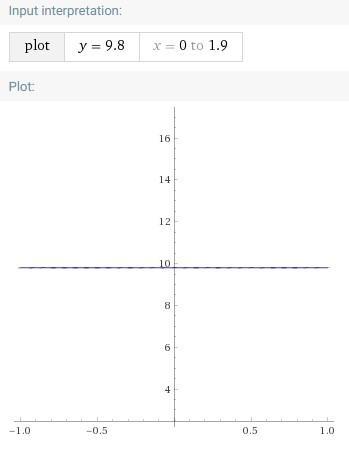
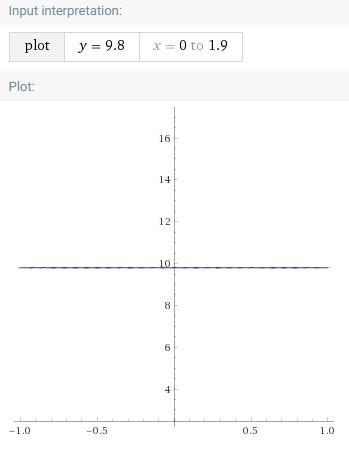
The acceleration graph is a linear representation described by y=9.8, as it remains constant:

The velocity graph can be represented by y=9.8x (where y signifies velocity and x indicates time):

The displacement graph can be described as y=4.9x^2 (with x as time and y as displacement):

These graphs apply exclusively from x=0 to x=1.9, so disregard other sections of the graphs.
You might be interested in
Rock X is released from rest at the top of a cliff that is on Earth. A short time later, Rock Y is released from rest from the s
Yuliya22 [1153]

Answer:

C) True. The distance S increases over time, with v₁ = gt and v₂ = g (t-t₀), illustrating that v₁> v₂ for the same t.

Explanation:

We have a set of statements to evaluate for correctness. The most effective approach is to examine the problem in detail.

Using the equation for vertical launch, we acknowledge that the positive direction signifies downward movement.

Stone 1

    y₁ = v₀₁ t + ½ g t²

    y₁ = 0 + ½ g t²

Stone 2

Released shortly thereafter, let's assume a delay of one second, we can utilize the same timing mechanism

     t ’= (t-t₀)

    y₂ = v₀₂ t ’+ ½ g t’²

    y₂ = 0 + ½ g (t-t₀)²

    y₂ = + ½ g (t-t₀)²

We can now calculate the separation distance between the two stones, which is applicable for t> = to

    S = y₁ -y₂

    S = ½ g t²– ½ g (t-t₀)²

    S = ½ g [t² - (t² - 2 t t₀ + t₀²)]  

    S = ½ g (2 t t₀ - t₀²)

    S = ½ g t₀ (2 t - t₀)

This represents the distance between the two stones over time, with the coefficient outside the parentheses being constant.

For t < to, the first stone remains stationary while the distance grows.

For t > = to, the expression (2t/to-1) yields a value greater than 1, indicating that the distance expands as time progresses.

We can now analyze the different statements

A) false. The height difference increases over time.

B) False S increases.

C) It is true that S increases over time, with v₁ = gt and V₂ = g (t-t₀) indicating v₁> v₂ at the same t.

3 0
12 days ago
Vector A⃗ has magnitude 8.00 m and is in the xy-plane at an angle of 127∘ counterclockwise from the +x–axis (37∘ past the +y-axi
kicyunya [1025]

Answer:

293.7 degrees

Explanation:

A = - 8 sin (37) i + 8 cos (37) j

A + B = -12 j

B = a i + b j, where a and b represent constants to solve for.

A + B = (a - 8 sin (37) ) i + ( 8cos(37) + b ) j

- 12 j = (a - 8 sin (37) ) i + ( 8cos(37) + b ) j

By comparing the coefficients of i and j:

a = 8 sin (37) = 4.81452 m

b = -12 - 8cos(37) = -18.38908

Thus,

B = 4.81452 i - 18.38908 j..... 4th quadrant

<pTherefore,

cos(Q) = 4.81452 / 12

Q = 66.346 degrees

360 - Q gives us 293.65 degrees from the + x-axis in a counterclockwise direction.

5 0
9 days ago
A Chevrolet Corvette convertible can brake to a stop from a speed of 60.0 mi/h in a distance of 123 ft on a level roadway. What
kicyunya [1025]

Response:

83.1946504051 m

Rationale:

u = Starting velocity = 60\ mph=\dfrac{60\times 1609.34}{3600}=26.82233\ m/s

s = Distance traveled = 123\ ft=\dfrac{123}{3.281}=37.4885705578\ m

\theta = Incline = 26^{\circ}

v^2-u^2=2as\\\Rightarrow a=\dfrac{v^2-u^2}{2s}\\\Rightarrow a=\dfrac{0^2-26.82233^2}{2\times 37.4885705578}\\\Rightarrow a=-9.5954230306\ m/s^2

Friction coefficient

\mu=-\dfrac{a}{g}\\\Rightarrow \mu=\dfrac{9.5954230306}{9.81}\\\Rightarrow \mu=0.978126710561

mg sin\theta - u mg cos\theta = ma\\\Rightarrow a=9.81(sin26-0.978126710561cos26)\\\Rightarrow a=-4.32382\ m/s^2

v^2-u^2=2as\\\Rightarrow s=\dfrac{v^2-u^2}{2a}\\\Rightarrow s=\dfrac{0^2-26.82233^2}{2\times -4.32382}\\\Rightarrow s=83.1946504051\ m

The calculated stopping distance is 83.1946504051 m

6 0
15 days ago
One end of a rope is tied to the handle of a horizontally-oriented and uniform door. a force fis applied to the other end of the
serg [1198]
<span>Conclusion: The door's weight results in a CCW torque which can be calculated as Tccw = 145 N*3.13 m / 2. You require a CW torque that balances this Tcw = F*2.5 m*sin20</span>
4 0
9 days ago
Read 2 more answers
Rita has two small containers, one holding a liquid and one holding a gas. Rita transfers the substances to two larger container
Ostrovityanka [942]

Response: Liquids conform to the shape of their container, yet they maintain a specific volume. Similarly, gases adjust their shape based on their container, but the volume of a gas is variable depending on the containment it occupies.

Explanation:

4 0
15 days ago
Read 2 more answers
Other questions:
  • An object is released from rest near and above Earth’s surface from a distance of 10m. After applying the appropriate kinematic
    8·1 answer
  • How many electrons must be removed from a neutral, isolated conducting sphere to give it a positive charge of 8.0 x 10 8 C? [Q=n
    14·1 answer
  • Suppose you push a hockey puck of mass m across frictionless ice for a time 1.0 s, starting from rest, giving the puck speed v a
    13·2 answers
  • A clever inventor has created a device that can launch water balloons with an initial speed of 85.0 m/s. Her goal is to pass a b
    8·1 answer
  • In your own words, describe the three steps in ray tracing used to identify where an image forms.
    14·2 answers
  • An imaginary cubical surface of side L has its edges parallel to the x-, y- and z-axes, one corner at the point x = 0, y = 0, z
    9·1 answer
  • A running mountain lion can make a leap 10.0 mlong, reaching a maximum height of 3.0 m. What is the speed of the mountain lion j
    10·1 answer
  • You are asked to design a retroreflector using two mirrors that will reflect a laser beam by 180 degrees independent of the inci
    11·1 answer
  • If a 50.0-kg mass weighs 554 n on the planet saturn, calculate saturn’s radius
    14·1 answer
  • Imagine you derive the following expression by analyzing the physics of a particular system: a=gsinθ−μkgcosθ, where g=9.80meter/
    6·1 answer
Add answer
Login
Not registered? Fast signup
Signup
Login Signup
Ask question!