answer.
Ask question
Login Signup
Ask question
All categories
  • English
  • Mathematics
  • Social Studies
  • Business
  • History
  • Health
  • Geography
  • Biology
  • Physics
  • Chemistry
  • Computers and Technology
  • Arts
  • World Languages
  • Spanish
  • French
  • German
  • Advanced Placement (AP)
  • SAT
  • Medicine
  • Law
  • Engineering
Vlad
1 day ago
13

Marcus can drive his boat 24 miles down the river in 2 hours but takes 3 hours to return upstream. Find the rate of the boat in

still water and the rate of the current.

Physics
2 answers:
Sav [1K]1 day ago
8 0

Representing the boat's speed as

v_b = 10 mph

and noting that the river's speed is given as

v_r = 2 mph

Explanation:

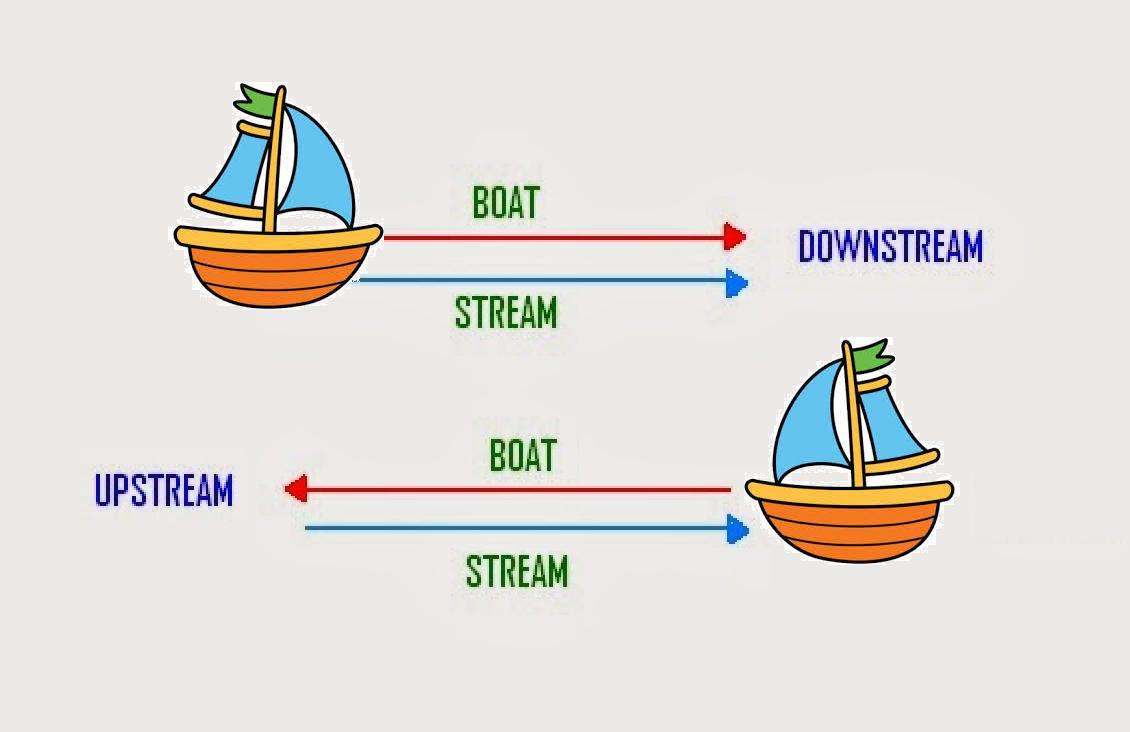
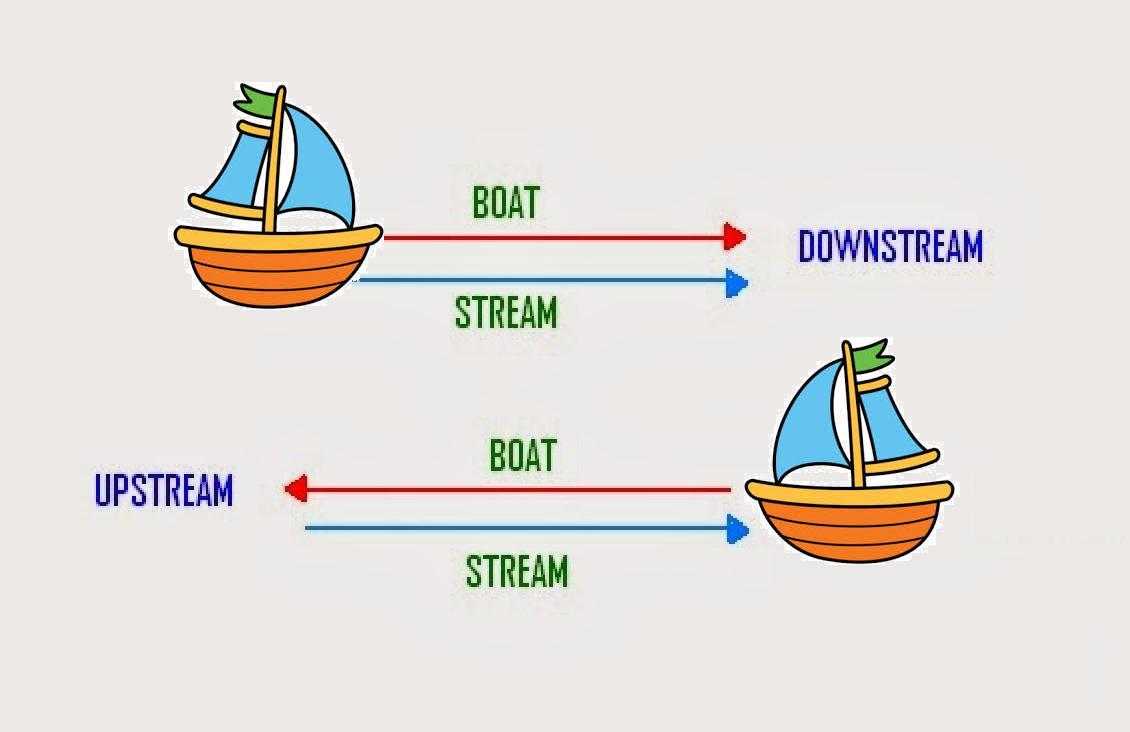
When the boat travels downstream, its effective speed is determined by combining the boat's speed with the river's current since they move in the same direction:

v_1 = v_r + v_b

Conversely, when the boat moves upstream, its net speed is reduced by the river's current, resulting in:

v_2 = v_b - v_r

As we observe, the boat covers 24 miles downstream in 2 hours:

v_1 = \frac{24}{2} = 12 mph

Similarly, for the upstream journey, it covers the same distance in 3 hours:

v_2 = \frac{24}{3} = 8 mph

v_b + v_r = 12 mph

v_b - v_r = 8 mph

Therefore, the speed of the boat is given by

v_b = 10 mph

and the river speed is described as

v_r = 2 mph

Softa [913]1 day ago
3 0

The boat's speed in still water is 10 mph.

The current's speed is 2 mph.

Further explanation

Acceleration is defined as the rate at which velocity changes.

\large {\boxed {a = \frac{v - u}{t} } }

\large {\boxed {d = \frac{v + u}{2}~t } }

a = acceleration (m/s²), v = final velocity (m/s)

u = initial velocity (m/s)

t = duration (s)

d = distance (m)

Let's delve into this problem!

Given:

Distance d = 24 miles

Time taken to travel downstream = td = 2 hours

Time taken for the upstream return = tu = 3 hours

Unknowns:

Speed of the boat in still water = vs =?

Speed of the current = vc =?

Solution:

While Marcus sails downstream, the boat's speed aligns with the current's velocity.

v_s + v_c = \frac{d}{t_d}

v_s + v_c = \frac{24}{2}

v_s + v_c = 12

v_s = 12 - v_c → Equation 1

When proceeding upstream, the boat's speed counters the current's force.

v_s - v_c = \frac{d}{t_d}

v_s - v_c = \frac{24}{3}

v_s - v_c = 8

12 - v_c - v_c = 8 ← Equation 1

12 - 2v_c = 8

2v_c = 12 - 8

2v_c = 4

v_c = 4 \div 2

\large {\boxed {v_c = 2 ~ mph} }

v_s = 12 - v_c

v_s = 12 - 2

\large {\boxed {v_s = 10 ~ mph} }

Learn more

  • Velocity of Runner:
  • Kinetic Energy:
  • Acceleration:
  • The Speed of Car:

Answer details

Grade: High School

Subject: Physics

Chapter: Kinematics

Keywords: Velocity, Driver, Car, Deceleration, Acceleration, Obstacle, Speed, Time, Rate
You might be interested in
Use the terms "force", "weight", "mass", and "inertia" to explain why it is easier to tackle a 220 lb football player than a 288
ValentinkaMS [1144]
<span>Answer
A person who weighs 220 lb has less mass than someone who weighs 288 lb, so accelerating the 220 lb player requires less force. The heavier player therefore carries greater momentum. Because 288 lb corresponds to more weight (and mass), that player has higher inertia and is harder to stop. For these reasons it is easier to tackle a 220 lb player than a 288 lb player. 
</span>
7 0
14 days ago
Read 2 more answers
Phyllis had always been the one to take care of Douglas, now he feels as if it is his duty and privilege to take care of her, ev
ValentinkaMS [1144]
1. Certainty in Reasoning: Douglas is confident in his ability to reason well to make sound judgments.

2. Analytical: <span>Douglas remains constantly aware of potential issues and is proactive in predicting both short-term and long-term consequences while taking care of his wife.</span>
7 0
2 days ago
Read 2 more answers
A 7.5 kg cannon ball leaves a canon with a speed of 185 m/s. Find the average net force applied to the ball if the cannon muzzle
Keith_Richards [1021]

To determine the average net force, we can calculate acceleration using:

x = 0.5*a*t^2

v = a*t

where x=3.6m and v=185 m/s.

Thus,

t=v/a and therefore x = 0.5*a*(v/a)^2 = 0.5 * (v^2)/a

which gives us a= (0.5*v^2)/x

Since we have the known values of v and x, we can compute a by substituting these numbers.

The average net force is then given as:

F = m*a,

with m=7.5kg.


5 0
1 day ago
Charge is placed on two conducting spheres that are very far apart and connected by a long thin wire. The radius of the smaller
Softa [913]

Answer:

σ₁ = 3.167 * 10^{-6} C/m²

σ₂ = 7.6 * 10 ^{-6}  C/m²

Explanation:

Provided Information:

i) Smaller sphere's radius ( r ) = 5 cm.

ii) Larger sphere's radius ( R ) = 12 cm.

iii) Electric field at the larger sphere's surface  ( E₁ ) = 358 kV/m, which is equivalent to 358 * 1000 v/m

E_{1} = (\frac{1}{4\pi\epsilon }) (\frac{Q_{1} }{R^{2} } )

358000 = 9 * 10^{9 } *\frac{Q_{1} }{0.12^{2} }

Charge (Q₁) = 572.8 * 10^{-9} C

Since the electric field inside a conductor is zero, the electric potential ( V ) remains constant.

V = constant

∴\frac{Q_{1} }{R} = \frac{Q_{2} }{r}

Q_{2} = \frac{r}{R} *Q_{1}

Q_{2} = \frac{5}{12} *572.8*10^{-9}   = 238.666 *10^{-9} C

Surface charge density ( σ₁ ) for the larger sphere.

Calculated Area ( A₁ )  = 4 * π * R²  = 4 * 3.14 * 0.12 = 0.180864 m².

σ₁  = \frac{Q_{1} }{A_{1} } = \frac{572.8 *10^{-9} }{0.180864} = 3.167 * 10^{-6}  C/m².

Surface charge density ( σ₂ ) for the smaller sphere.

Calculated Area ( A₂ )  = 4 * π * r²  = 4 * 3.14 * 0.05²  = 0.0314 m².

σ₂ =\frac{Q_{2} }{A_{2} } = \frac{238.66 *10^{-9} }{0.0314} = 7.6 * 10 ^{-6} C/m²

8 0
4 days ago
A pole-vaulter is nearly motionless as he clears the bar, set 4.2 m above the ground. he then falls onto a thick pad. the top of
Yuliya22 [1153]
Refer to the diagram below.

Ignoring air resistance, use gravitational acceleration g = 9.8 m/s².

The pole vaulter drops with an initial vertical speed u = 0.
At impact with the pad, velocity v satisfies:
v² = 2 × (9.8 m/s²) × (4.2 m) = 82.32 (m/s)²
v = 9.037 m/s

As the pad compresses by 0.5 m to bring the vaulter to rest,
let the average acceleration (deceleration) be a m/s². Then:
0 = (9.037 m/s)² + 2 × a × 0.5 m
Solving for a gives:
a = - 82.32 / (2 × 0.5) = -82 m/s²

Thus, the deceleration magnitude is 82 m/s².

8 0
17 days ago
Read 2 more answers
Other questions:
  • Soot particles ("black carbon aerosols" generally cause ________ of earth's atmosphere by ________ solar energy.
    10·1 answer
  • 3. A 3.0 × 10⁻³ kg copper penny drops a distance of 50.0 m to the ground. If 65 percent of the initial potential energy goes int
    6·1 answer
  • Mo is on a baseball team and hears that a ball thrown at a 45 degree angle from the ground will travel the furthest distance. Ho
    13·1 answer
  • A roller coaster, traveling with an initial speed of 15 meters per second, decelerates uniformly at â7.0 meters per second2 to a
    11·1 answer
  • Hawks and gannets soar above the ground and, when they spot prey, they fold their wings and essentially drop like a stone. They
    5·1 answer
  • A clever inventor has created a device that can launch water balloons with an initial speed of 85.0 m/s. Her goal is to pass a b
    8·1 answer
  • A sled that has a mass of 8 kg is pulled at a 50 degree angle with a force of 20 N. The force of friction acting on the sled is
    14·2 answers
  • Find the change in volume for a metallic dental filling due to the difference between body temperature (37.0°C) and the temperat
    15·1 answer
  • A 7.0-kilogram cart, A, and a 3.0-kilogram cart, B, are initially held together at rest on a horizontal, frictionless surface. W
    7·1 answer
  • Suppose you sketch a model of an atom using the ones here as a guide. How would you build a model that is ionized? How would you
    15·1 answer
Add answer
Login
Not registered? Fast signup
Signup
Login Signup
Ask question!