answer.
Ask question
Login Signup
Ask question
All categories
  • English
  • Mathematics
  • Social Studies
  • Business
  • History
  • Health
  • Geography
  • Biology
  • Physics
  • Chemistry
  • Computers and Technology
  • Arts
  • World Languages
  • Spanish
  • French
  • German
  • Advanced Placement (AP)
  • SAT
  • Medicine
  • Law
  • Engineering
serious
2 months ago
5

Glycolysis is the process by which energy is harvested from glucose by living things. Several of the reactions of glycolysis are

thermodynamically unfavorable (nonspontaneous), but proceed when they are coupled with other reactions.
Reaction A: Pi+glucose⟶glucose-6-phosphate+H2OΔG=13.8 kJ/mol

Reaction B: Pi+fructose-6-phosphate⟶fructose-1,6-bisphosphate+H2OΔG=16.3 kJ/mol

Reaction C: ATP+H2O⟶ADP+PiΔG=−30.5 kJ/mol

Select every unfavorable reaction.

reaction B
reaction C
reaction A

Select every set of coupled reactions where the overall reaction is favorable.

reactions B and C
reactions A and B
reactions A and C

What is the net change in free energy if one set of reactions from the previous question is coupled so that the overall reaction is favorable? Note that if you selected more than one set of coupled reactions as favorable in the previous question, you may enter the net change for any one of your selected sets.
Chemistry
1 answer:
Tems11 [2.7K]2 months ago
4 0

Answer:

Unfavorable reactions include Reaction A and Reaction B.

Favorable coupled reactions: Reactions B with C and Reactions A with C.

Net energy change:

For Reactions B and C: -14.2 kJ/mol

For Reactions A and B: 30.1 kJ/mol

For Reactions A and C: -16.7 kJ/mol

Explanation:

A reaction is considered thermodynamically favorable (or spontaneous) if ΔG is less than 0. Thus, the unfavorable reactions where -ΔG is greater than 0 are:

Reaction A and Reaction B.

In coupling Reaction C with Reaction B and Reaction A, the following equation is obtained:

ATP + fructose-1,6-phosphate ⟶ ADP + fructose-1,6-bisphosphate

ΔG equals 16.3 minus 30.5, resulting in -14.2 kJ/mol.

For the reaction ATP + glucose ⟶ ADP + glucose-6-phosphate, ΔG equals 13.8 minus 30.5, yielding -16.7 kJ/mol.

Overall, the coupled reaction of A and B results in a change of free energy of:

ΔG = 13.8 plus 16.3, which equals 30.1 kJ/mol.

You might be interested in
It is 762 miles from here to Chicago. An obese physics teacher jogs at a rate of 5.0 miles every 20.0 minutes. How long would it
Anarel [2989]
3,048 minutes. Explanation: 762 divided by 5, then multiply that number by 20.
5 0
1 month ago
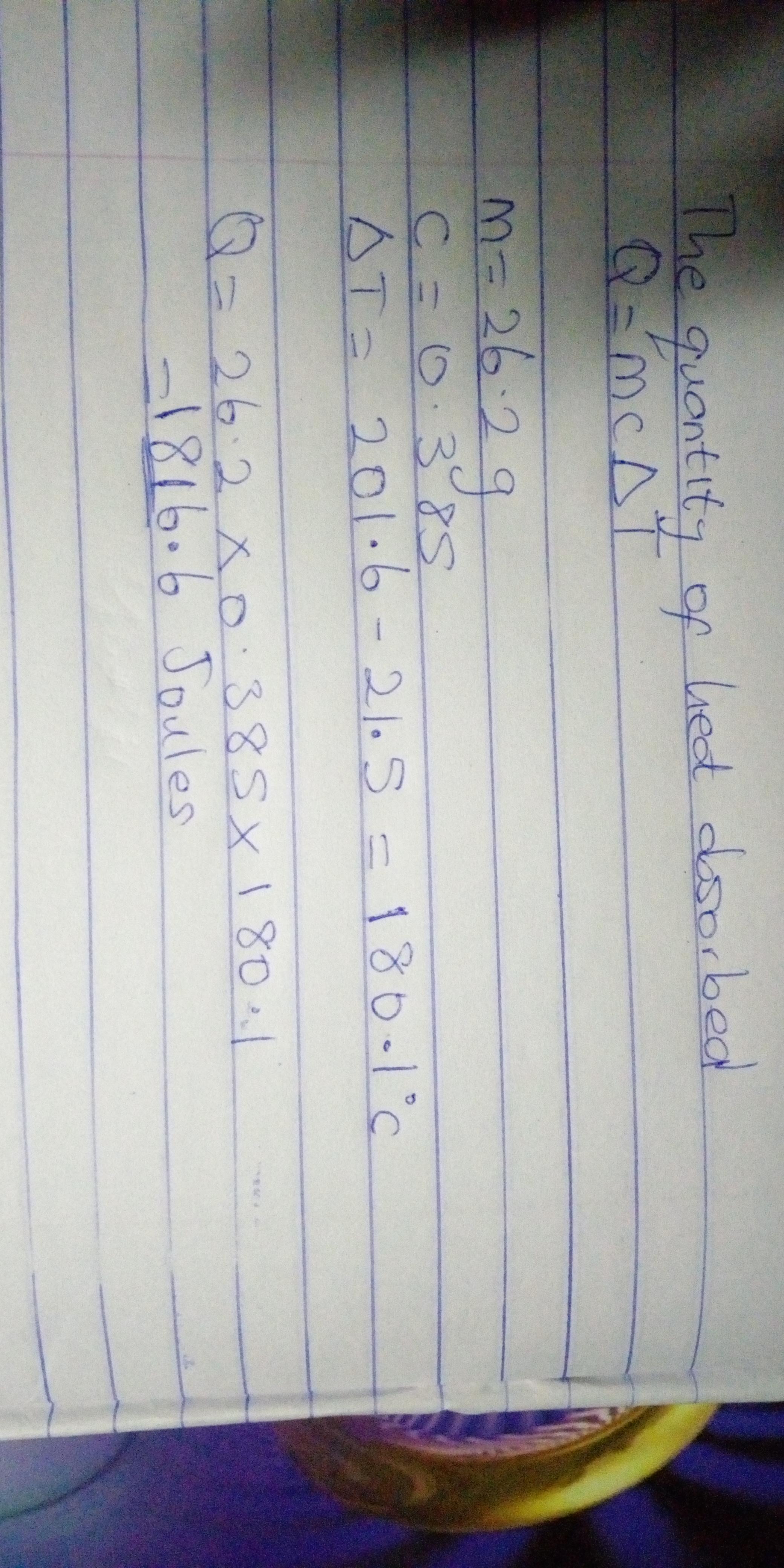
26.2 g piece of copper metal is heated from 21.5°C to 201.6°C. Calculate the amount of heat absorbed by the metal. The specific
lorasvet [2795]

Response:1816.6 joules

Clarification:refer to the attached image

6 0
1 month ago
A patient needs 40.0 mg of antibiotic per kilogram of body weight each day. If the patient weighs 55 kilograms.
VMariaS [2998]

Response:

2200 mg of antibiotic

Explanation:

The prescribed antibiotic dosage is 40 mg/kg of body weight.

For a patient weighing 55 kg, we calculate the dose of antibiotic as follows:

If we analyze 40/1000000, we can determine antibiotic allocation in kg per kg of weight

= 0.00004 kg of antibiotic for each kilogram

0.00004 multiplied by 55 (to find out the required amount for a 55 kg individual)

= 0.0022 kg

This 0.0022 figure converts to milligrams as follows

0.0022*10^6

= 2200 mg of antibiotic is indicated for a patient weighing 55 kg.

4 0
1 month ago
A student puts 0.020 mol of methyl methanoate into an empty and rigid 1.0 L vessel at 450 K. The pressure is measured to be 0.74
KiRa [2933]

Explanation:

Initial moles of ethanoic acid = 0.020 mol

At equilibrium, half of the ethanoic acid molecules have reacted.

Thus, moles of ethanoic acid reacted = 0.020 mol * (50% / 100%)

                                                                     = 0.010 mol

Moles of ethanoic acid remaining = 0.020 mol - 0.010 mol = 0.010 mol

The moles of product (CH3COOH)^{2} gas formed are determined as follows:

0.010 mol CH3COOH * (1 mol (CH3COOH)^{2} / 2 mol CH3COOH)

= 0.005 mol (CH3COOH)^{2}

Consequently, the total moles of gas present in the vessel at equilibrium are 0.010 mol CH3COOH and 0.005 mol (CH3COOH)^{2}

Total gas moles at equilibrium = 0.010 mol + 0.005 mol = 0.015 mol

Next, let’s determine the pressure:

0.020 mol of gas has a pressure of 0.74 atm; so under the same conditions, we find the pressure exerted by 0.015 mol of gas:

P1/n1 = P2/n2

P2 = P1*(n2 / n1)

      = 0.74 atm * (0.015 mol / 0.020 mol)

     = 0.555 atm

4 0
2 months ago
Other questions:
  • Calculate the mass, in grams, of a single tellurium atom (mte = 127.60 amu ).
    12·2 answers
  • You are eating a pizza. What type of mixture are you consuming?
    10·2 answers
  • Indicate how the concentration of each species in the chemical equation will change to reestablish equilibrium after changing th
    12·1 answer
  • an alloy contains 56g of pure silver and 22g of pure copper what is the percentage(%) of silver in the alloy?
    14·2 answers
  • The dihydrogenphosphate ion, H2PO4− is amphiprotic. In which of the following reactions is this ion serving as a base?
    7·1 answer
  • Which sentence correctly describes an aspect of the Antarctic treaty system
    7·2 answers
  • a chemist uses hot hydrogen gas to convert chromium (iii) oxide to pure chromium. how many grams of hydrogen are needed to produ
    10·1 answer
  • Which compound releases hydroxide ions in an aqueous solution?
    7·2 answers
  • A student performs the following experiment. Step 1: She pours a colorless solution into a beaker that contains another colorles
    10·1 answer
  • How many molecules of sodium oxide will be created if 275 grams of sodium reacts with excess oxygen?
    15·1 answer
Add answer
Login
Not registered? Fast signup
Signup
Login Signup
Ask question!