Answer:
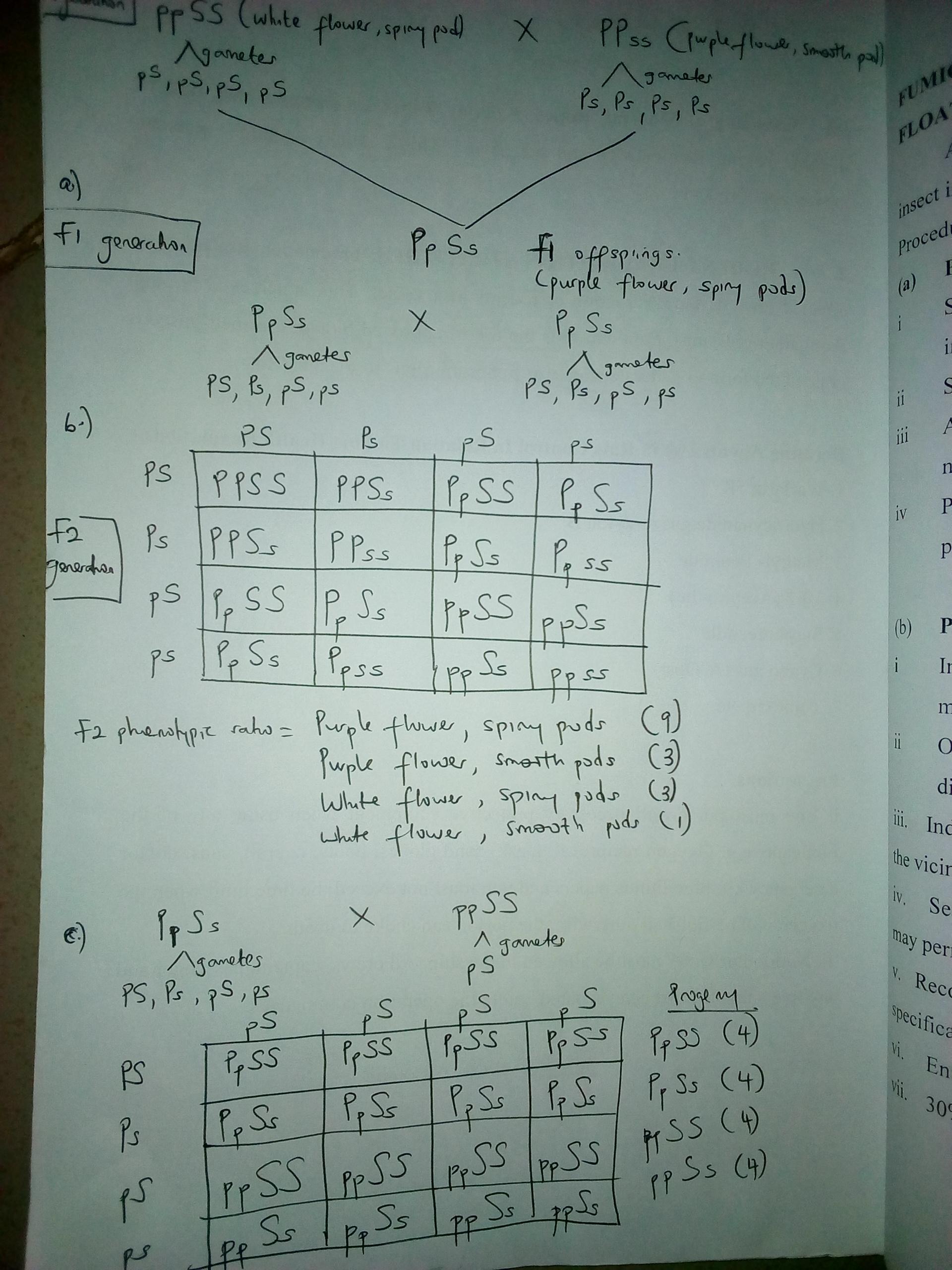
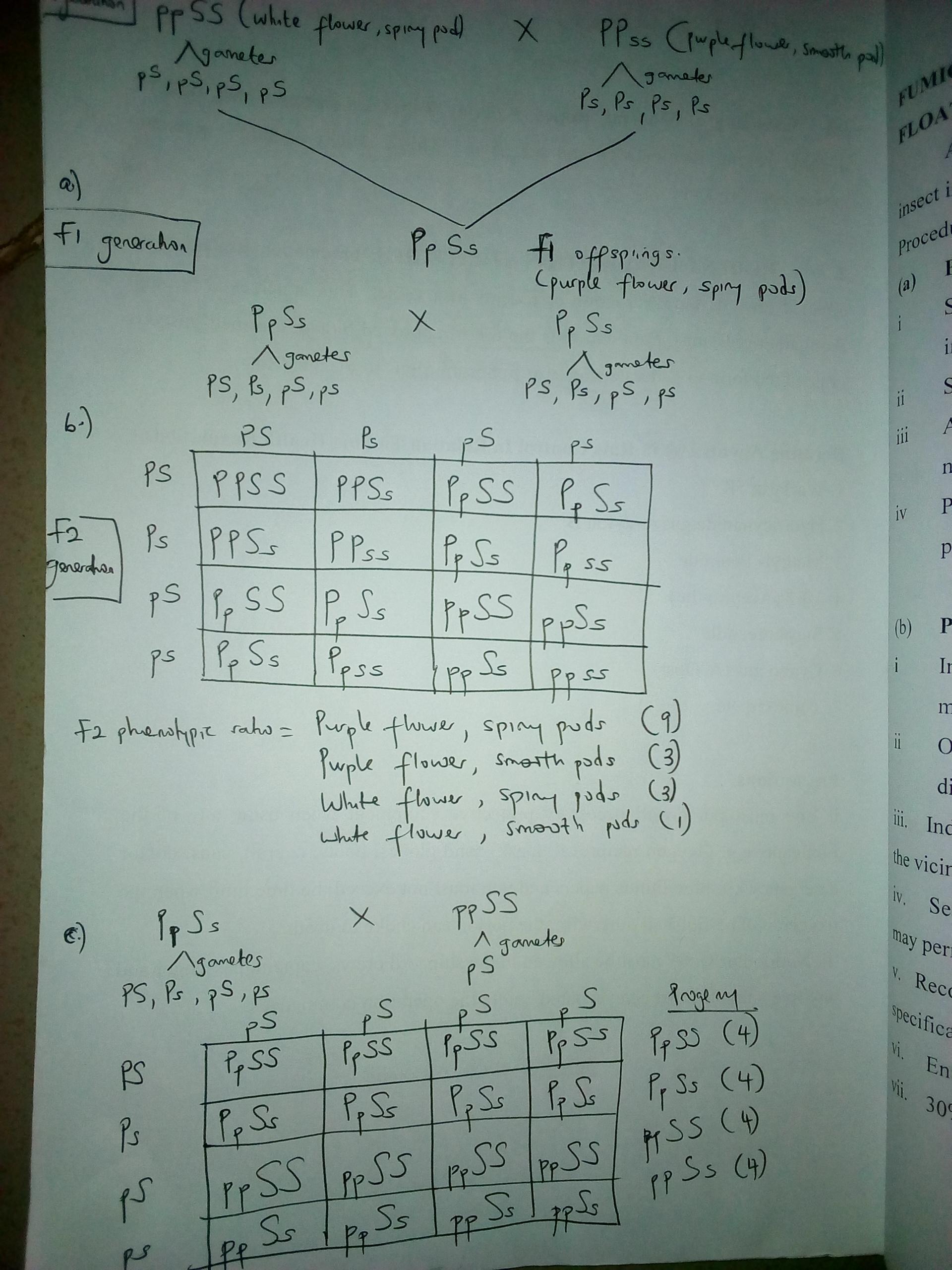
Refer to the attached image for detailed Punnett squares and diagrams
a) First generation: Offspring with purple flowers and spiny pods (PpSs)
b) Second generation: Progeny with purple flower, spiny pods (9), purple flower, smooth pods (3), white flower, spiny pods (3), and white flower, smooth pods (1).
c) The resulting genotype combinations are: PpSS (4), PpSs (4), ppSS (4), and ppSs (4)
d) The resulting genotype combinations are: PPSs (4), PPss (4), PpSs (4), and Ppss (4)
Explanation:
This inquiry involves two distinct genes in jimsonweed: one governing flower color and the other determining pod texture. The alleles for purple color (P) and spiny pods (S) dominate over those for white flowers (p) and smooth pods (s) respectively.
A plant consistently breeding with white flowers and spiny pods has the genotype: ppSS, while a true-breeding plant with purple blooms and smooth pods has the genotype: PPss. Crossing these two parents results in the production of the following gametes:
ppSS- pS, pS, pS and pS
PPss- Ps, Ps, Ps, PS
a) Thus, the first generation offspring from this cross will possess a heterozygous genotype: PpSs, which is characterized by purple flowers and spiny pods.
b) If the first generation offspring undergo self-crossing i.e., PpSs × PpSs, they produce gametes PS, Ps, pS, ps. These gametes will be depicted in a Punnett square (see the attached image) yielding the following second generation ratios:
Purple flower, spiny pods (9)
Purple flower, smooth pods (3)
White flower, spiny pods (3)
White flower, smooth pods (1)
c) When first generation offspring are back-crossed with the white spiny parent i.e., PpSs × ppSS: Results will yield the following genotypes: (see attached image)
PpSS (4),
PpSs (4),
ppSS (4), and
ppSs (4)
d) When the first generation offspring are back-crossed with the purple smooth parent i.e., PpSs × PPss, the resulting genotypes produced will include:
PPSs (4),
PPss (4),
PpSs (4), and
Ppss (4)