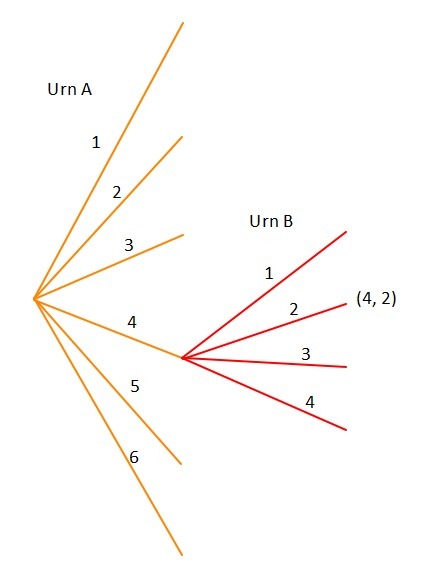
Constructing the tree diagram for this scenario, there are 6 options for drawing from Urn A, each followed by 4 options from Urn B.
This yields a total of 6 × 4 = 24 possible outcomes, which can be enumerated as
{(1, 1), (1, 2), (1, 3), (1, 4), (2, 1), ..., (6, 3), (6, 4)},
where the first number indicates the draw from Urn A and the second number the draw from Urn B.
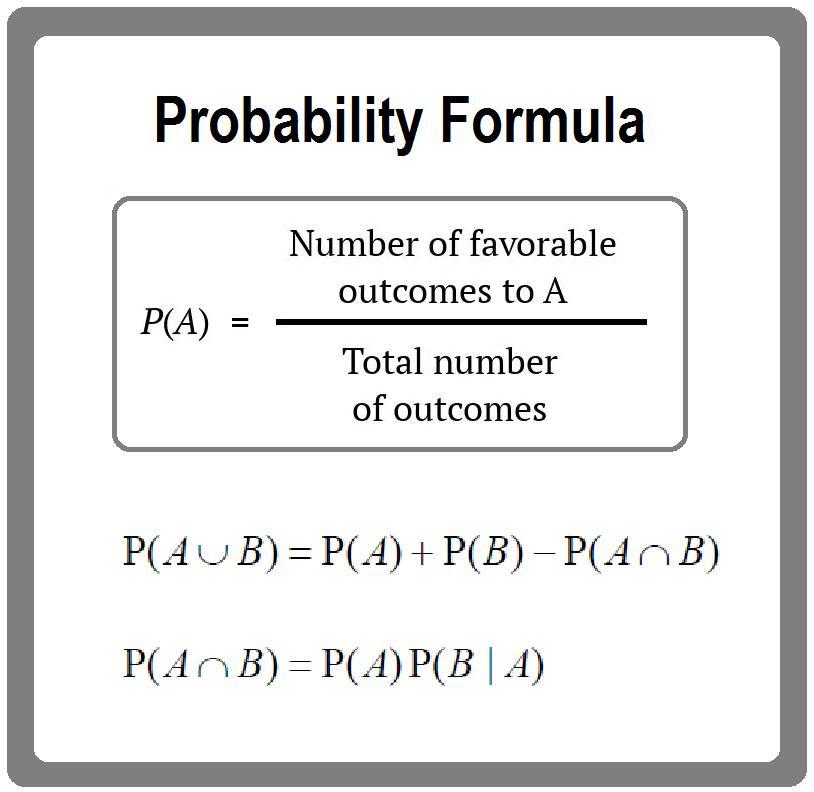
The specific outcome (4, 2) is among these 24 possibilities, so its probability equals 1/24.
Alternatively, calculating the probability via the multiplication rule for independent events, the chance of drawing a 4 from Urn A is 1/6 and drawing a 2 from Urn B is 1/4; multiplying these gives 1/24.
Final answer: 1/24