answer.
Ask question
Login Signup
Ask question
All categories
  • English
  • Mathematics
  • Social Studies
  • Business
  • History
  • Health
  • Geography
  • Biology
  • Physics
  • Chemistry
  • Computers and Technology
  • Arts
  • World Languages
  • Spanish
  • French
  • German
  • Advanced Placement (AP)
  • SAT
  • Medicine
  • Law
  • Engineering
AlekseyPX
9 days ago
14

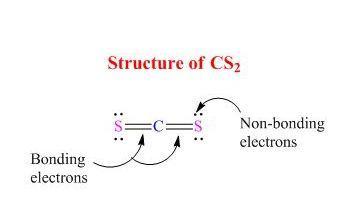
Determine the number of bonding electrons and the number of nonbonding electrons in the structure of cs2.

Chemistry
2 answers:
alisha [2.7K]9 days ago
5 0
The counts of bonding and non-bonding electrons in this case are represented by the values in the previous tags. To ascertain these amounts, we must start by sketching the accurate Lewis structure of the molecule. The Lewis structure visually depicts an element along with any nonbonding pairs. For covalent compounds, this structure delineates the electrons that are involved in bonds and any remaining nonbonding pairs. Furthermore, Lewis structures aid in predicting the geometry, polarity, and reactivity of the molecules. The atom with the least electronegativity, excluding hydrogen, is generally the central atom. Therefore, carbon, being less electronegative than sulfur, serves as the central atom with two sulfur atoms arranged around it. Next, we calculate the total number of valence electrons. The total valence electrons are computed as follows: Since carbon has 4 valence electrons and sulfur has 6, we arrive at a total. The Lewis structure of the molecule and its linear shape, along with the bonding and non-bonding electron pairs, can be found in the attached image. Out of 16 electrons, eight are utilized in forming four bonds between carbon and the two sulfur atoms. Carbon establishes one sigma and one pi bond with each sulfur atom. This leaves us with 8 electrons, which represent the non-bonding (lone pairs), with 2 lone pairs present on each sulfur atom.
lorasvet [2.5K]9 days ago
3 0
Carbon disulfide (S=C=S) consists of a single carbon atom and two sulfur atoms. Carbon possesses 4 valence electrons, whereas sulfur has 6. In the bonding process, all four valence electrons from carbon participate, while each sulfur atom provides two electrons for bonding. Consequently, a total of 4 + 2(2) = 8 electrons are involved in bonding, while there are 8 electrons (four from each sulfur atom) that remain unbonded. 
You might be interested in
Two different atoms have six protons each and the same mass. However, one has a negative charge while the other has a positive c
castortr0y [2743]

The equal mass indicates that both atoms have the same number of protons and neutrons.

A positive charge signifies a difference in electron count.

Assuming the atomic number is A,

the mass number equals M.

In a neutral atom, there are A electrons.

A negatively charged atom would have A + 1 electrons [while the count of protons and mass number remains unchanged].

A positively charged atom contains A - 1 electrons [with consistent protons and mass number].

For instance: Cl- and Cl+.

8 0
1 month ago
Read 2 more answers
Kayla owns a food truck that sells tacos and burritos. She sells each taco for $3 and each burrito for $7.25. Yesterday Kayla ma
VMariaS [2693]
They overcomplicated things with lots of words. Your initial equation deals with the revenue. I’ll denote tacos as x and burritos as y.
The first equation would be 3x + 7.25y = 595, given that you already have the prices but need the quantities. The second equation will reflect that double the burritos were sold compared to tacos, expressed as y = x + 2.
Hope this clarifies things. If you need further explanation, I can elaborate more.
6 0
1 month ago
A sample of solid naphthalene is introduced into an evacuated flask. Use the data below to calculate the equilibrium vapor press
Tems11 [2403]

Answer: The vapor pressure of naphthalene within the flask remains at 2.906\times 10^{-4} atm.

Explanation:

The transformation from solid naphthalene to its gaseous form follows the equilibrium reaction:

C_{10}H_8(s)\rightleftharpoons C_{10}H_8(g)

  • The formula employed to determine the enthalpy change for the reaction is:  

\Delta H^o_{rxn}=\sum [n\times \Delta H^o_f(product)]-\sum [n\times \Delta H^o_f(reactant)]

The formula for calculating the enthalpy change regarding the aforementioned reaction is:

\Delta H^o_{rxn}=(1\times \Delta H^o_f_{(C_{10}H_8(g))})-(1\times \Delta H^o_f_{(C_{10}H_8(s))})

The provided information includes:

\Delta H^o_f_{(C_{10}H_8(s))}=78.5kJ/mol\\\Delta H^o_f_{(C_{10}H_8(g))}=150.6kJ/mol

Substituting the values into the previous equation produces:

\Delta H^o_{rxn}=(1\times 150.6)-(1\times 78.5)=72.1kJ/mol

  • The formula utilized to compute Gibbs free energy change is of a reaction:

\Delta G^o_{rxn}=\sum [n\times \Delta G^o_f(product)]-\sum [n\times \Delta G^o_f(reactant)]

The equation for the enthalpy change for the reaction is:

\Delta G^o_{rxn}=(1\times \Delta G^o_f_{(C_{10}H_8(g))})-(1\times \Delta G^o_f_{(C_{10}H_8(s))})

The given factors include:

\Delta G^o_f_{(C_{10}H_8(s))}=201.6kJ/mol\\\Delta G^o_f_{(C_{10}H_8(g))}=224.1kJ/mol

By inserting values from the above equation, we arrive at:

\Delta G^o_{rxn}=(1\times 224.1)-(1\times 201.6)=22.5kJ/mol

  • For the calculation of K_1 (at 25°C) regarding the provided value of Gibbs free energy, the following relationship is applied:

\Delta G^o=-RT\ln K_1

where,

\Delta G^o = Gibbs free energy = 22.5 kJ/mol = 22500 J/mol  (Conversion factor: 1kJ = 1000J)

R = Gas constant = 8.314J/K mol

T = temperature = 25^oC=[273+25]K=298K

K_1 = equilibrium constant at 25°C =?

Inserting values into the above equation yields:

22500J/mol=-(8.314J/Kmol)\times 298K\times \ln K_1\\\\K_1=1.14\times 10^{-4}

  • To determine the equilibrium constant at 35°C, we refer to the equation proposed by Arrhenius, which states:

\ln(\frac{K_2}{K_1})=\frac{\Delta H}{T}(\frac{1}{T_1}-\frac{1}{T_2})

where,

K_2 = Equilibrium constant at 35°C =?

K_1 = Equilibrium constant at 25°C = 1.14\times 10^{-4}

\Delta H = Enthalpy change of the reaction = 72.1 kJ/mol = 72100 J

R = Gas constant = 8.314J/K mol

T_1 = Initial temperature = 25^oC=[273+25]K=298K

T_2 = Final temperature = 35^oC=[273+35]K=308K

By plugging values into the equation above, we obtain:

\ln(\frac{K_2}{1.14\times 10^{-4}})=\frac{72100J/mol}{8.314J/K.mol}(\frac{1}{298}-\frac{1}{308})\\\\K_2=2.906\times 10^{-4}

  • In order to calculate the partial pressure of naphthalene at 35°C, we utilize the equation for K_p, which is:

K_p=\frac{p_{C_{10}H_8(g)}}{p_{C_{10}H_8(g)}}=p_{C_{10}H_8(g)

The partial pressure of the solid phase is considered to be 1 at equilibrium.

Therefore, the value for K_2 will equal K_p

p_{C_{10}H_8}=2.906\times 10^{-4}

Consequently, the partial pressure of naphthalene at 35°C is 2.906\times 10^{-4} atm.

3 0
8 days ago
Which procedure cannot be performed on a hot plate, requiring a Bunsen burner instead
Tems11 [2403]

Answer: The process of heating a crucible to eliminate moisture from a hydrate.

Explanation:

The available choices are:

a. Heating a solvent to aid in the dissolution of a solute.

b. Heating a solid in isolation to remove moisture.

c. Bringing water to a boil for use in a water bath.

d. Heating a crucible to eliminate moisture from a hydrate.

Possible actions that can be done on a hot plate include:

a. Heating a solvent to assist a solute in dissolving.

b. Heating a solid in isolation to dry it.

c. Heating water to boiling for a water bath.

However, it's important to note that using a hot plate for heating a crucible to remove water from a hydrate is not advisable. Silica or ceramic materials are not meant to be heated on a hot plate.

Consequently, the correct procedure is heating a crucible to remove water from a hydrate.

4 0
1 month ago
Consider the following system at equilibrium:
VMariaS [2693]

Answer:

A - Increase (R), Decrease (P), Decrease(q), Triple both (Q) and (R)

B - Increase(P), Increase(q), Decrease (R)

C - Triple (P) and cut (q) down to a third

Explanation:

According to the principle of Le Chatelier, when a system reaches equilibrium and a change is introduced, the system will respond to counteract that change.

Since P and Q are reactants, raising the amount of either one or both without a proportional rise in R (which is a product) will cause the equilibrium to move towards the right. Similarly, if R decreases while P and Q remain constant, this too will push the equilibrium to the right. Thus, Increase(P), Increase(q), and Decrease(R) will lead to a rightward shift in the equilibrium.

Conversely, raising R without increasing P and Q will draw the equilibrium to the left. Likewise, cutting down P and/or Q without a similar reduction in R will shift the equilibrium leftward. Therefore, Increase(R), Decrease(P), Decrease(q), and triple both (Q) and (R) will shift the equilibrium to the left.

If there are equivalent changes in P and Q, with R remaining unchanged, then the equilibrium remains stationary. So, tripling (P) while reducing (q) to one third will not alter the equilibrium.

6 0
1 month ago
Other questions:
  • (g) On the graph in part (d) , carefully draw a curve that shows the results of the second titration, in which the student titra
    14·1 answer
  • A 100 milliliters (mL) sample of a liquid is poured from a beaker into a graduated cylinder. Which of the following best explain
    13·1 answer
  • Which of the following accurately represents a carbon source and the process that releases carbon from that source? A. Fossil fu
    7·1 answer
  • Butane (c4h10) undergoes combustion in excess oxygen to generate gaseous carbon dioxide and water. given δh°f[c4h10(g)] = –124.7
    11·1 answer
  • Which statements accurately describe soap? Select one or more:
    5·1 answer
  • Identify one disadvantage to each of the following models of electron configuration:
    12·2 answers
  • How many known elements have atoms, in their ground-state, with valence electrons whose quantum numbers are n = 5 and l = 1?a. 3
    9·1 answer
  • A solution contains 10.0 g pentane, C5H12, 20.0 g hexane, C6H14, and 10.0 g benzene, C6H6. What is the mole fraction of hexane?
    7·1 answer
  • 34.62 mL of 0.1510 M NaOH was needed to neutralize 50.0 mL of an H2SO4 solution. What is the concentration of the original sulfu
    9·1 answer
  • If three potatoes have a mass of 667 g, what will be the mass of 100 potatoes? A. 200 kg B. 22.2 kg C. 2223 g D. 20.0 kg
    11·1 answer
Add answer
Login
Not registered? Fast signup
Signup
Login Signup
Ask question!