answer.
Ask question
Login Signup
Ask question
All categories
  • English
  • Mathematics
  • Social Studies
  • Business
  • History
  • Health
  • Geography
  • Biology
  • Physics
  • Chemistry
  • Computers and Technology
  • Arts
  • World Languages
  • Spanish
  • French
  • German
  • Advanced Placement (AP)
  • SAT
  • Medicine
  • Law
  • Engineering
zavuch27
1 month ago
14

When switched on, the grinding machine accelerates from rest to its operating speed of 3550 rev/min in 10 seconds. When switched

off, it coasts to rest in 31 seconds. Determine the number of revolutions turned during both the startup and shutdown periods. Also determine the number of revolutions turned during the first half of each period. Assume uniform angular acceleration in both cases.
Physics
1 answer:
serg [3.5K]1 month ago
5 0

Response:

At startup, the total revolutions

N_1 = 296 turn

After the first half of the duration, total revolutions

N_3 = \frac{29.6 + 0}{2}(5) = 74 turns

Total revolutions until it halts

N_2 = \frac{59.17 + 0}{2}(31) = 917 turn

Following the first half of the duration, the total revolutions are

N_4 = 688 turns

Clarification:

At the beginning, the machine is stationary and then accelerates to a speed of 3550 rev/min

At this point we calculate

f = \frac{3550}{60} = 59.17 rev/s

Since it took 10 seconds to achieve the speed

the angular acceleration can be expressed as

\alpha = \frac{\omega_f - \omega_i}{t}

\alpha = \frac{59.17- 0}{10} = 5.917 rev/s^2

It comes to a stop after 31 seconds, leading to the angular deceleration being defined as

\alpha_2 = -\frac{59.17}{31} = -1.91 rev/s^2

Initially, the revolutions taken to reach the specified speed

N_1 = \frac{59.17 + 0}{2}(10) = 296 turn

the number of revolutions during the stopping phase is

N_2 = \frac{59.17 + 0}{2}(31) = 917 turn

Now, considering the increase in speed after t = 5 seconds is

\omega_1 = (5.917)(5) = 29.6 rev/s

N_3 = \frac{29.6 + 0}{2}(5) = 74 turns

During the stopping phase, the speed after half of the duration is calculated as

\omega_2 = 59.17 - (1.91)(15.5) = 29.56 rev/s

Lastly, the total revolutions are calculated as

N_4 = \frac{59.17 + 29.56}{2}(15.5)

N_4 = 688 turns

You might be interested in
Which of the following are inertial reference frames? A. A car driving at steady speed on a straight and level road. B. A car dr
Softa [3030]
A. A car moving at a constant speed on a flat, straight road. B. A vehicle traveling at a steady speed on a 10-degree incline. An object operates within an inertial reference frame if there is no net force acting upon it. According to Newton's second law, this implies that the object's acceleration also equals zero. Assessing the scenarios yields: A. A car moving at a constant speed on a flat road qualifies as an inertial reference frame, since its velocity and direction remain unchanged; thus, acceleration is zero. B. A car moving steadily up a 10-degree incline still constitutes an inertial reference frame, for similar reasons. C. A car accelerating after departing a stop sign does not represent an inertial frame due to its change in speed. D. A car driving at a steady speed around a curve cannot be considered an inertial reference frame since its direction is changing, resulting in a change in velocity and thus acceleration. Therefore, options A and B are correct.
8 0
1 month ago
Read 2 more answers
A 55 kg gymnast wedges himself between two closely spaced vertical walls by pressing his hands and feet against the walls. Part
ValentinkaMS [3465]

answer:

Let frictional forces due to both hands and feets be "Ff" each(since its given that they all are equal), acting in upward direction( in opposite direction of supposed motion).\\
Then since there is no motion of gymnast thus net frictional force due to both hands and feets will be exactly balanced by the weight of the gymnast,\\ i.e\\
4f_{f}=weight =mg\\
f_{f}=\frac{55x9.8}{4}\\
=134.75N

5 0
2 months ago
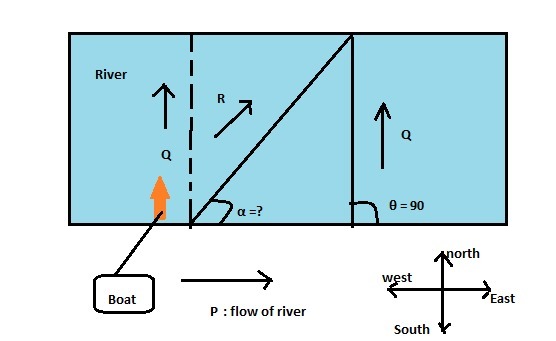
A person is rowing across the river with a velocity of 4.5 km/hr northward. The river is flowing eastward at 3.5 km/hr (Figure 4
Yuliya22 [3333]

Answer: Her velocity magnitude (v) relative to the shore is 5.70 km/h.

Explanation:

Let Q be the speed of the boat, and P be the speed of the river flow.

R represents the resultant velocity combining boat velocity and river current.

According to vector addition using the law of triangles:

R=\sqrt{P^2+Q^2+2PQCos\theta}

From the diagram:

P = 3.5 km/h, Q = 4.5 km/h

\theta= 90^o

R=\sqrt{P^2+Q^2+2PQCos\theta}=\sqrt{(3.5)^2+(4.5)^2+3.5\times 4.5\times cos90^o}=5.70

(Cos90^o=0),(sin 90^o=1)

\alpha =tan^{-1}\frac{Qsin\theta}{P+Qcos\theta}=tan^{-1}\frac{4.5 sin 90^o}{3.5+4.5 cos90^o}=tan^{-1}\frac{4.5}{3.5}=52.12^o

Therefore, her velocity magnitude relative to the shore is 5.70 km/h.

8 0
3 months ago
Other questions:
  • The amount of energy necessary to remove an electron from an atom is a quantity called the ionization energy, Ei. This energy ca
    7·1 answer
  • Two identical objects are moving directly toward one another at the same speed v. ~v −~v m m What is the total kinetic energy of
    15·2 answers
  • If you start with the number 3.0 and move the decimal point one unit to the left, you wind up with 0.30. If you move the decimal
    7·1 answer
  • The frequency of a wave increases. If the speed of the wave remains constant, what happens to the distance between successive cr
    6·1 answer
  • A 1.0 kg brick falls off a ledge of height 44m and lands on the ground at 3.0 s later.
    6·1 answer
  • You are stranded on a deserted island with 100 m of 18 gauge insulated copper wire, a light bulb rated at 3.0 V, a 50 V battery,
    7·2 answers
  • Suppose that the mirror described in Part A is initially at rest a distance R away from the sun. What is the critical value of a
    10·1 answer
  • A jet plane comes in for a downward dive as shown in the figure below.
    14·2 answers
  • A double slit apparatus is held 1.2 m from a screen. [___/4] (a) When red light (λ = 600 nm) is sent through the double slit, th
    13·1 answer
  • Points A, B, and C lie along a line from left to right, respectively. Point B is at a lower electric potential than point A. Poi
    15·1 answer
Add answer
Login
Not registered? Fast signup
Signup
Login Signup
Ask question!