answer.
Ask question
Login Signup
Ask question
All categories
  • English
  • Mathematics
  • Social Studies
  • Business
  • History
  • Health
  • Geography
  • Biology
  • Physics
  • Chemistry
  • Computers and Technology
  • Arts
  • World Languages
  • Spanish
  • French
  • German
  • Advanced Placement (AP)
  • SAT
  • Medicine
  • Law
  • Engineering
Ganezh
5 days ago
5

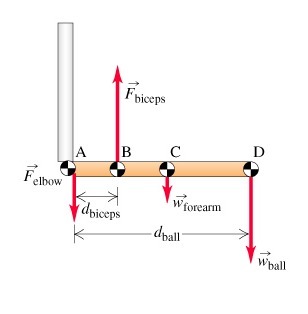
Determine the sign (+ or −) of the torque about the elbow caused by the biceps, τbiceps, the sign of the weight of the forearm,

τforearm, and the sign of the weight of the ball, τball. express your answers as using + and - separated by commas.

Physics
1 answer:
Sav [2.8K]5 days ago
8 0
1. τbiceps = +(Positive) 2. τforearm = -(Negative) 3. τball = -(Negative) Explanation: The attached figure illustrates the following: 1. For the biceps, τbiceps indicates that torque is calculated as Torque = r x F, where r and F are vectors. Here, r corresponds to the vector from the elbow to the biceps. In the figure, the force from the biceps is directed upwards. Applying the right-hand rule from r to F results in counterclockwise torque, which is considered positive (+). 2. The torque related to the weight of the forearm, τforearm, uses the same torque formula, with r being the vector from the elbow to the forearm. The weight acts downward, causing a clockwise torque that is negative (-). 3. Similarly, for the weight of the ball, τball, the downward force from the ball's weight generates a clockwise torque, which also registers as negative (-).
You might be interested in
A force is applied to a block sliding along a surface (Figure 2). The magnitude of the force is 15 N, and the horizontal compone
Softa [2661]

If my calculations are accurate, the angle is 67.5 degrees.

4 0
1 month ago
Read 2 more answers
Which contributions did Galileo make to the model of the solar system? Select two options.a mathematical model for the orbits of
Sav [2826]
Galileo's contributions to the solar system model include: Data indicating that planets reflect sunlight like the Moon, and his observations of Jupiter's moons orbiting the gas giant. With the assistance of an early telescope that he constructed, Galileo made these two significant discoveries.
7 0
18 days ago
Suppose that A’, B’ and C’ are at rest in frame S’, which moves with respect to S at speed v in the +x direction. Let B’ be loca
Keith_Richards [2897]

Response:

1) An observer in B 'perceives the two events occurring at the same time

2) Observer B recognizes that the events happen at different times

3)  Δt = Δt₀ /√ (1 + v²/c²)

Clarification:

This scenario illustrates the concept of simultaneity in special relativity. It is important to keep in mind that light's speed remains constant across all inertial frames

1) Since the events are stationary within the frame S ', they propagate at the constant speed of light, resulting in them reaching observation point B'—located equidistantly between both events—simultaneously

Thus, an observer in B 'observes the two events occurring at the same time

2) For an observer B situated within frame S attached to the Earth, both events at A and B appear to take place at the same moment. However, the event at A covers a shorter distance, while the event at B travels a longer distance, since frame S 'is in motion at velocity + v. Hence, with a constant speed, the event covering the lesser distance is perceived first.

Consequently, observer B perceives that the events do not occur simultaneously

3) Let's determine the timing for each event

        Δt = Δt₀ /√ (1 + v²/c²)

where t₀ represents the time in the S' frame, which remains at rest for the events

8 0
18 days ago
A steady circular __________ light means drivers must stop at a marked stop line.
kicyunya [2911]
B. red................
5 0
27 days ago
Read 2 more answers
A 0.050-kg lump of clay moving horizontally at 12 m/s strikes and sticks to a stationary 0.15-kg cart that can move on a frictio
Ostrovityanka [2814]

Answer:

Explanation:

According to the parameters provided,

mass of the clay lump, m₁ = 0.05 kg

initial velocity of the lump, u₁ = 12 m/s

mass of the cart, m₂ = 0.15 kg

initial speed of the cart, u₂ = 0

As the clay adheres to the cart, we have an inelastic collision scenario. Let v represent the combined speed of both the cart and lump post-collision. Given that momentum is conserved, we have:

m_1u_1+m_2u_2=(m_1+m_2)v

v=\dfrac{m_1u_1+m_2u_2}{(m_1+m_2)}

v=\dfrac{0.05\ kg\times 12\ m/s+0}{0.05\ kg+0.15\ kg}

The resultant speed is v = 3 m/s.

Thus, the final speed of both cart and lump following the collision is 3 m/s. This concludes the solution.

3 0
29 days ago
Other questions:
  • You are an industrial engineer with a shipping company. As part of the package- handling system, a small box with mass 1.60 kg i
    9·1 answer
  • Two parallel wires carry a current I in the same direction. Midway between these wires is a third wire, also parallel to the oth
    11·2 answers
  • A carmaker has designed a car that can reach a maximum acceleration of 12 meters/second2. The car’s mass is 1,515 kilograms. Ass
    8·1 answer
  • A ladybug sits at the outer edge of a turntable, and a gentleman bug sits halfway between her and the axis of rotation. The turn
    7·2 answers
  • Jo, Daniel and Helen are pulling a metal ring. Jo pulls with a force of 100N in one direction and Daniel with a force of 140N in
    10·1 answer
  • While walking to work in Boston shortly after sunrise you notice that the water level in the bay is exceptionally low. Based on
    12·1 answer
  • An isolated charged point particle produces an electric field with magnitude E at a point 2 m away. At a point 1 m from the part
    7·1 answer
  • A 120-kg refrigerator that is 2.0 m tall and 85 cm wide has its center of mass at its geometrical center. You are attempting to
    14·1 answer
  • An ideal gas is allowed to expand isothermally from 2.00 l at 5.00 atm in two steps:
    8·1 answer
  • What types of atoms compose each type of compound – only metals
    14·1 answer
Add answer
Login
Not registered? Fast signup
Signup
Login Signup
Ask question!