answer.
Ask question
Login Signup
Ask question
All categories
  • English
  • Mathematics
  • Social Studies
  • Business
  • History
  • Health
  • Geography
  • Biology
  • Physics
  • Chemistry
  • Computers and Technology
  • Arts
  • World Languages
  • Spanish
  • French
  • German
  • Advanced Placement (AP)
  • SAT
  • Medicine
  • Law
  • Engineering
allochka39001
2 months ago
5

Michelle is the general manager of a power plant. This morning, she will meet with city officials to discuss environmental issue

s. After the meeting, she will confer with the plant's section managers to address the concerns of the city representatives. This afternoon, Michelle will meet with a team leader to go over a complaint filed by an employee. After the complaint meeting, Michelle plans to spend time in the library and on the Internet researching new technologies that can be used to improve the performance of her plant. Which type of management skill does Michelle use most during the day?
Engineering
1 answer:
grin007 [323]2 months ago
6 0
interpersonal. Among all of Michelle's activities, three require her interpersonal skills. These include meeting with city officials, conferring with section managers, and addressing a complaint brought forth by an employee. Therefore, the majority of her day revolves around utilizing these interpersonal skills.
You might be interested in
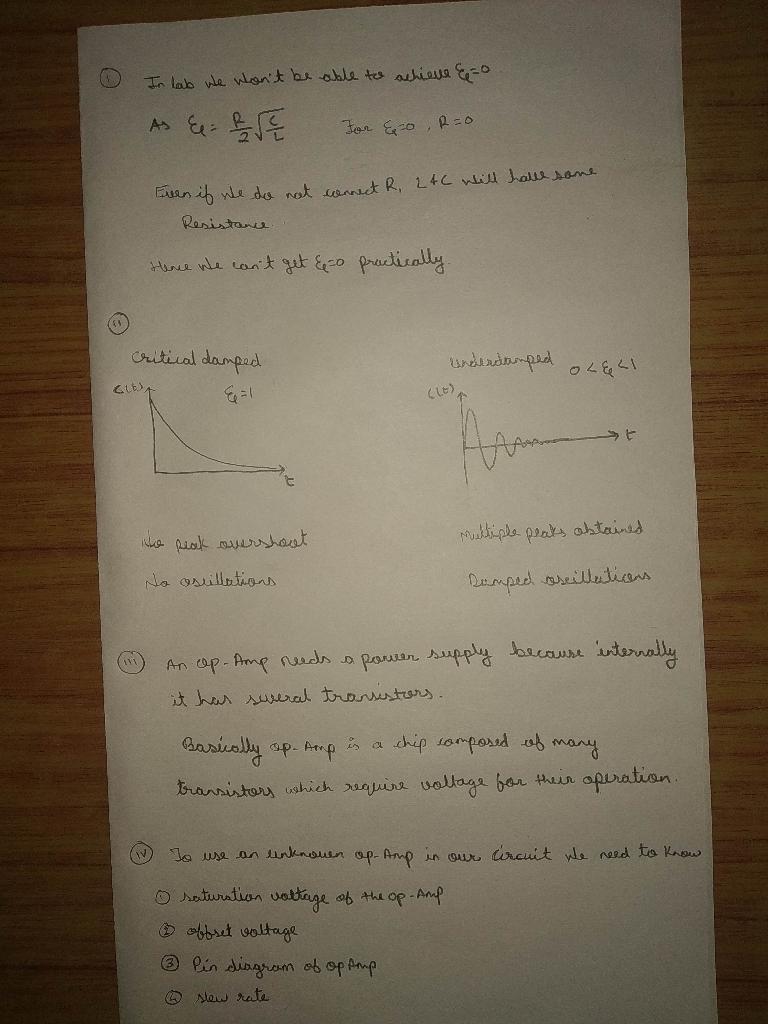
. Were you able to observe ???? = 0 in the circuit you constructed during lab? Why or why not? Hint: What value of resistance wo
Mrrafil [318]

Answer:

An attachment follows below

Explanation:

1) The formula used for the damping coefficient in a series RLC circuit.

If \xi = 0, it is possible to set c = 0 but an inductor will still possess some capacitance.

2) The behaviors of critically damped and underdamped systems are illustrated along with comments on their temporal responses.

4) While several answers might suffice, the four I’ve highlighted are the crucial parameters necessary about an unknown op-amp before utilizing it in a circuit.

Hope this addresses all your inquiries.

5 0
3 months ago
The rate of flow of water in a pump installation is 60.6 kg/s. The intake static gage is 1.22 m below the pump centreline and re
mote1985 [299]

Answer:

The power of the pump is 23.09 kW.

Explanation:

Parameters

gravitational constant, g = 9.81 m/s^2

mass flow rate, \dot{m} = 60.6 kg/s

flow density, \rho = 1000 kg/m^3

efficiency of the pump, \eta = 0.74

output gauge pressure, p_o = 344.75 kPa

input gauge pressure, p_i = 68.95 kPa

cross-sectional area of output pipe, A_o = 0.069 m^2

cross-sectional area of input pipe, A_i = 0.093 m^2

height of discharge, z_o = 1.22 m - 0.61 m = 0.61 m (evaluated at pump’s maximum height of 1.22 m)

input height, z_i = 0 m

hydraulic power of the pump,P =? kW

Initially, the volumetric flow (Q) needs to be determined

Q = \frac{\dot{m}}{\rho}

Q = \frac{60.6 kg/s}{1000 kg/m^3}

Q = 0.0606 m^3/s

Next, compute the velocity (v) for both input and output

v_o = \frac{Q}{A_o}

v_o = \frac{0.0606 m^3/s}{0.069 m^2}

v_o = 0.88 m/s

v_i = \frac{Q}{A_i}

v_i = \frac{0.0606 m^3/s}{0.093 m^2}

v_i = 0.65 m/s

Subsequently, the total head (H) can be calculated

H = (z_o - z_i) + \frac{v_o^2 - v_i^2}{2 \, g} + \frac{p_o - p_i}{\rho \, g}

H = (0.61 m - 0 m) + \frac{{0.88 m/s}^2 - {0.65 m/s}^2}{2 \, 9.81 m/s^2} + \frac{(344.75 Pa-68.95 Pa)\times 10^3}{1000 kg/m^3 \, 9.81 m/s^2}

H = 28.74m

Finally, the computation of pump power is done as follows

P = \frac{Q \, \rho \, g \, H}{\eta}

P = \frac{0.0606 m^3/s \, 1000 kg/m^3 \, 9.81 m/s^2 \, 28.74m}{0.74}

P = 23.09 kW

6 0
3 months ago
A thermometer requires 1 minute to indicate 98% of the response to a unit step input. Assuming the thermometer to be a first ord
mote1985 [299]

Answer:

Time constant = 15.34 seconds

The thermometer indicates an error margin of 0.838°

Explanation:

Given

t = 1 minute = 60 seconds

c(t) = 98% = 0.98

According to the details provided, the thermometer functions as a first-order system.

The transfer function of such a system is expressed as;

C(s)/R(s) = 1/(sT + 1).

To determine the time constant, the step response must be evaluated.

This is defined as

r(t) = u(t) --- Applying Laplace Transformation

R(s) = 1/s

Replacing 1/s back into C(s)/R(s) = 1/(sT + 1).

What we have

C(s)/1/s = 1/(sT + 1)

C(s) = 1/(sT + 1) * 1/s

C(s) = 1/s - 1/(s + 1/T) --- Taking Inverse Laplace Transformation

L^-1(C(s)) = L^-1(1/s - 1/(s + 1/T))

Given that e^-t <–> 1/(s + 1) --- {L}

1 <–> 1/s {L}

Thus, the unit response c(t) = 1 - e^-(t/T)

Substituting 0.98 for c(t) and 60 for t

0.98 = 1 - e^-(60/T)

0.98 - 1 = - e^-(60/T)

-0.02 = - e^-(60/T)

e^-(60/T) = 0.02

ln(e^-(60/T)) = ln(0.02)

-60/T = -3.912

T = -60/-3.912

T = 15.34 seconds

It follows that the time constant = 15.34 seconds

The error signal is characterized by

E(s) = R(s) - C(s)

Where the temperature shifts at 10°/min; which equals 10°/60 s = 1/6

Thus,

E(s) = R(s) - 1/6 C(s)

Calculating C(s)

C(s) = 1/s - 1/(s + 1/T)

C(s) = 1/s - 1/(s + 1/15.34)

Note that R(s) = 1/s

Thus, E(s) turns into

E(s) = 1/s - 1/6(1/s - 1/(s + 1/15.34))

E(s) = 1/s - 1/6(1/s - 1/(s + 0.0652)

E(s) = 1/s - 1/6s + 1/(6(s+0.0652))

E(s) = 5/6s + 1/(6(s+0.0652))

E(s) = 0.833/s + 1/(6(s+0.0652)) ---- Taking Inverse Laplace Transformation

e(t) = 1/6e^-0.652t + 0.833

In a first-order system, a steady state condition is reached when the time is four times the time constant.

Thus,

Time = 4 * 15.34

Time = 61.36 seconds

Consequently, e(t) becomes

e(t) = 1/6e^-0.652t + 0.833

e(t) = 1/(6e^-0.652(61.36)) + 0.833

e(t) = 0.83821342824942664566211

e(t) = 0.838 --- Rounded off

Thus, the thermometer reveals an error of 0.838°

4 0
2 months ago
Read 2 more answers
Other questions:
  • Write multiple if statements. If car_year is 1969 or earlier, print "Few safety features." If 1970 or later, print "Probably has
    12·1 answer
  • A pipe in a district heating network is transporting over-pressurized hot water (10 atm) at a mass flow of 0.5 kg/s. The pipe is
    14·1 answer
  • You want to determine whether the race of the defendant has an impact on jury verdicts. You assign participants to watch a trial
    9·1 answer
  • A cylinder with a 6.0 in. diameter and 12.0 in. length is put under a compres-sive load of 150 kips. The modulus of elasticity f
    5·1 answer
  • The pressure drop across a valve through which air flows is expected to be 10 kPa. If this differential were applied to the two
    11·1 answer
  • Select the qualification that is best demonstrated in each example.
    11·2 answers
  • A 10-ft-long simply supported laminated wood beam consists of eight 1.5-in. by 6-in. planks glued together to form a section 6 i
    5·1 answer
  • . A piston-cylinder device whose piston is resting on top of a set of stops initially contains 0.5 kg of helium gas at 100 kPa a
    14·1 answer
  • Q4. What happen when a steady potential is connected across the end points of the [3] conductor? Illustrate with an example.
    12·1 answer
  • Oil enters a counterflow heat exchanger at 600 K with a mass flow rate of 10 kg/s and exits at 200 K. A separate stream of liqui
    12·1 answer
Add answer
Login
Not registered? Fast signup
Signup
Login Signup
Ask question!