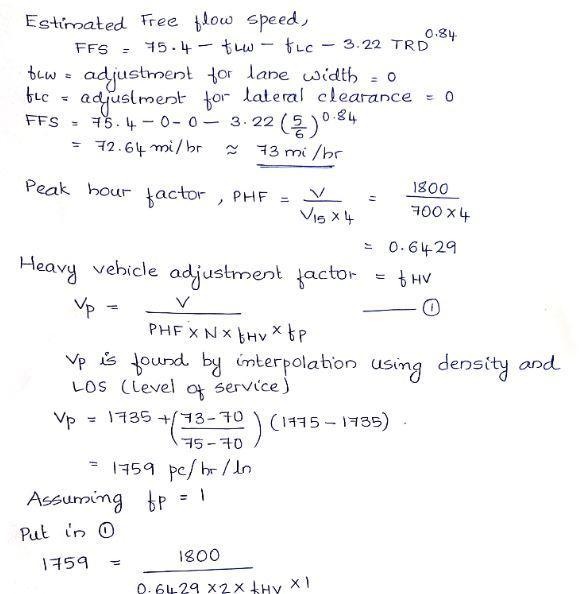
answer.
Ask question
Login Signup
Ask question
All categories
  • English
  • Mathematics
  • Social Studies
  • Business
  • History
  • Health
  • Geography
  • Biology
  • Physics
  • Chemistry
  • Computers and Technology
  • Arts
  • World Languages
  • Spanish
  • French
  • German
  • Advanced Placement (AP)
  • SAT
  • Medicine
  • Law
  • Engineering
MA_775_DIABLO
2 months ago
15

The rate of flow of water in a pump installation is 60.6 kg/s. The intake static gage is 1.22 m below the pump centreline and re

ads 68.95 kPa gage;the discharge static gage is 0.61 m below the pump centre line and reads 344.75 kPagage. The gages are located close to the pump as much as possible. The area of the intake and discharge pipes are; 0.093 m2 and 0.069 m2 respectively. The pump efficiency is 74%. Take density of water equals 1000 kg/m3. What is the hydraulic power in kW
Engineering
1 answer:
mote1985 [299]2 months ago
6 0

Answer:

The power of the pump is 23.09 kW.

Explanation:

Parameters

gravitational constant, g = 9.81 m/s^2

mass flow rate, \dot{m} = 60.6 kg/s

flow density, \rho = 1000 kg/m^3

efficiency of the pump, \eta = 0.74

output gauge pressure, p_o = 344.75 kPa

input gauge pressure, p_i = 68.95 kPa

cross-sectional area of output pipe, A_o = 0.069 m^2

cross-sectional area of input pipe, A_i = 0.093 m^2

height of discharge, z_o = 1.22 m - 0.61 m = 0.61 m (evaluated at pump’s maximum height of 1.22 m)

input height, z_i = 0 m

hydraulic power of the pump,P =? kW

Initially, the volumetric flow (Q) needs to be determined

Q = \frac{\dot{m}}{\rho}

Q = \frac{60.6 kg/s}{1000 kg/m^3}

Q = 0.0606 m^3/s

Next, compute the velocity (v) for both input and output

v_o = \frac{Q}{A_o}

v_o = \frac{0.0606 m^3/s}{0.069 m^2}

v_o = 0.88 m/s

v_i = \frac{Q}{A_i}

v_i = \frac{0.0606 m^3/s}{0.093 m^2}

v_i = 0.65 m/s

Subsequently, the total head (H) can be calculated

H = (z_o - z_i) + \frac{v_o^2 - v_i^2}{2 \, g} + \frac{p_o - p_i}{\rho \, g}

H = (0.61 m - 0 m) + \frac{{0.88 m/s}^2 - {0.65 m/s}^2}{2 \, 9.81 m/s^2} + \frac{(344.75 Pa-68.95 Pa)\times 10^3}{1000 kg/m^3 \, 9.81 m/s^2}

H = 28.74m

Finally, the computation of pump power is done as follows

P = \frac{Q \, \rho \, g \, H}{\eta}

P = \frac{0.0606 m^3/s \, 1000 kg/m^3 \, 9.81 m/s^2 \, 28.74m}{0.74}

P = 23.09 kW

You might be interested in
A rod is 2m long at temperature of 10oC. Find the expansion of the rod, when the temperature is raised to 80oC. If this expansio
Kisachek [356]

Answer:

ΔL = 1.68 mm

σ = 84 MPa

Explanation:

Thermal expansion can be calculated as:

ΔL = α ΔT L

And thermal stress is given by:

σ = α ΔT E

Provided values:

α = 1.2×10⁻⁵ /°C

E = 1.0×10⁵ MPa

ΔT = 80°C − 10°C = 70°C

L = 2 m

Thus, ΔL can be calculated as follows:

ΔL = (1.2×10⁻⁵ /°C) (70°C) (2 m)

ΔL = 0.00168 m

ΔL = 1.68 mm

For the thermal stress:

σ = (1.2×10⁻⁵ /°C) (70°C) (1.0×10⁵ MPa)

σ = 84 MPa

8 0
2 months ago
At what forward voltage does a diode conduct a current equal to 10,000 Is ? In terms of Is , what current flows in the same diod
pantera1 [306]

Answer:a) The forward voltage is 0.23 V

b) The current that flows  

I_{d} = (1.45*10^{12}I_{s})A

Explanation:

The forward voltage refers to the minimum voltage required for a diode to start conducting. The formula used is given by:

a) At which forward voltage does a diode allow a current equal to 10,000 Is? In terms of Is

I_{d} = I_{s}(e^{\frac{v_{f} }{0.025} }-1)

Where:

Id denotes the diode current = 10000Is,

Vd stands for the forward voltage at which conduction begins,

Is indicates the saturation current.

I_{d} = I_{s}(e^{\frac{v_{f} }{0.025} }-1)

10000I_{s} = I_{s}(e^{\frac{v_{f} }{0.025} }-1)

By dividing through by Is,

10000 = (e^{\frac{v_{f} }{0.025} }-1)

10000 +1= e^{\frac{v_{f} }{0.025} }

10001= e^{\frac{v_{f} }{0.025} }

Taking the natural log of both sides,

ln(10001)= {\frac{v_{f} }{0.025} }

9.21= {\frac{v_{f} }{0.025} }

Multiplying through by 0.025 yields  

= 0.23 V

This indicates the forward voltage at which the diode conducts a current equal to 10,000 Is is 0.23 V

b) What current flows in the same diode when the forward voltage is 0.7 V?

I_{d} = I_{s}(e^{\frac{v_{f} }{0.025} }-1)

I_{d} = I_{s}(e^{\frac{0.7}{0.025} }-1)

I_{d} = I_{s}(1.45*10^{12} -1)

I_{d} = (1.45*10^{12}I_{s})A

6 0
1 month ago
1. A four-lane freeway (two lanes in each direction) is located on rolling terrain and has 12-ft lanes, no lateral obstructions
choli [298]

Answer:

The highest vehicle count = 308

Explanation:

Refer to the attached document for the calculations.

6 0
2 months ago
All MOS devices are subject to damage from:________
Viktor [391]

Answer:

d. all of these

Explanation:

Electrostatic discharge typically generates a high voltage in a localized area, leading to increased current and heat. It can create craters in an MOS device, damage bond wires, or result in other forms of impairment. Essentially, MOS devices are vulnerable to harm from "all of these."

6 0
2 months ago
Other questions:
  • A sign erected on uneven ground is guyed by cables EF and EG. If the force exerted by cable EF at E is 46 lb, determine the mome
    13·1 answer
  • Degreasers can be broken down into two main categories
    9·2 answers
  • A pitfall cited in Section 1.10 is expecting to improve the overall performance of a computer by improving only one aspect of th
    6·1 answer
  • A pipe in a district heating network is transporting over-pressurized hot water (10 atm) at a mass flow of 0.5 kg/s. The pipe is
    14·1 answer
  • Suppose a steam locomotive is rated at 7500 horsepower. If its efficiency is 6%, how much wood must be burned in a 3-hour trip?
    11·1 answer
  • 4.68 Steam enters a turbine in a vapor power plant operating at steady state at 560°C, 80 bar, and exits as a saturated vapor at
    15·1 answer
  • The pressure drop across a valve through which air flows is expected to be 10 kPa. If this differential were applied to the two
    11·1 answer
  • 100.0 mL of 4.0°C water is heated until its temperature is 37°C. If the specific heat of water is 4.18 J/g°C, calculate the amou
    8·1 answer
  • A composite wall consists of 20 mm thick steel plate backed by insulation brick (k = 0.39 W/mK) of 50 cm thickness and overlaid
    6·1 answer
  • Q4. What happen when a steady potential is connected across the end points of the [3] conductor? Illustrate with an example.
    12·1 answer
Add answer
Login
Not registered? Fast signup
Signup
Login Signup
Ask question!