answer.
Ask question
Login Signup
Ask question
All categories
  • English
  • Mathematics
  • Social Studies
  • Business
  • History
  • Health
  • Geography
  • Biology
  • Physics
  • Chemistry
  • Computers and Technology
  • Arts
  • World Languages
  • Spanish
  • French
  • German
  • Advanced Placement (AP)
  • SAT
  • Medicine
  • Law
  • Engineering
Eddi Din
4 days ago
15

Platinum (pt) has the fcc crystal structure, an atomic radius of 0.1387 nm, and an atomic weight of 195.08 g/mol. what is its th

eoretical density?

Physics
2 answers:
Sav [3K]4 days ago
7 0

21.46 g/cm³

Further explanation

This calculation pertains to the topic of the arrangement of crystalline solids.

This question requires us to determine the theoretical density of platinum (Pt).

The formula for calculating theoretical density can be expressed as \boxed{ \ \rho = \frac{(number \ of \ atoms/unit \ cell)(atomic \ mass)}{(volume \ of \ unit \ cell)(Avogadro's \ number)} \ }

using the following symbols, i.e.,

\boxed{ \ \rho = \frac{(n)(A)}{(V_C)(N_A)}\ }

The given information includes:

an atomic radius of 0.1387 nm; therefore, \boxed{R = 0.1387 \ nm \times \Big( \frac{10^{-9} \ m}{1 \ nm} \Big) \times \Big( \frac{10^2 \ cm}{1 \ m} \Big)}

Consequently, \boxed{ \ R = 0.1387 \times 10^{-7} \ cm \ = 1.387 \times 10^{-8} \ cm \ }

the atomic mass is 195.08 g/mol

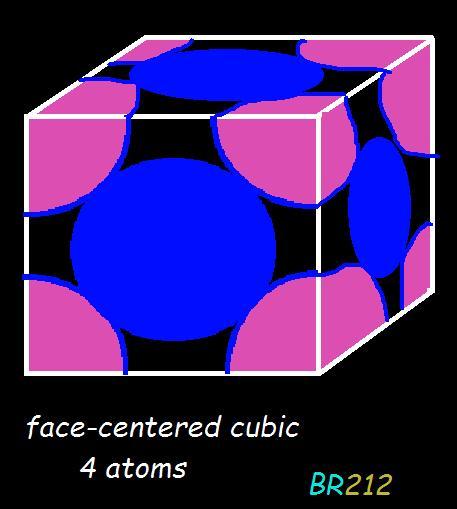
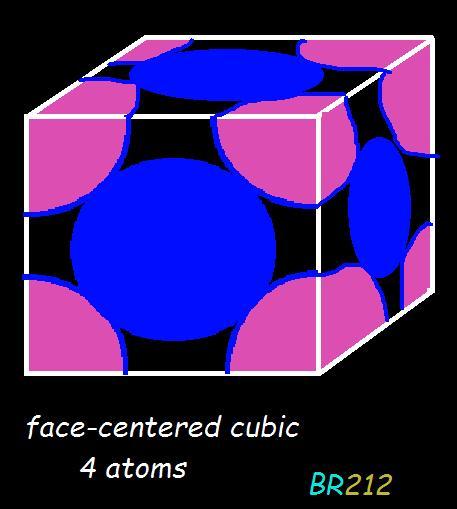
Since platinum exhibits an FCC crystal structure, n = 4 atoms, and \boxed{ \ V_C = (2R \sqrt{2})^3 \ }

Now, let’s calculate the unit cell volumes.

\boxed{ \ V_C = (2(1.387 \times 10^{-8}) \sqrt{2})^3 \ }

\boxed{ \ V_C = (1.387 \times 10^{-8})^3 \times 16\sqrt{2} \ }

\boxed{ \ V_C = 6.038 \times 10^{-23} \ cm^3 \ }

Insert all data into the general formula.

\boxed{ \ \rho = \frac{(4 \ atoms/unit \ cell)(195.08 \ g/mol)}{(6.038 \times 10^{-23} \ cm^3/unit \ cell)(6.023 \times 10^{23} \ atoms/mol)} \ }

Therefore, the theoretical density of platinum equates to 21.46 g/cm³ (rounded to two decimal places).

Learn more

  1. What is the mass in grams of 387 mL of ethylene glycol
  2. How many carbon atoms are there in a 1.3-carat diamond
  3. Water is a compound because it is what?

Keywords: platinum, Pt, the FCC crystal structure, atomic radius, weight, mass, theoretical density, volume, face-centered cubic
inna [2.9K]4 days ago
7 0
The formula to apply is expressed as:

ρ = nA/VcNₐ
where
ρ signifies density
n represents the number of atoms within a unit cell (for FCC, n=4)
A indicates the atomic weight
Vc stands for the cubic cell volume equal to a³, with a being the side length (for FCC, a = 4r/√2, where r is the radius)\
Nₐ denotes Avogadro's number, which is 6.022×10²³ atoms/mol

Calculating the radius: r = 0.1387 nm*(10⁻⁹ m/nm)*(100 cm/1m) = 1.387×10⁻⁸ cm
Then find a: a = 4(1.387×10⁻⁸ cm)/√2 = 3.923×10⁻⁸ cm
Then calculate V: V = a³ = (3.923×10⁻⁸ cm)³ = 6.0376×10⁻²³ cm³

Now compute density:
ρ = [(4 atoms)(195.08 g/mol)]/[(6.0376×10⁻²³ cm³)(6.022×10²³ atoms/mol)]Finally, we get ρ = 21.46 g/cm³
You might be interested in
A plasma is a gas of ionized (charged) particles. When plasma is in motion, magnetic effects "squeeze" its volume, inducing inwa
Softa [2925]

Answer:

 a

    The density of volume charge is  \rho = nq

b

    The density of surface charge is  \sigma = n^{\frac{2}{3} } q

Explanation:

The question states that

    The radius measures  R

     The length is L

       The speed is  v

        The ion count per unit volume is  n

         The charge per ion is  q

          The surface thickness of the cylinder is  n^{\frac{1}{3} }

The volume charge density is mathematically expressed as

      \rho = nq

The surface charge density is mathematically expressed as

    \sigma = \rho n^{\frac{1}{3} }

substituting for  \rho

     \sigma = n * n^{\frac{1}{3} } q

     \sigma = n^{\frac{2}{3} } q

5 0
11 days ago
5. The speed of a transverse wave on a string is 170 m/s when the string tension is 120 ????. To what value must the tension be
Sav [3041]

Answer:

The tension in the string when the speed increased is 134.53 N

Explanation:

Given;

Tension in the string, T = 120 N

initial speed of the transverse wave, v₁ = 170 m/s

final speed of the transverse wave, v₂ = 180 m/s

The wave speed is expressed as;

v = \sqrt{\frac{T}{\mu} }

where;

μ represents mass per unit length

v^2 = \frac{T}{\mu} \\\\\mu = \frac{T}{v^2} \\\\\frac{T_1}{v_1^2} = \frac{T_2}{v_2^2}

The new tension T₂ will be computed as;

T_2 = \frac{T_1 v_2^2}{v_1^2} \\\\T_2 = \frac{120*180^2}{170^2} \\\\T_2 = 134.53 \ N

Consequently, the tension in the string when the speed was increased is 134.53 N

3 0
20 days ago
Suppose a new asteroid was recently discovered which takes 557 months to orbit the Sun once (that's equal to 16,700 days or 46.4
Keith_Richards [3141]

Answer:

The average distance of the new asteroid from the Sun is estimated to be (2.02 × 10⁶) km.

Explanation:

The orbital speed of planets varies based on their distance from the Sun, which also affects their orbital period.

With its 557 months, equivalent to 46.4 years for an orbit around the Sun, the new asteroid's speed is situated between the orbital speeds of Saturn and Uranus.

Uranus orbits the Sun in 84 years at 24.61 km/hour,

while Saturn completes its orbit in 29.4 years at 34.82 km/hour.

To interpolate the speed for our asteroid at 46.4 years,

we denote its speed as x.

84 years ----> 24.61 km/h

46.4 years ----> x km/h

29.4 years -----> 34.82 km/h

Setting up the proportion:

(84 - 46.4)/(46.4 - 29.4) = (24.61 - x)/(x - 34.82)

Solving for x gives the asteroid's speed as 31.64 km/hr.

To find the average speed, use the formula:

Average speed = (total distance)/(time taken).

The total distance covered equals the circumference of the orbit around the Sun = 2πR,

where R = distance from the asteroid to the Sun.

Time taken = 16700 days = 16700 × 24 hours = 400800 hours.

Thus, we find that 31.64 = (2πR)/400800.

From this, we get 2πR = 31.64 × 400800 = 12681312 km.

And, R = 12681312/(2π) = 2018293.5 km = (2.02 × 10⁶) km.

8 0
1 month ago
A person who weighs 625 N is riding a 98-N mountain bike. Suppose that the entire weight of the rider and bike is supported equa
Keith_Richards [3141]

Answer:

A = 4.76 x 10⁻⁴ m²

Explanation:

Given data:

Person's weight = 625 N

Bike's weight = 98 N

Pressure per tire = 7.60 x 10⁵ Pa

Find: Contact area per tire

Total system weight = 625 + 98 = 723 N

Let F represent the force supported by each tire

2F = 723 N

Therefore, F = 361.5 N

Using the formula F = P × A

A = \dfrac{F}{P}

A = \dfrac{361.5}{7.60 \times 10^5}

Contact area, A = 4.76 x 10⁻⁴ m²

7 0
1 month ago
Part a consider another special case in which the inclined plane is vertical (θ=π/2). in this case, for what value of m1 would t
serg [3462]

The solution leads to the conclusion that m1 = m2

For mass m1, the force balance in the y direction equals zero:
0 = T - m1*g
Rearranging gives:
m1*g = T

For mass m2, the force balance in the y direction equals zero:
0 = T - m2*g
Rearranging provides:
m2*g = T

Setting these two equal allows us to solve for m1:
m1*g = m2*g

= m1 = m2


Explanation:

The force acting on each individual mass pulls down while the tension created by the other mass exerts an upward force due to the operation of the pulley system, resulting in balanced forces on both masses.

6 0
1 month ago
Other questions:
  • At which latitudes shown in the image of Earth do people experience the greatest tangential speed? Explain why.
    10·2 answers
  • Kayla, a fitness trainer, develops an exercise that involves pulling a heavy crate across a rough surface. The exercise involves
    6·1 answer
  • A spinning wheel is slowed down by a brake, giving it a constant angular acceleration of 25.60 rad/s2. During a 4.20-s time inte
    6·1 answer
  • A proton (mass = 1.67 10–27 kg, charge = 1.60 10–19 C) moves from point A to point B under the influence of an electrostatic for
    6·1 answer
  • Ellen does an experiment by releasing a ball from a height of 1 m above each floor in a tall building. She records the time it t
    8·2 answers
  • 4. A cylindrical tube has a length of 14.4cm and a radius of 1.5cm and is filled with a colorless gas. If the density of the gas
    12·1 answer
  • How many times could Haley fly bewteen the two flowers in 1 minute (60 seconds)​
    7·2 answers
  • Rita throws a ball straight up into the air and catches it at the same position from which she threw it. The ball has 18 J of me
    11·2 answers
  • A cylinder has 500 cm3 of water. After a mass of 100 grams of sand is poured into the cylinder and all air bubbles are removed b
    8·1 answer
  • A car is traveling at 118 km/h. What is its speed in mm/h?
    8·2 answers
Add answer
Login
Not registered? Fast signup
Signup
Login Signup
Ask question!