answer.
Ask question
Login Signup
Ask question
All categories
  • English
  • Mathematics
  • Social Studies
  • Business
  • History
  • Health
  • Geography
  • Biology
  • Physics
  • Chemistry
  • Computers and Technology
  • Arts
  • World Languages
  • Spanish
  • French
  • German
  • Advanced Placement (AP)
  • SAT
  • Medicine
  • Law
  • Engineering
Oksanka
3 days ago
14

How many molecules of ascorbic acid (vitamin c, c6h8o6) are in a 500 mg tablet?

Chemistry
2 answers:
Tems11 [2.6K]3 days ago
8 0

1.71 x 10²¹ molecules of ascorbic acid.

Further explanation

The Problem:

What is the number of molecules of ascorbic acid (vitamin C or C₆H₈O₆) found in a 500 mg tablet?

The Process:

Step-1

Calculate the molar mass of ascorbic acid or C₆H₈O₆.

Rounding the relative atomic mass gives us:

  • C = 12 g/mol
  • H = 1 g/mol
  • O = 16 g/mol

Ascorbic acid consists of six carbon atoms, eight hydrogen atoms, and six oxygen atoms, leading to a molar mass of

\boxed{(12 \times 6) + (1 \times 8) + (16 \times 6) = 176 \ g/moles}

Step-2

Next, we will determine the number of moles in 500 mg of ascorbic acid by converting it into grams, which is 0.5 g.

\boxed{ \ moles = \frac{mass}{molar \ mass} \ } \rightarrow \boxed{ \ moles = \frac{0.5 \ g}{176 \ g/mol} \ }

This results in 2.84 x 10⁻³ moles.

Step-3

It’s important to note that one mole is equivalent to 6.02 x 10²³ molecules, known as Avogadro's number.

Now let's convert 2.84 x 10⁻³ moles to the total number of molecules (N).

\boxed{ \ moles = \frac{N}{6.02 \times 10^{23}} \ } \rightarrow \boxed{ \ N = moles \times 6.02 \times 10^{23} \ }

\boxed{ \ N = 2.84 \times 10^{-3} \ moles \times 6.02 \times 10^{23} \ \frac{molecules}{mol} \ }

Hence, the total number of molecules in a 500 mg tablet of C₆H₈O₆ is \boxed{ \ 1.71 \times 10^{21} \ molecules \ }.

- - - - - - -

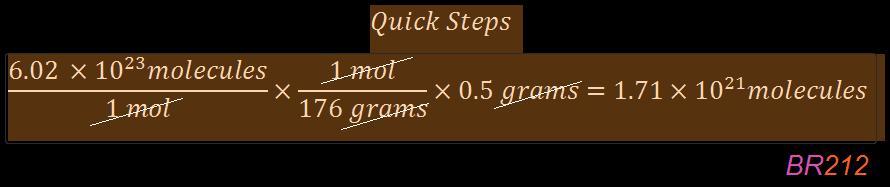
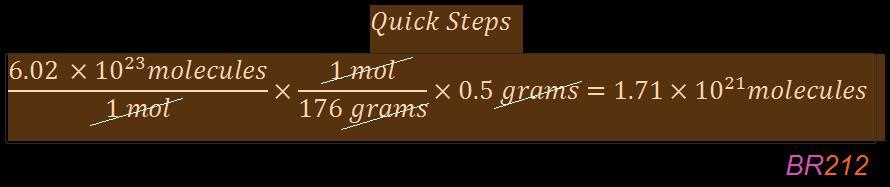
Quick Steps

\boxed{ \ \frac{6.02 \times 10^{23} \ molecules}{1 \ mol} \times \frac{1 \ mole}{176 \ gram} \times 0.5 \ grams \ } = \boxed{ \ 1.71 \times 10^{21} \ molecules \ }

Learn more

  1. Calculate the mass of aspirin from the total number of molecules
  2. Determine the quantity of moles of water formed.
  3. What is the chemical formula for the hydrate?
eduard [2.6K]3 days ago
6 0
1) To find the molar mass of C6H8O6, you must refer to the atomic weights of C, H, and O from the periodic table: C is 12; H is 1; O is 16 <span> (12x6)+(1x8)+(16x6)= 176g/mol


</span> <span> 176 g = 1 mol
0.5 g = x mol = 500 mg = 0.5 grams

Molar mass = mass ÷ moles
176 = 0.5 ÷ x
x = 2.84 x 10⁻³ mol
2) To calculate the total number of molecules in those </span> 2.84 x 10⁻³ mol, multiply the moles by <span> Avogadro's constant.
Number of molecules = Avogadro's constant x number of moles
Number of molecules = 6.022 x 10²³ x 2.84 x 10⁻³ </span> = 1.71 x 10²¹ molecules of vitamin C. <span>
</span>


You might be interested in
What acid chloride would be needed to prepare the following ketone from benzene using a Friedel-Crafts acylation? Click the "dra
alisha [2865]

Answer:

                    Benzoyl Chloride

Explanation:

                     Friedel-Craft Acylation is a reaction used to incorporate electrophiles (especially carbonyl groups) into the double bonds of aromatic compounds.

This scenario involves synthesizing benzophenone using benzene and benzoyl chloride.

Mechanism:

Step 1: Initially, benzoyl chloride reacts with a Lewis acid to create an electrophile known as oxo(phenyl)methylium.

Step 2: The second stage involves benzene participating in an electrophilic substitution reaction, where the electrophile is added.

Step 3: Finally, the aromatic nature of benzene is restored by releasing a proton.

3 0
1 month ago
Which statements describe how stars are born? Check all that apply. Stars are born in clouds of gas and dust called nebulas. The
VMariaS [2867]
1. Stars originate within clouds of gas and dust referred to as nebulas. 2. These clouds are drawn together by gravitational forces. 3. Once sufficient heat and pressure accumulate, nuclear fusion commences, representing the birth of a star.
6 0
5 days ago
Read 2 more answers
The enthalpy change for converting 10.0 g of ice at -25.0°C to water at 80.0°C is __________ kJ. The specific heats of ice, wate
Alekssandra [2904]
The enthalpy change in this scenario totals 7.205 KJ. The task is to compute the enthalpy variation during the conversion of 10.0 g of ice at -25.0°C into water at 80.0°C, factoring in specific heats and enthalpy for phase transitions.
6 0
11 days ago
Suppose a 5.00 l sample of o2 at a given temperature and pressure contains 1.08
castortr0y [2921]
Missing question: A sample of O2 with a volume of 5.00 L at specified temperature and pressure contains 1.08x10^23 molecules. How many molecules would be present in each of the following under the same conditions? a) 5.00 L H2. b) 5.00 L CO2. Utilize Avogadro's Law: Equal volumes of all gases, at constant temperature and pressure, contain the same number of molecules. Hence, for both hydrogen and carbon dioxide—being gases—the number of molecules will equal the oxygen molecules, thus: a) N(H₂) = 1.08·10²³. b) N(CO₂) = 1.08·10²³.
5 0
15 days ago
The ________ orbital is degenerate with 5py in a many-electron atom.
Tems11 [2638]

The ________ orbital shares degeneracy with 5py in a multi-electron atom.


5px is the right choice

5 0
1 month ago
Other questions:
  • The Michaelis‑Menten equation models the hyperbolic relationship between [S] and the initial reaction rate V 0 V0 for an enzyme‑
    15·1 answer
  • How quickly can bacterial contamination occur?
    10·2 answers
  • An ice cube at 0.00 ˚C with a mass of 8.32 g is placed into 55 g of water, initially at 25 ˚C. If no heat is lost to the surroun
    7·1 answer
  • If you weigh 100 kg, how much would you weigh if all the water were removed from your body? A65 kg B45 kg C50 kg D35 kg
    9·1 answer
  • An electrochemical cell is constructed with a zinc metal anode in contact with a 0.052 M solution of zinc nitrate and a silver c
    9·1 answer
  • Compute 4.659×10⁴−2.14×10⁴. Round the answer appropriately.
    13·2 answers
  • a chemist uses hot hydrogen gas to convert chromium (iii) oxide to pure chromium. how many grams of hydrogen are needed to produ
    10·1 answer
  • Identify some of the ways nuclear reaction equations differ from chemical reaction equations by matching each statement with the
    8·1 answer
  • Suppose you wanted to make a buffer of exactly ph 7.00 using kh2po4 and na2hpo4. if the final solution was 0.10 m in kh2po4, wha
    5·1 answer
  • (CH3)2N2H2 + N2O4 → N2 + H2O + CO2 + heat [balance?]​
    14·1 answer
Add answer
Login
Not registered? Fast signup
Signup
Login Signup
Ask question!