answer.
Ask question
Login Signup
Ask question
All categories
  • English
  • Mathematics
  • Social Studies
  • Business
  • History
  • Health
  • Geography
  • Biology
  • Physics
  • Chemistry
  • Computers and Technology
  • Arts
  • World Languages
  • Spanish
  • French
  • German
  • Advanced Placement (AP)
  • SAT
  • Medicine
  • Law
  • Engineering
Troyanec
12 days ago
12

A random sample of 20 individuals who graduated from college five years ago were asked to report the total amount of debt (in $)

they had when they graduated from college and the total value of their current investments (in $) resulting in the data set below.
Debt,Invested
16472,37226
19048,33930
4033,66292
22575,24887
12020,44976
4731,59924
4571,59901
18224,33154
1995,66794
21884,26700
18741,34926
14425,42960
22088,25054
24123,22511
2999,60091
11798,47106
8507,49350
2627,59963
21951,26687
3782,62539
a) Which statement best describes the relationship between these two variables?

As college debt decreases current investment decreases.

College debt is not associated with current investment.

As college debt increases current investment decreases.

As college debt increases current investment increases.


b) Develop a regression equation for predicting current investment based on college debt. What is the expected change in current investment for each additional dollar of college debt? Give your answer to four decimal places.

c) When testing for a significant linear relationship in your regression analysis, what is the proper conclusion at the 0.1 level of significance?

We fail to reject the claim of no linear relationship between college debt and current investment because the P-value is less than 0.1.

There is a significant linear relationship between college debt and current investment because the P-value is greater than 0.1.

We fail to reject the claim of no linear relationship between college debt and current investment because the P-value is greater than 0.1.

There is a significant linear relationship between college debt and current investment because the P-value is less than 0.1.


d) What is the predicted current investment for an individual who had a college debt of $5000? Give your answer to two decimal places.

e) What proportion of the variation in current investment is explained by college debt? Give your answer to four decimal places.

Mathematics
1 answer:
AnnZ [12.3K]12 days ago
5 0

Response:

a. As student debt rises, current investment diminishes.

b. Y= 68778.2406 - 1.9112X

For each dollar increase in college debt, the average current investments decrease by 1.9112 dollars.

c. A substantial linear correlation exists between college debt and current investment as the P-value falls below 0.1.

d. Y= $59222.2406

e. R²= 0.9818

Step-by-step breakdown:

Hello!

Data has been gathered on a random sample of 20 individuals who completed their college education five years ago. The variables under consideration are:

Y: Current investment by an individual who graduated from college five years prior.

X: Total debt of an individual upon graduating five years ago.

a)

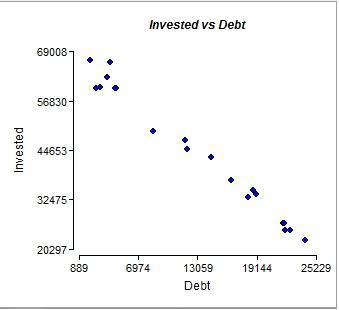
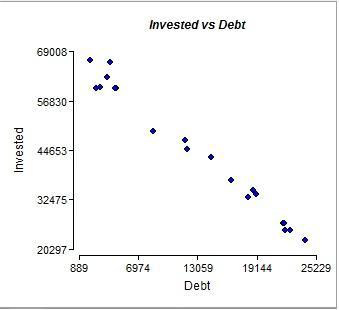
To explore the relationship between debt and investment, creating a scatterplot with the sample data is ideal.

The scatterplot demonstrates a negative correlation, indicating that as these individuals' debt increases, their current investments decrease.

Therefore, the statement that accurately describes this is: As college debt rises, current investment decreases.

b)

The population regression equation is Y= α + βX +Ei

To develop this equation, estimates for alpha and beta are required:

a= Y[bar] -bX[bar]

a= 44248.55 - (-1.91)*12829.70

a= 68778.2406

b= \frac{sumXY-\frac{(sumX)(sumY)}{n} }{sumX^2-\frac{(sumX)^2}{n} }

b=\frac{9014653088-\frac{(256594)(884971)}{20} }{4515520748-\frac{(256594)^2}{20} }

b= -1.9112

∑X= 256594

∑X²= 4515520748

∑Y= 884971

∑Y²= 43710429303

∑XY= 9014653088

n= 20

Averages:

Y[bar]= ∑Y/n= 884971/20= 44248.55

X[bar]= ∑X/n= 256594/20= 12829.70

The estimated regression equation becomes:

Y= 68778.2406 - 1.9112X

For every dollar increase in college debt, the average current investments drop by 1.9112 dollars.

c)

To evaluate if there's a linear regression between these variables, the following null hypotheses are formulated:

H₀: β = 0

H₁: β ≠ 0

α: 0.01

Testing can be performed utilizing either a Student t-test or Snedecor's F (ANOVA)

Using t=  b - β  =  -1.91 - 0  = -31.83

                 Sb         0.06

The critical area and P-value for this test is two-tailed. The P-value equals: 0.0001

Since this P-value is underneath the significance level, we reject the null hypothesis.

In the case of ANOVA, the rejection area is also one-tailed to the right, corresponding to the P-value.

The P-value remains: 0.0001

Using this method, we similarly reject the null hypothesis.F= \frac{MSTr}{MSEr}= \frac{4472537017.96}{4400485.72} =1016.37

In conclusion, at a significance level of 1%, there exists a linear relationship linking current investment to college debt.

The accurate statement is:

There exists a significant linear association between college debt and current investment since the P-value is less than 0.1.

d)

To forecast the value of Y when X is set, it is essential to substitute X in the estimated regression equation.

Y/$5000

Y= 68778.2406 - 1.9112*5000

Y= $59222.2406

The anticipated investment for someone with a college debt of $5000 is $59222.2406.

e)

To determine the proportion of variation in the dependent variable that the independent variable accounts for, the coefficient of determination R² must be calculated.

R²= 0.9818

R^2= \frac{b^2[sumX^2-\frac{(sumX)^2}{n} ]}{sumY^2-\frac{(sumY)^2}{n} }

R^2= \frac{-1.9112^2[4515520748-\frac{(256594)^2}{20} ]}{43710429303-\frac{(884971)^2}{20} }

This indicates that 98.18% of the variability in current investments relates to college graduation debt within the projected regression model: Y= 68778.2406 - 1.9112X

I trust this is beneficial!
You might be interested in
A scientist is studying some rabbits. A disease is killing the rabbits. A population of 240 of these rabbits was reduced to 180
Zina [12379]
By the seventh day, there are zero rabbits remaining.
7 0
1 month ago
A follow-up study will be conducted with a sample of 20 people from the 300 people who responded yes (support) and no (do not su
PIT_PIT [12445]

Response:

Detailed explanation:

Hello!

Stratified sampling involves the categorization of the population into subgroups based on pre-established criteria for the study. These subgroups consist of homogeneous units concerning the relevant characteristics. In this instance, individuals in the groups will represent only one of the two potential opinions (support or not support) and not both.

The researcher determines the sample size desired, considering several factors such as finances, material availability, and accessibility to experimental subjects (for instance, if they are endangered species, larger sample sizes may not be feasible).

One might conduct proportionate stratified sampling by selecting a proportion of respondents who answered "yes" along with those who answered "no."

In this sampling method, taking a specific proportion from each subgroup allows for a more straightforward extrapolation of results to the overall populations. For example, if you needed a sample size of n = 20, each stratum would ideally contain half, meaning 10 from the “yes” group and 10 from the “no” group.

I hope this is helpful!

4 0
1 month ago
Two of the steps in the derivation of the quadratic formula are shown below. Step 6: StartFraction b squared minus 4 a c Over 4
babunello [11817]

Explanation:

Step-by-step clarification:

Referring to step 6

(b² — 4ac) / 4a² = (x + b/2a)²

The mistake in the question is that it should be (x + b/2a)²

According to step 7

±√(b² —4ac) /2a = x + b/2a

The error in the question is that it should be divided by 2a, not 1a.

1. The transition from step 6 to step 7 involves taking the square roots of both sides

(b² — 4ac) / 4a² = (x + b/2a)²

Taking the square of both sides

√(b²—4ac) / √4a² = √(x + b/2a)²

√(b²—4ac) / 2a = x + b/2a

This forms step 7 correctly.

Next, subtracting b/2a from both sides

√(b²—4ac) / 2a - b/2a= x + b/2a -b/2a

√(b²—4ac) / 2a — b/2a = x

(√(b²—4ac)  — b)/2a = x

x = [—b ± √(b²—4ac)] / 2a

This gives the desired formula.

The discriminant is D = b²—4ac.

6 0
1 month ago
Read 2 more answers
Choose Yes or No to tell if the digit in the ones place is 1/10 the value of the digit in the tens place.
babunello [11817]

Response:

  • 4099 yes
  • 4110 no
  • 5909 no
  • 5011 yes

Step-by-step breakdown:

The digits are related through a factor of 10 when they are identical. 4099 and 5011 have identical digits in the tens and units places. 4110 and 5909 do not share this property.

5 0
1 month ago
Read 2 more answers
The proof diagram to complete the question state the missing reason in the proof for the letter given
tester [12383]

ANSWER

Initially, it was established that line p is parallel to line r.

To begin with the proof:

As stated in the prompt:

∠1 ≈∠5

∠1 and ∠5 are corresponding angles.

Utilizing the property of corresponding angles,

if two lines are intersected by a transversal such that the corresponding angles are


congruent, then those lines must be parallel.


In the diagram, q acts as the transversal.

Thus, based on this characteristic,

line p is parallel to line r.

Proof of 1(a)

REASON

Vertically opposite angle

When two lines intersect, the angles formed are referred to as vertically opposite angles.

Therefore,

∠4 and ∠1 are vertically opposite angles,

hence,

∠4 ≈∠1

Proof of 2(b)

REASON

Alternate interior angle

The angles situated on either side of the transversal, within the two lines, are termed alternate interior angles. When two parallel lines are crossed by a transversal, the alternate interior angles produced will be congruent.

Since line p is parallel to line r (as proven above)

and q is the transversal,

then

∠4 ≈∠5

Thus, it is established.

Proof of 3 (c)

Given that ∠4 ≈ ∠5 (as demonstrated above)

REASON

If two lines are intersected by a transversal such that the alternate interior angles are congruent, then those lines are parallel.

Thus, based on the previously mentioned property,

line p is parallel to line r.

Therefore, it is proven.


4 0
1 month ago
Read 2 more answers
Other questions:
  • The area of a square can be represented by the expression x10 Which monomial represents a side of the square?
    14·2 answers
  • Alan is conducting a survey to find out the type of art preferred by students in the town’s high school. Identify the population
    7·2 answers
  • A job shop consists of three machines and two repairmen. The amount of time a machine works before breaking down is exponentiall
    9·1 answer
  • Which of the following is true regarding the solutions to the logarithmic equation below? 2 log Subscript 6 Baseline (x) = 2. lo
    12·2 answers
  • A sample of 2,845 auto workers was selected to learn if they would go on strike. Over 50% of those in the sample declared they w
    10·1 answer
  • Jane builds a ramp made of a triangular prism and a rectangular prism. What is the volume
    13·2 answers
  • If Pedro starts hiking at 7:30 a.m. and it takes him 3 hours and 50 minutes to complete the hike, what time did he finish the hi
    6·2 answers
  • Store A advertises a sale for 3 loves of bread for $5.94. Explain how to use an equivalent rate to find the unit price of the br
    8·2 answers
  • Patty has a flower box in the shape of a rectangular prism with interior dimensions that are 15 inches in length , 8 inches in w
    5·2 answers
  • 9. Your credit card has a $2,142.62 balance. You charge $475.95. What is the new balance?
    6·2 answers
Add answer
Login
Not registered? Fast signup
Signup
Login Signup
Ask question!