answer.
Ask question
Login Signup
Ask question
All categories
  • English
  • Mathematics
  • Social Studies
  • Business
  • History
  • Health
  • Geography
  • Biology
  • Physics
  • Chemistry
  • Computers and Technology
  • Arts
  • World Languages
  • Spanish
  • French
  • German
  • Advanced Placement (AP)
  • SAT
  • Medicine
  • Law
  • Engineering
joja
1 month ago
6

A conducting sphere 45 cm in diameter carries an excess of charge, and no other charges are present. You measure the potential o

f the surface of this sphere and find it to be 14 kV relative to infinity. Find the excess charge on this sphere.
Physics
1 answer:
Maru [3.3K]1 month ago
7 0

Answer:

The excess charge is Q = 3.5 *10^{-7} \ C

Explanation:

According to the question, we are informed that

The diameter is d = 45 \ cm = 0.45 \ m

The potential of the surface is V = 14 \ kV = 14 *10^{3} \ V

The radius of the sphere is

r = \frac{d}{2}

by plugging in given values

r = \frac{0.45}{2}

r = 0.225 \ m

The potential at the surface is mathematically expressed as

V = \frac{k * Q }{r }

Where k is Coulomb's constant with a value k = 9*10^{9} \ kg\cdot m^3\cdot s^{-4} \cdot A^{-2}.

Based on the question stating there are no other charges, Q represents the excess charge

Therefore

Q = \frac{V* r}{ k}

inserting the numerical values

Q = \frac{14 *10^{3} 0.225}{ 9*10^9}

Q = 3.5 *10^{-7} \ C

You might be interested in
Rock X is released from rest at the top of a cliff that is on Earth. A short time later, Rock Y is released from rest from the s
Yuliya22 [3333]

Answer:

C) True. The distance S increases over time, with v₁ = gt and v₂ = g (t-t₀), illustrating that v₁> v₂ for the same t.

Explanation:

We have a set of statements to evaluate for correctness. The most effective approach is to examine the problem in detail.

Using the equation for vertical launch, we acknowledge that the positive direction signifies downward movement.

Stone 1

    y₁ = v₀₁ t + ½ g t²

    y₁ = 0 + ½ g t²

Stone 2

Released shortly thereafter, let's assume a delay of one second, we can utilize the same timing mechanism

     t ’= (t-t₀)

    y₂ = v₀₂ t ’+ ½ g t’²

    y₂ = 0 + ½ g (t-t₀)²

    y₂ = + ½ g (t-t₀)²

We can now calculate the separation distance between the two stones, which is applicable for t> = to

    S = y₁ -y₂

    S = ½ g t²– ½ g (t-t₀)²

    S = ½ g [t² - (t² - 2 t t₀ + t₀²)]  

    S = ½ g (2 t t₀ - t₀²)

    S = ½ g t₀ (2 t - t₀)

This represents the distance between the two stones over time, with the coefficient outside the parentheses being constant.

For t < to, the first stone remains stationary while the distance grows.

For t > = to, the expression (2t/to-1) yields a value greater than 1, indicating that the distance expands as time progresses.

We can now analyze the different statements

A) false. The height difference increases over time.

B) False S increases.

C) It is true that S increases over time, with v₁ = gt and V₂ = g (t-t₀) indicating v₁> v₂ at the same t.


3 0
3 months ago
A 5 kg block moves with a constant speed of 10 ms to the right on a smooth surface where frictional forces are considered to be
Yuliya22 [3333]

Answer:

The work done, W = 19.6 J

Explanation:

It’s provided that

The mass of the block, m = 5 kg

The velocity of the block, v = 10 m/s

The coefficient of kinetic friction between the block and rough surface is 0.2

Distance traveled by the block, d = 2 m

As the block traverses the rough section, it loses energy equal to the work done by the kinetic energy.

W=\mu_kmgd

W=0.2\times 5\times 9.8\times 2

W = 19.6 J

Thus, the change in kinetic energy of the block moving through the rough section is 19.6 J. Consequently, this is the required answer.

5 0
2 months ago
Read 2 more answers
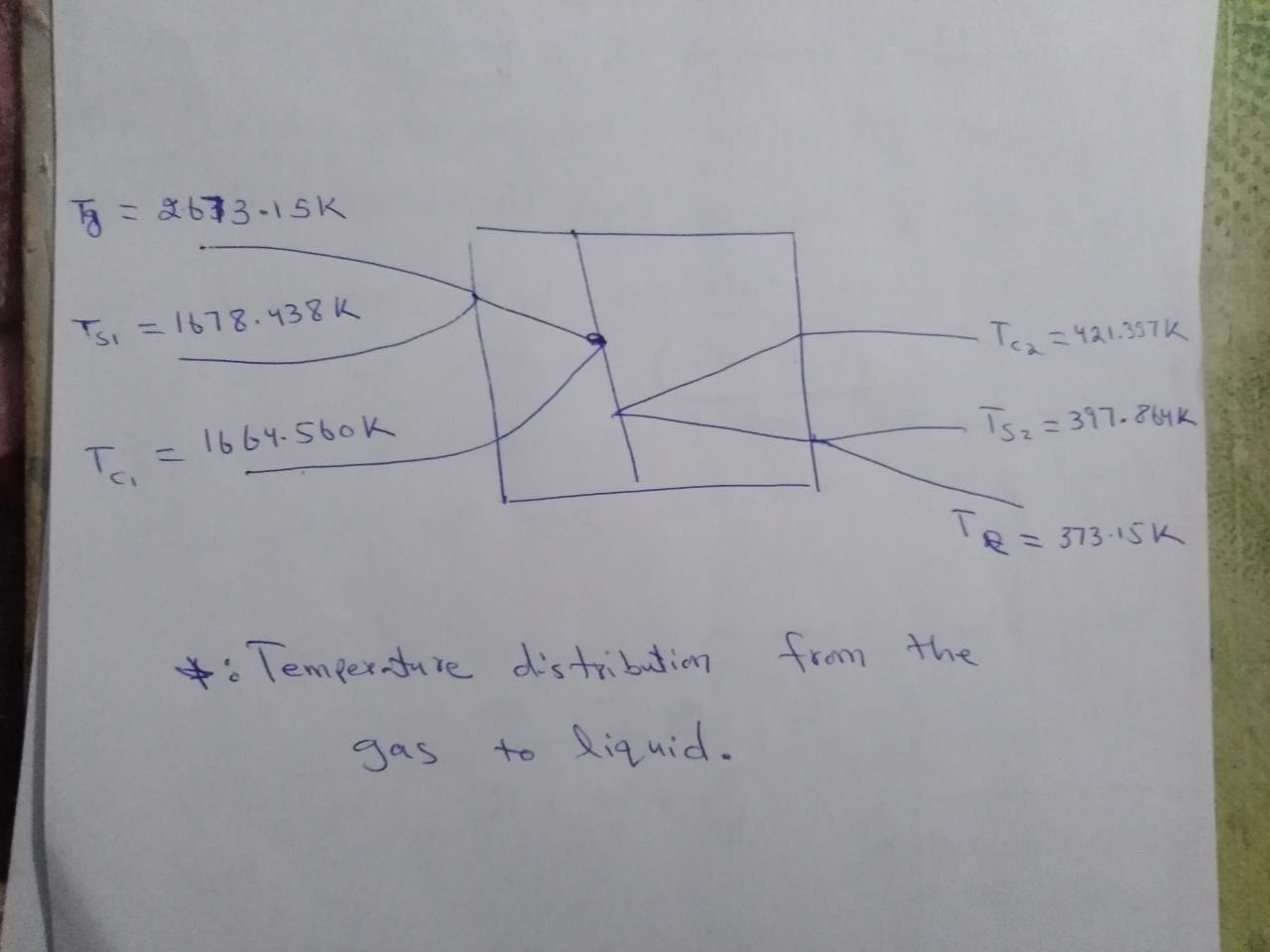
A composite wall separates combustion gases at 2400°C from a liquid coolant at 100°C, with gas and liquid-side convection coeffi
Ostrovityanka [3204]

Response:

\text{heat loss} = 24864.05 \ W/m^2

Clarification:

If

  • T_1, T_2 represent the temperatures of gases and liquids in Kelvins,
  • t_1 and t_2 denote the thicknesses of the gas layer and steel slab in meters,
  • h_1, h_2 are the convection coefficients for gas and liquid in W/m^2 \cdot K,
  • R_c represents the contact resistance in m^2 \cdot K/W,
  • and k_1, k_2 signify thermal conductivities of gas and steel in W/m \cdot K,

then: part(a):

\text{heat loss } = \frac{T_1 - T_2} { \frac{1}{h_1} + \frac{t_1}{t_2} + R_c + \frac{t_2}{k_2} + \frac{1}{h_2}}

by employing known values:

\text {heat loss} = 2486.05 W/m^2

part(b): Utilizing the rate equation:

\text {heat loss} = h_1 (T_1 - T_{s1})

the surface temperature is T_{s1} = 1678.438 \ K

and T_{c1} = T_{s1} - \frac {t_1 (\text{heat loss})}{k_1} = 1664.560 \ K

Correspondingly

T_{c2} = T_{c1} - R_c (\text{heat loss}) = 421.357 \ K

T_{s2} = T_{c2} - \frac {t_2 (\text{heat loss})}{ k_2} = 397.864 \ K

The temperature profile is depicted in the image provided

3 0
2 months ago
A car covers 72 kilometers in the first hour of its journey. In the next hour, it covers 90 kilometers. What is the amount of wo
Softa [3030]
The work done can be calculated using the equation:

Work = Force x Distance = Change in kinetic energy

The kinetic energy is derived using the following formula: KE = (1/2)*m*v^2
Thus, the change in kinetic energy is calculated as (1/2)*m*(Vf)^2 - (1/2)*m*(Vo)^2

Where:

Vf represents the final speed = 90 kph = 25 m/s
Vo denotes the initial speed = 72 kph = 20 m/s

By substituting in the given values:

Work = (1/2)*2500*(25^2) - (1/2)*2500*(20^2) = 281250 J, which can also be represented as 2.8 x 10^5 Joules.

The correct choice among the options is A.
4 0
3 months ago
Read 2 more answers
Other questions:
  • A bus slows down uniformly from 75.0 km/h to 0 km/h in 21 s. How far does it travel before stopping?
    10·2 answers
  • Multiply the number 4.48E-8 by 5.2E-4 using Google. What is the correct answer in scientific notation?
    8·1 answer
  • A 120-kg refrigerator that is 2.0 m tall and 85 cm wide has its center of mass at its geometrical center. You are attempting to
    14·1 answer
  • You are conducting an experiment inside a train car that may move along level rail tracks. A load is hung from the ceiling on a
    5·1 answer
  • A cart of mass M is attached to an ideal spring that can stretch and compress equally well. The cart and spring rest on a smooth
    10·1 answer
  • A portable television using a 12 volt, 3 Ah rechargeable battery can operate for a period of about 6 hours. What is the average
    7·1 answer
  • Which one of the following devices converts radioactive emissions to light for detection?
    8·1 answer
  • When a 12.0-V battery causes 2.00 μC of charge to flow onto the plates of an air-filled capacitor, how much work did the battery
    7·2 answers
  • Tex, an 85.0 kilogram rodeo bull rider is thrown from the bull after a short ride. The 520. kilogram bull chases after Tex at 13
    13·1 answer
  • Question
    7·1 answer
Add answer
Login
Not registered? Fast signup
Signup
Login Signup
Ask question!